




- By Ruth Huppach
Moments before the start of the Australian Grand Prix 2026, Oscar Piastri’s home race came to an abrupt end. A crash on the warm-up lap meant his McLaren never took the grid, reducing the team to a single car before the race had even begun.
In a sport as exposure-intensive as the F1 World Championship, that moment had implications beyond the competitive outcome. With one car removed, a significant share of McLaren’s potential broadcast visibility, and therefore sponsor value, was lost in real time.
Three weeks later, both Piastri and teammate Lando Norris completed the Japanese Grand Prix, with Piastri on the podium. This contrast provides a clear lens through which to understand how sponsor exposure is generated in Formula One and the role driver participation plays in it. Using Mastercard as an example, we compared both events, assessing the impact of an absent driver on F1 sponsor visibility.
A counterintuitive outcome: Japan outperforms Australia despite shorter race time
At a headline level, the two races present differing conditions: Japan was shorter in duration (2hrs 2 mins, compared to Australia’s 2hrs 54mins) and featured two less Mastercard branded assets than Australia, so on the face of it offered less favourable circumstances for Mastercard.
One might assume that 30% shorter coverage would yield 30% less exposure duration – however, the overall reduction in Mastercard exposure between Australia and Japan was only 24.8%, meaning Japan was proportionately better at establishing on-screen time for the Mastercard brand.
When removing the two additional assets that appeared in Australia but did not receive airtime in Japan (Equipment and Spectator Clothing), the number of Mastercard exposures per hour in Japan was higher (see Chart 1 below), highlighting the fact that in Australia, with one car unable to start, exposure opportunities were vastly reduced before the race even began.
Where exposure was won and lost: Australia vs. Japan compared
Asset-level data from both races provides deeper insight as to how Piastri’s absence affected Mastercard’s exposure performance, showing a distinct shift between the two races.
Looking first at Australia, Chart 2 (above) and Chart 3 (below) show a clear tendency towards car assets, such as Steering Wheel, Front Wing and Side Pod delivering the highest exposure and Net Sponsorship Value X, whilst driver assets such as Clothing and Helmet rank lowest.
Driver Helmet branding delivered the lowest total exposures (2) and Net Sponsorship Value X (NSV-X, $12,383) for Mastercard in Australia, with branding at this location being dependent on the use of specific on-board camera angles, an effect that was amplified by Piastri’s absence, with only Norris providing already limited helmet exposure during the race. The asset did, however, achieve a contrastingly high Brand Impact Score of 3.99 (an assessment of branding quality), due to generating strong ‘Solus’ exposure when captured on screen.
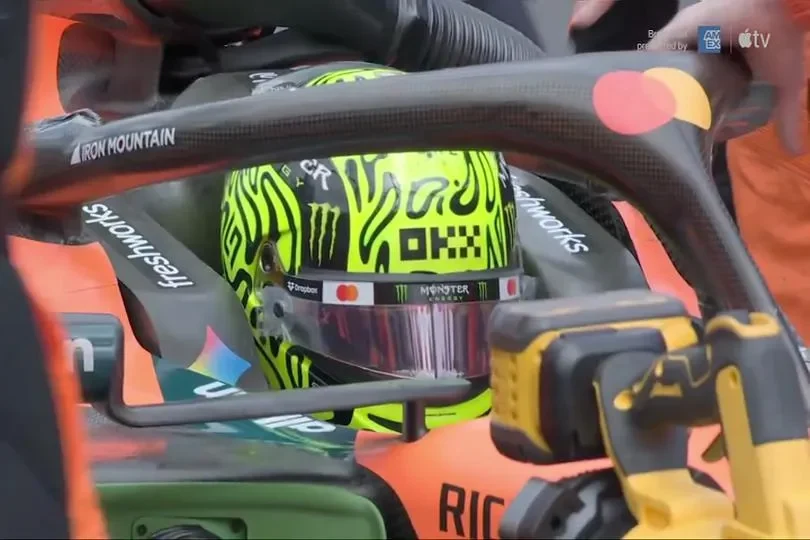
Example of Mastercard’s Driver Helmet sponsorship
Offering F1’s largest brand surface for sponsors, Driver Clothing achieved a notably lower brand exposure duration (14) and NSV X ($105,791) than was typical for its 2025 season races, when McLaren was regularly on top. With one driver absent and Norris not making it to the podium, the asset missed out on valuable exposure opportunities for Mastercard such as post-race coverage, with losses compounded by the brand having to compete for visibility among multiple sponsor logos.
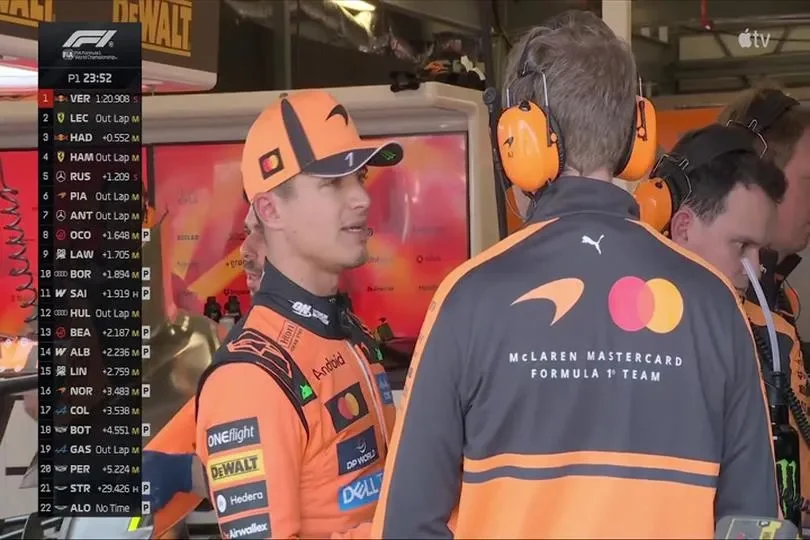
Less reliant on driver participation, and therefore arguably suffering least from Piastri’s absence, Team Clothing emerged as Australia’s best performing asset in terms of exposure (33 per hour), Brand Impact Score (4.22) and NSV X ($699,315). The asset benefited from strong on-screen centrality and a high degree of brand Solus, with Mastercard logos clearly visible when in frame, as shown in the image above.
Steering wheel branding delivered a similarly strong performance (33 exposures per hour), achieving the highest Brand Impact Score by asset of 4.24, despite the logo itself being one of Mastercard’s smallest. Even when taking into account the absence of a second car on the track, Steering Wheel’s exposure duration was supported by onboard camera angles, allowing for sustained visibility and increasing the likelihood of recognition.
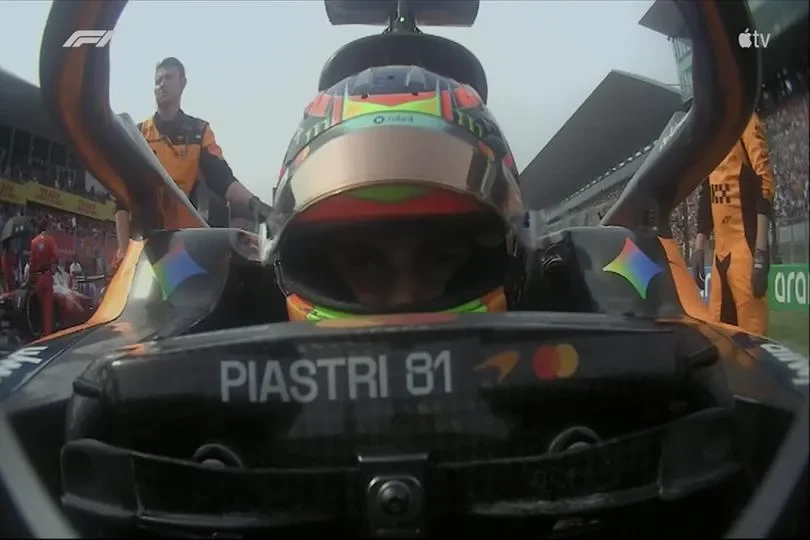
Example of Mastercard’s Steering Wheel sponsorship
Driver asset exposure surges with full race participation
Whilst Team Clothing and Front Wing were the most visible sponsor locations in Australia, Steering Wheel and Driver Helmet achieved a much higher profile in Japan, with two drivers on the track significantly increasing Mastercard’s exposure opportunities.
When comparing Mastercard exposure across the two races, Chart 2 shows a clear overall trend towards driver-focused assets generating greater visibility at the Japanese race, boosted by Piastri’s participation, as well as his podium place.
Driver Helmet stood out as achieving the greatest exposure increase, witnessing a sharp rise of 3500.0%, from 2 exposures in Australia to 72 in Japan. Sustained race participation from two drivers rather than one resulted in twice the opportunity for use of onboard camera angles and close-up coverage during key race moments, creating meaningful impact.
Ranking second for exposure uplift between races, Driver Clothing exposure rose by 207.1%, with Piastri’s performance keeping him in the spotlight and amplifying the asset’s visibility. Finishing second, the driver’s podium place captured valuable exposure during key moments including the closing stages of the race and post-event coverage, when sustained camera focus and replays increase both duration and prominence of sponsor branding.
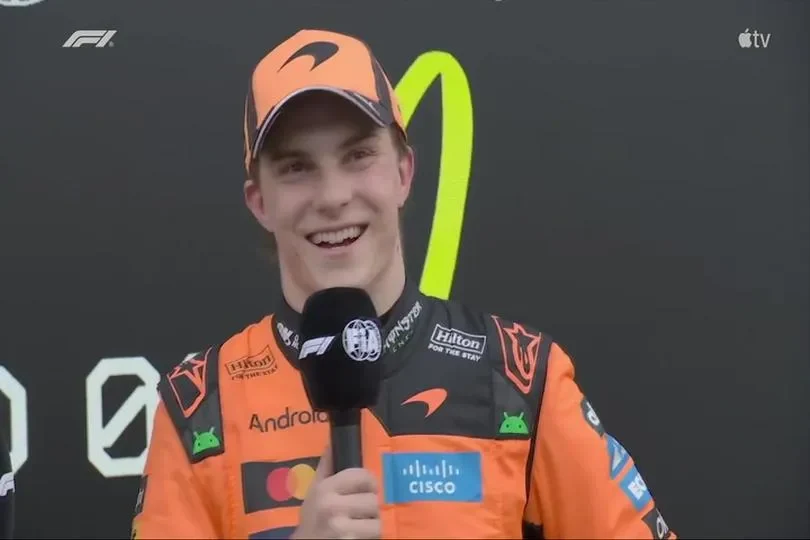
Example of Mastercard’s Driver Clothing sponsorship
Steering Wheel exposure, already performing well for Mastercard in Australia, increased by 100.0% in Japan. The asset generated the highest number of exposures of all monitored assets (106), with the inclusion of both McLaren cars significantly boosting visibility during race action and offsetting any disadvantage caused by the Mastercard logo size.
Driver assets vs. car assets: the participation effect
Contrasting with the upward trend in exposure for driver-specific assets, car asset exposure declined during the Japan race in comparison with Australia: Sidepod, Halo and Front Wing all saw drops of between 40 – 65%, reflecting the inclusion of fewer static or slower-paced broadcast moments, with camera shots of the ‘drivers’ eye view’ much more frequent during coverage.
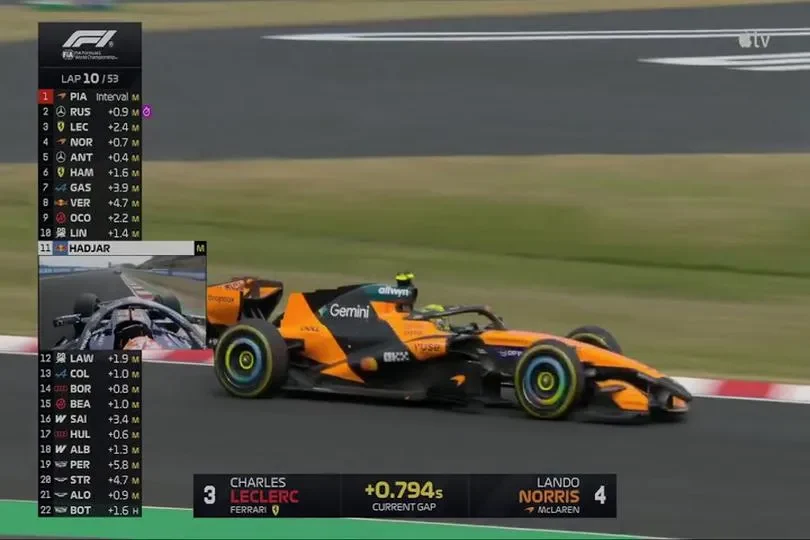
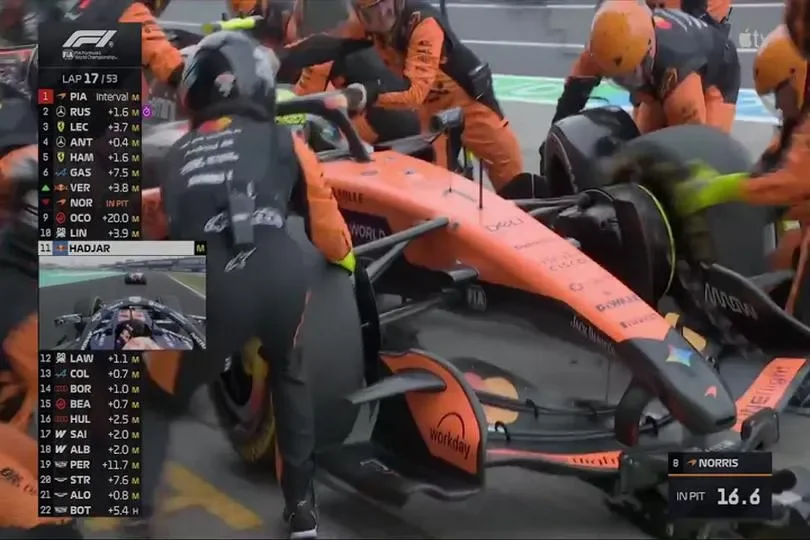
Example of Mastercard’s Side Pod and Halo sponsorship
This trend highlights that not all F1 branding performs the same way: assets that rely on dynamic race action, most notably driver-specific, are far more sensitive to participation than car assets, which depend more heavily on static moments during coverage. With both McLaren cars participating in Japan, opportunities for driver asset exposure increased due to onboard cameras, high speed footage and race-time close-ups accounting for a larger proportion of coverage.
While broadcast exposure provides a clear measure of visibility, brand recall also contributes to overall Net Sponsorship Value via YouGov’s boosted NSV-X metric. Mastercard’s branding benefited from strong colour contrast and consistent visual recognition during both races, allowing it to stand out, even in less favourable conditions.
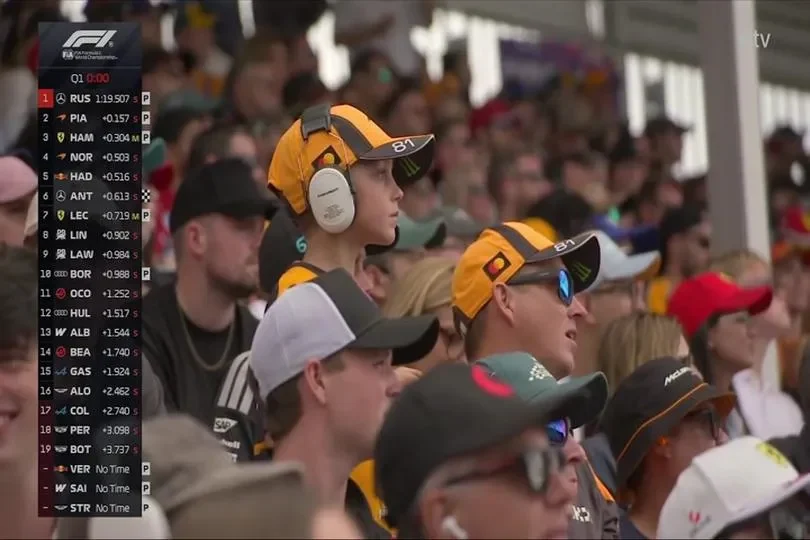
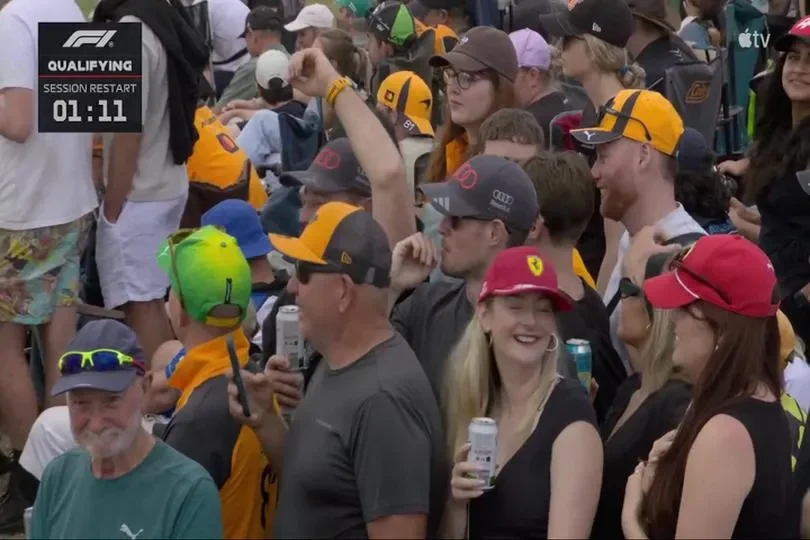
Examples of Mastercard vs. Audi branding on spectator hats
Beyond broadcast: How participation influences online press coverage
The effect of driver participation on Mastercard’s exposure was also reflected in online press coverage of the Australian Grand Prix, where markets such as the United Kingdom and United States generated the highest Net Sponsorship Value X ($161,571 and $146,188 respectively) through race-driven imagery and large audiences.
As a British driver winning the season opener, George Russell’s victory in particular proved to be a key catalyst for coverage, readership and value across the United Kingdom, demonstrating once again how drivers become the central narrative in media reporting, extending reach and engagement around races.
Host market Australia, on the other hand, delivered lower than expected online press value for Mastercard ($2,623) due to the absence of Piastri and associated visuals. With the market’s sporting hero out before the race began and no McLaren podium finish, Australian reporting focused on Piastri’s early exit rather than race performance, limiting exposure to kit branding rather than full livery. Coverage was also overshadowed by extensive stories around team / car performances and predictions across the board, with it being the first race of the season, examples of which can be seen in the press clippings below.
Australia did, however, record the highest uplift in brand impact for Mastercard as a result of positive brand health and perception across Australian sport fans (+5.6% BIS-X) but this arguably reflects strong underlying brand affinity for Mastercard rather than increased exposure volume. Consequently, although online press extended the sponsor’s reach, it by no means compensated for the loss of race-driven exposure moments.
Participation and performance: Key drivers of sponsor visibility
For partners such as Mastercard, the comparison between the Australian and Japanese Grands Prix highlights how quickly exposure can shift, based on race-day conditions.
In Australia, Piastri’s absence reduced McLaren’s and consequently Mastercard’s exposure capacity before the race had even begun, while his return in Japan, combined with performance, demonstrates how exposure can be recovered and amplified, even when structural conditions are less favourable.
F1 sponsor exposure is evidently not defined by race duration or asset count alone – it is also driven by participation and performance on the track, with broadcast and online press coverage expanding its reach through the stories that emerge.