
We put the iconic question to Pokémon players: which is better, Bulbasaur, Charmander or Squirtle?
Key takeaways
- 67% of Britons can name Pikachu
- 17% love or like Pokémon, rising to 40% among Gen Z
- 35% of Britons say they have engaged with Pokémon in some way, rising to 71% among Gen Z and 57% among Millennials
- Charmander is the best starter Pokémon
Friday marks the 30th anniversary of Pokémon, with the original series of video games having launched in Japan on 27 February 1996.
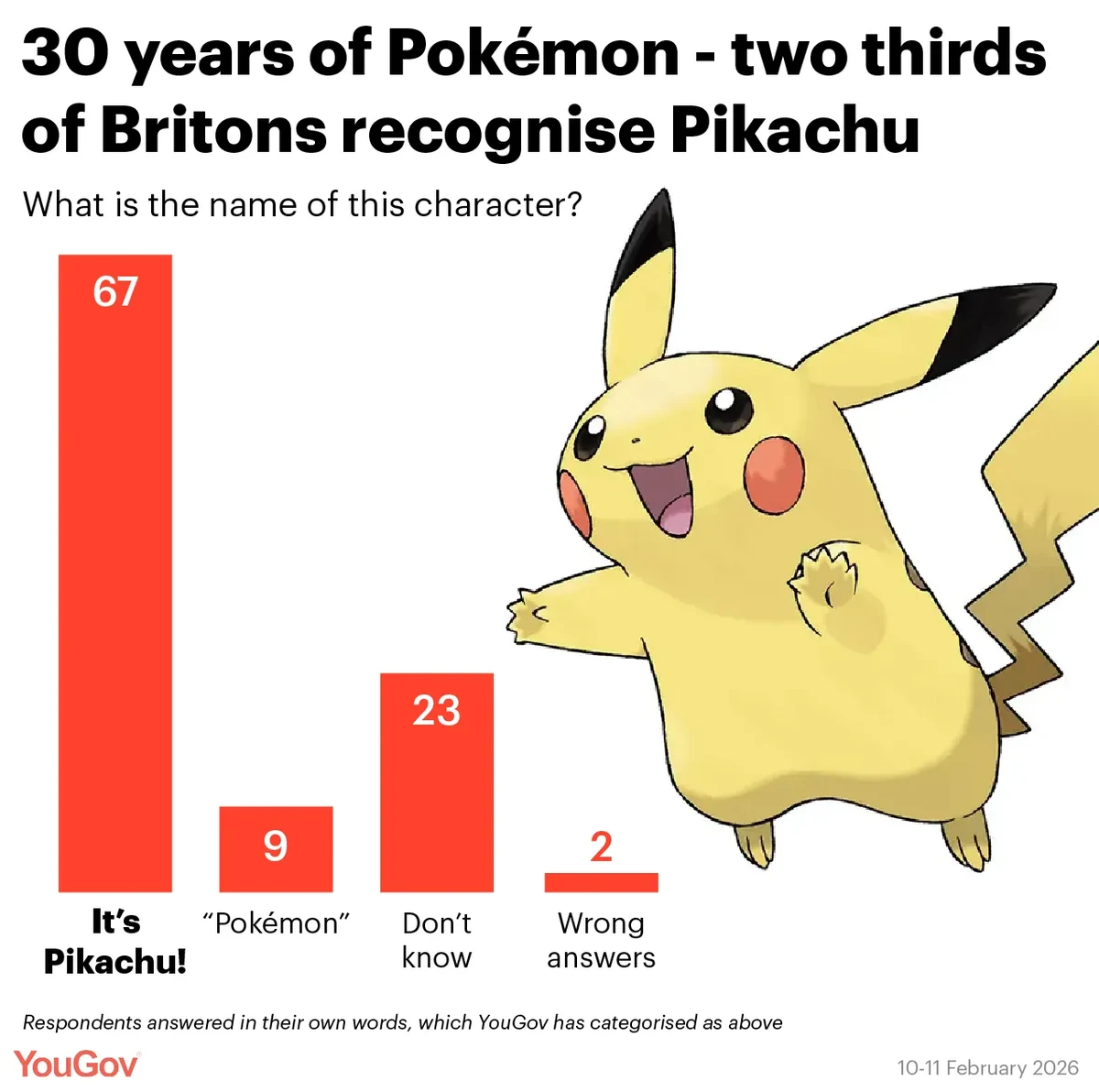
The extent to which Pokémon has made its mark on the public psyche is shown by a new YouGov survey, which found that fully 67% of Britons could identify the series mascot Pikachu when shown an image (a further 9% answered “Pokémon”, or that it was a Pokémon).
Among Gen Z and Millennials, this recognition level is approximately 90-92%, with the two thirds (66%) of Gen X (who are in their mid-40s to early 60s) also able to name the critter, and an additional 14% aware it is a Pokémon. However, Pikachu’s name recognition stands at only 33% among Baby Boomers (with 11% saying Pokémon instead).
Our data shows that around one in six Britons say that they either love (5%) or like (12%) Pokémon. Among Gen Z, affection for Pokémon increases to 40%, and 30% among Millennials.
How have Britons engaged with Pokémon over the years?
The Pokémon franchise has reportedly brought in more than $147 billion over the past three decades, making it the world’s highest-grossing media franchise. So in what ways have Britons engaged with ‘pocket monsters’ over the years?
The public are most likely to have watched the Pokémon anime, at 22%, with 15% also saying they have watched the movies.
When it comes to the video games, one in five (19%) say that they played Pokémon Go – an augmented reality mobile phone game that was all the rage in 2016, and reached audiences beyond the usual gamers – while 16% say they have played any of the more traditional Pokémon video games.
One in six (16%) say they have bought, collected, or played Pokémon trading cards, while 11% say they own some other form of Pokémon merchandise.
Overall, some 35% of Britons say they have engaged with Pokémon in some way, rising to 71% among Gen Z and 57% among Millennials.
However, some of these activities are much more restricted to childhood than others. While there is a resurgence in the popularity of Pokémon cards, most of those who ever bought them say they only ever did so as a child (62%).
Similarly, half of those who ever watched the Pokémon anime say they only did so when they were a kid (52%), with 45% saying so of the movies.
By contrast, the video games have more staying power, with 62% of those who ever played the mainline games saying they have done so as an adult.
What is the best starter Pokémon?
While they may have launched 30 years ago, Pokémon Red and Blue still remain the best-selling Pokémon games. Those games presented players with an iconic choice at the beginning of the game, between the grass-type Bulbasaur, the water-type Squirtle, and the fire-type Charmander.
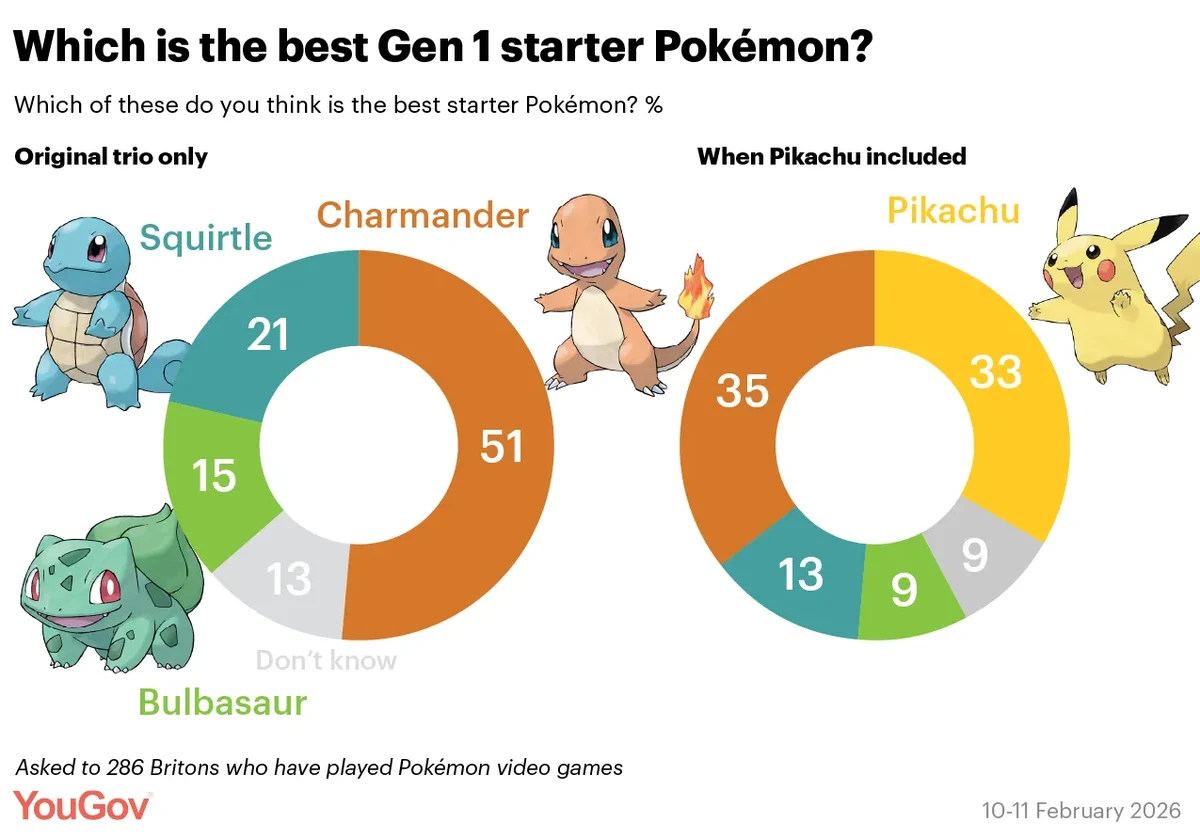
We asked those Britons who say they have played Pokémon which they think the best starter is, and the result is a resounding Charmander victory, with 51% picking the ‘lizard Pokémon’. Only 21% pick the ‘tiny turtle Pokémon’ Squirtle, and just 15% the ‘seed Pokémon’ Bulbasaur.
These rankings match those of a YouGov survey from 2016. Writing at that time, we noted “It is unclear how the introduction of lightning mouse Pikachu - the starter pocket monster in Pokémon Yellow - would change the results”.
Ten years later, we can finally settle that question. Including Pikachu in the list of Gen 1 starter Pokémon results in an effective tie between fire and electric: Charmander takes 35% of the vote in this contest, while Pikachu gains 33%.
Interested in taking YouGov surveys? What do you think about Pokémon, 90s trends in general, and everything else? Have your say, join the YouGov panel, and get paid to share your thoughts. Sign up here.
Interested in commissioning YouGov research? We connect in real-time with real people around the world to gather their thoughts, behaviours, and opinions, to ensure that our research data is powered by reality. Explore our survey services here.
Photo: The Pokémon Company