
Every month, YouGov identifies the brands generating the strongest surge in Word of Mouth scores in the UK.
Using data from YouGov BrandIndex, our daily brand tracking solution, we measure Word of Mouth, the percentage of people who say they have talked about a brand with friends or family in the past two weeks - whether in a positive, neutral, or negative capacity. The brands featured here recorded the largest increase in Word of Mouth in the latest month compared to the previous month. These scores are attributed to positive and negative conversations about the brands.
Word of Mouth Marketing: Brands with the strongest growth in September 2026
- Apple – 6.2 point increase (from 19.9% in August to 26.1% in September)
- Simple – 5.1 point increase (from 1.9% in August to 7.0% in September)
- Netflix – 4.2 point increase (from 32.0% in August to 36.2% in September)
- Grand Theft Auto – 4.0 point increase (from 10.7% in August to 14.7% in September)
- ChatGPT – 3.5 point increase (from 37.6% in August to 41.1% in September)
- Channel 4 – 3.5 point increase (from 5.4% in August to 8.9% in September)
- Gillette – 3.5 point increase (from 2.6% in August to 6.1% in September)
- Cadbury – 3.0 point increase (from 20.5% in August to 23.5% in September)
- Yorkshire Tea – 3.0 point increase (from 12.7% in August to 15.7% in September)
- Octopus Energy – 2.9 point increase (from 13.2% in August to 16.1% in September)
Apple leads UK WOM risers during its biggest launch window
Apple's Word of Mouth Exposure rose from 19.9% in August to 26.1% in September, a 6.2-point increase. The rise coincides with its annual launch event. It was the first under CEO John Ternus and unveiled the foldable iPhone Duo alongside the iPhone 18 Pro. Conversation over the Apple Watch's new always-listening features could also have contributed to the rising score.
Grand Theft Auto builds momentum as the GTA VI launch nears
Grand Theft Auto's Word of Mouth Exposure rose from 10.7% in August to 14.7% in September, a 4.0-point increase. The rise follows an almost 30-minute gameplay reveal that premiered on Netflix in August. It came shortly after leaked footage prompted an open letter from Rockstar confirming the November 19 release date.
Channel 4 rises as Bake Off returns with a new judge
Channel 4's Word of Mouth Exposure rose from 5.4% in August to 8.9% in September, a 3.5-point increase. The rise aligns with the return of The Great British Bake Off on September 22. It was Nigella Lawson's first series as a judge, replacing Prue Leith. The line-up reveal earlier in the month built anticipation, and the show's renewal for an eighteenth series, announced on launch day, may have also contributed.
Octopus Energy in conversation amid its plug-in solar launch
Octopus Energy's Word of Mouth Exposure rose from 13.2% in August to 16.1% in September, a 2.9-point increase. On August 28 it became the first major UK supplier to sell plug-in solar, as new rules came into force. The first 500 kits sold out within two weeks, and a further batch also sold out.
Word of Mouth Marketing: Brands with the strongest growth in August 2026
- Cineworld – 4.5 point increase (from 5.3% in July to 9.8% in August)
- Marks & Spencer – 4.3 point increase (from 23.4% in July to 27.7% in August)
- Lidl – 4.2 point increase (from 19.8% in July to 24.0% in August)
- Heathrow Airport – 4.2 point increase (from 9.7% in July to 13.9% in August)
- TK Maxx – 3.7 point increase (from 9.7% in July to 13.4% in August)
- BP – 3.5 point increase (from 5.1% in July to 8.6% in August)
- Vue – 3.2 point increase (from 5.9% in July to 9.1% in August)
- Weetabix – 3.1 point increase (from 8.7% in July to 11.8% in August)
- Shell – 2.9 point increase (from 5.1% in July to 8.0% in August)
- Amazon Prime Video – 2.8 point increase (from 18.5% in July to 21.3% in August)
Cineworld draws attention during a busy summer cinema season
Cineworld’s Word of Mouth Exposure rose from 5.3% in July to 9.8% in August, a 4.5-point increase. The increase coincided with a packed slate of new releases, anniversary screenings, family programming and August Bank Holiday promotions, giving consumers multiple reasons to visit cinemas and discuss upcoming films and premium viewing experiences.
Marks & Spencer maintains visibility through product launches and summer retail activity
Marks & Spencer’s Word of Mouth Exposure rose from 23.4% in July to 27.7% in August, a 4.3-point increase. The rise coincided with a series of new product launches, expansion of its Heathrow Terminal 5 store, and continued food and retail initiatives during the busy summer holiday period, sustaining consumer discussion across multiple categories. The period also included heavy promotional and PR activity around the brand's Gillian Anderson-fronted "Love That" campaign.
Heathrow remains in focus during the peak summer travel period
Heathrow Airport’s Word of Mouth Exposure rose from 9.7% in July to 13.9% in August, a 4.2-point increase. The increase aligns with one of the busiest travel periods of the year, alongside continued media attention surrounding airport expansion, operational performance and a burst water main that temporarily disrupted access, contributing to both positive and negative discussion.
Word of Mouth Marketing: Brands with the strongest growth in July 2026
- WhatsApp – 6.8 point increase (from 24.0% in June to 30.8% in July)
- Halifax – 4.3 point increase (from 5.0% in June to 9.3% in July)
- Diet Coke – 3.7 point increase (from 8.2% in June to 11.9% in July)
- Nando’s PERi-PERi sauce – 3.5 point increase (from 3.6% in June to 7.1% in July)
- Tesco Clubcard – 3.0 point increase (from 18.1% in June to 21.1% in July)
- Pimm's – 2.9 point increase (from 7.3% in June to 10.2% in July)
- Sony – 2.9 point increase (from 4.6% in June to 7.5% in July)
- The Range – 2.6 point increase (from 9.3% in June to 11.9% in July)
- Kinder Surprise – 2.6 point increase (from 1.6% in June to 4.2% in July)
- Ninja – 2.5 point increase (from 12.4% in June to 14.9% in July)
WhatsApp gains during a period of product updates
WhatsApp’s Word of Mouth Exposure rose 6.8 points, from 24.0% to 30.8%. A series of updates, including usernames and improved iPad, CarPlay and multi-device access, may have driven conversation around the platform. Coverage of security threats may also have contributed some discussion.
Halifax draws attention amid phase-out plans
Halifax’s score increased 4.3 points, from 5.0% to 9.3%. Plans to phase out the 173-year-old Halifax name generated significant coverage, alongside branch closures and account changes. The prospect of the familiar brand disappearing may have sparked customer discussion and nostalgia.
Nando’s sauce boosted by football tie-in
Nando’s PERi-PERi sauce rose 3.5 points, from 3.6% to 7.1%. Continued promotion of PERi-PERi Saka, its Bukayo Saka collaboration, may have kept the brand prominent in consumer discussion as the FIFA World Cup was top of mind for many.
Tesco Clubcard generates talk amid giveaways
Tesco Clubcard’s score rose 3.0 points, from 18.1% to 21.1%. Tesco’s “Freebie Thursdays” offered free products through the Clubcard app, including five million pizzas. The weekly giveaways and Wimbledon-linked offers may have helped boost engagement and conversation.
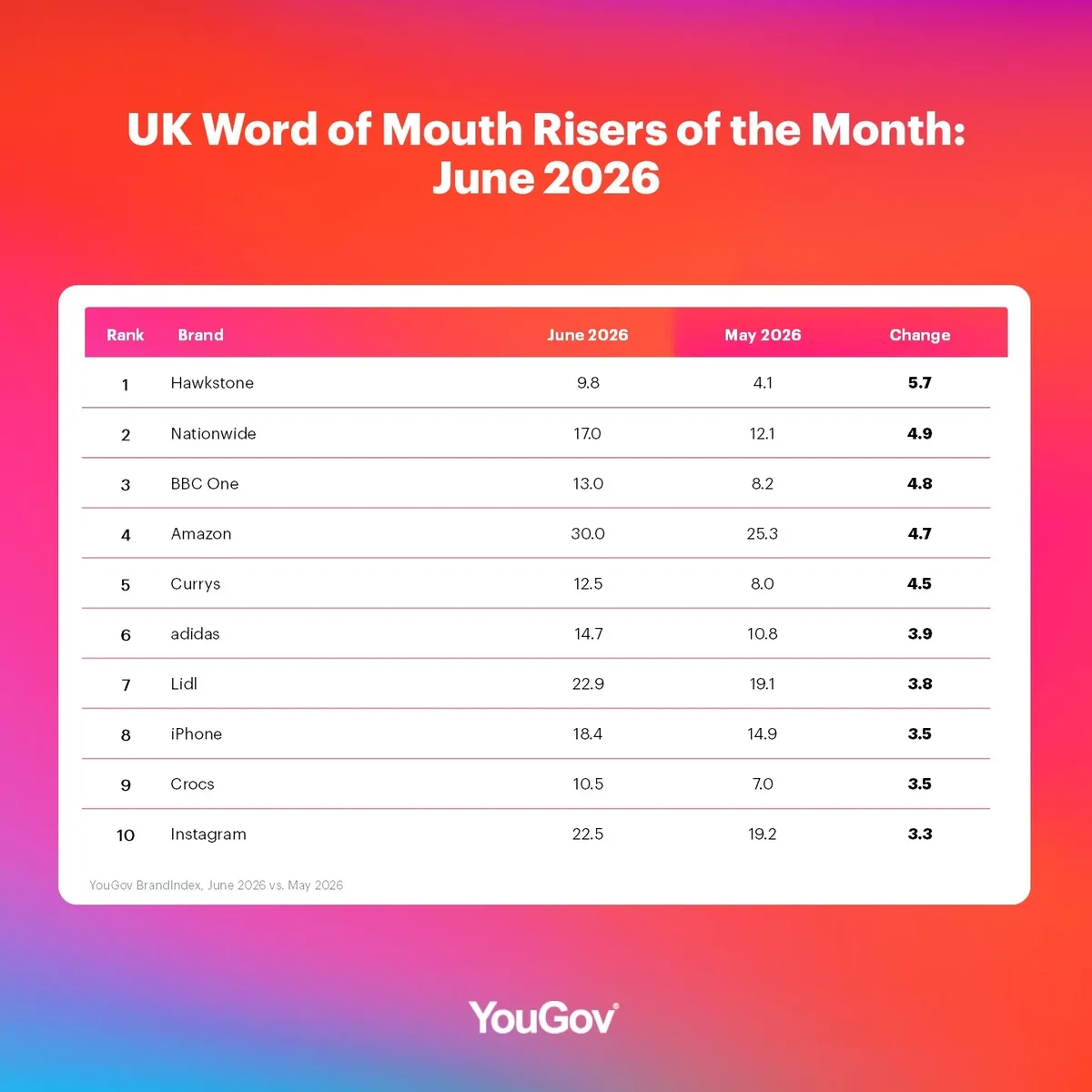
Word of Mouth Marketing: Brands with the strongest growth in June 2026
- Hawkstone – 5.7 percentage-point increase (from 4.1% in May to 9.8% in June)
- Nationwide – 4.9 percentage-point increase (from 12.1% in May to 17.0% in June)
- BBC One – 4.8 percentage-point increase (from 8.2% in May to 13.0% in June)
- Amazon – 4.7 percentage-point increase (from 25.3% in May to 30.0% in June)
- Currys – 4.5 percentage-point increase (from 8.0% in May to 12.5% in June)
- adidas – 3.9 percentage-point increase (from 10.8% in May to 14.7% in June)
- Lidl – 3.8 percentage-point increase (from 19.1% in May to 22.9% in June)
- iPhone – 3.5 percentage-point increase (from 14.9% in May to 18.4% in June)
- Crocs – 3.5 percentage-point increase (from 7.0% in May to 10.5% in June)
- Instagram – 3.3 percentage-point increase (from 19.2% in May to 22.5% in June)
Word of Mouth Marketing: Brands with the strongest growth in May 2026
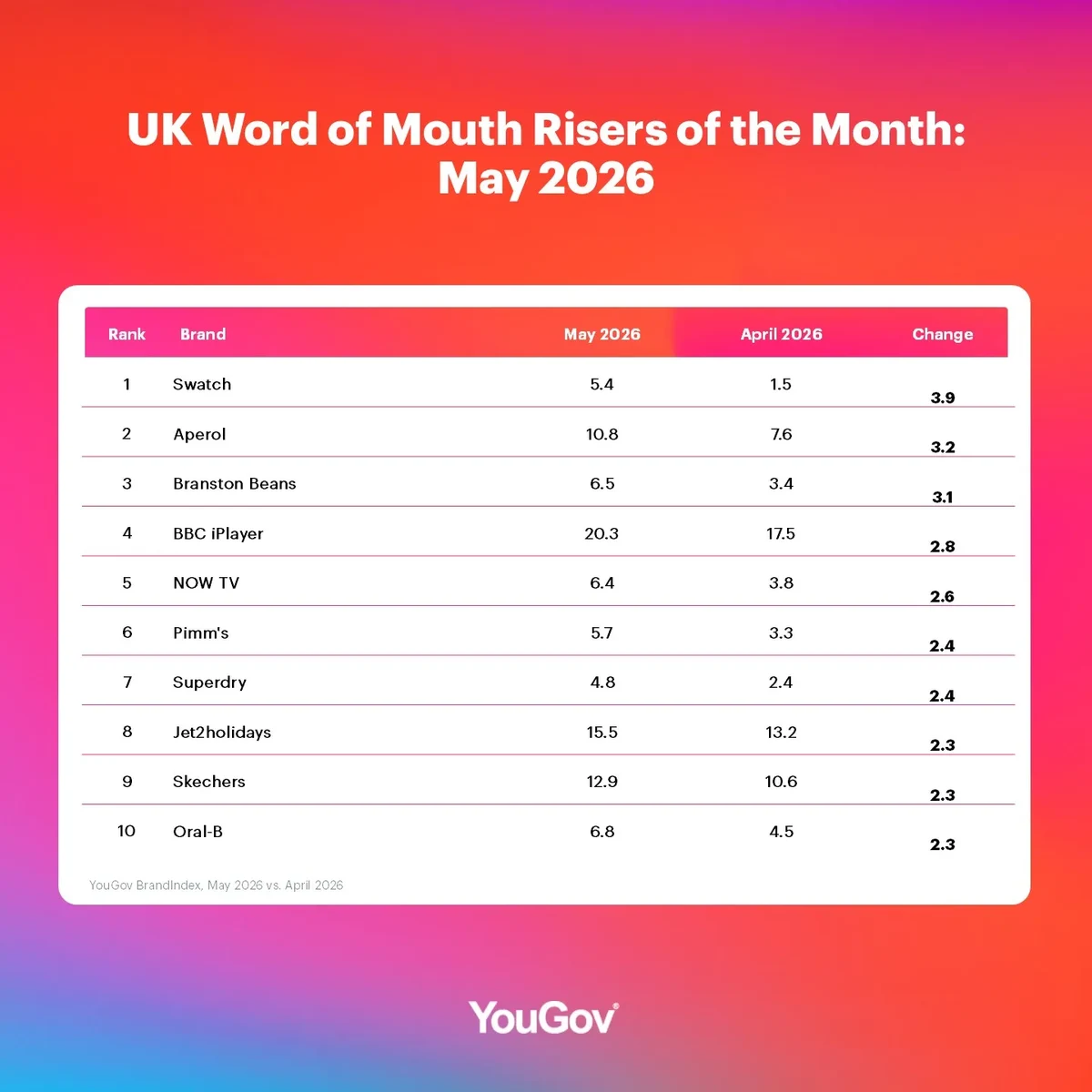
- Swatch – 3.9 percentage-point increase (from 1.5% in April to 5.4% in May)
- Aperol – 3.2 percentage-point increase (from 7.6% in April to 10.8% in May)
- Branston Beans – 3.1 percentage-point increase (from 3.4% in April to 6.5% in May)
- BBC iPlayer – 2.8 percentage-point increase (from 17.5% in April to 20.3% in May)
- NOW TV – 2.6 percentage-point increase (from 3.8% in April to 6.4% in May)
- Pimm's – 2.4 percentage-point increase (from 3.3% in April to 5.7% in May)
- Superdry – 2.4 percentage-point increase (from 2.4% in April to 4.8% in May)
- Jet2holidays – 2.3 percentage-point increase (from 13.2% in April to 15.5% in May)
- Skechers – 2.3 percentage-point increase (from 10.6% in April to 12.9% in May)
- Oral-B – 2.3 percentage-point increase (from 4.5% in April to 6.8% in May)
Methodology:
YouGov BrandIndex collects data on thousands of brands every day. Word of Mouth score is based on the question: “Which of the following brands have you talked about with friends or family in the past two weeks?"
Rankings in this article are based on change in Word of Mouth scores. To qualify as top improvers, a minimum base size of 300 (n) is required. In cases where the change in scores is the same between two brands, the current scores are used as a secondary metric to determine their ranking.
Brands tracked across multiple sectors are ranked based on their highest-performing sector. Both parent and child brands, such as Google and YouTube, are included to allow for greater granularity in performance tracking.
The data analysis in this article was created with the assistance of AI.