The BBC this week reported calls from a tech entrepreneur to institute a tax on work conducted by AI rather than humans. Such calls have been made previously by such major figures as Sam Altman and Bill Gates, but what do the public think?
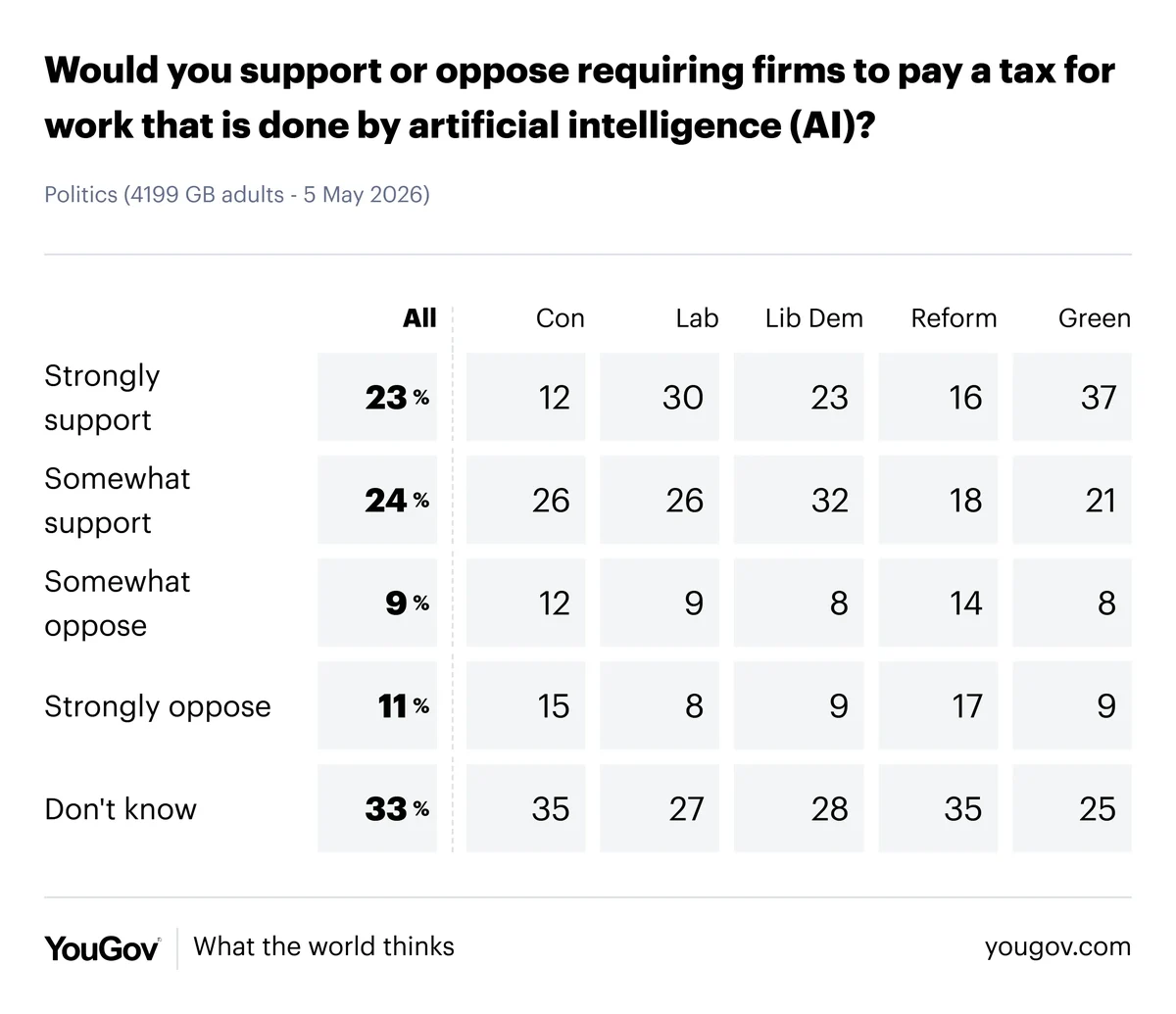
Almost half of Britons (47%) would support a tax on AI, compared to 20% who are opposed.
Those who voted Labour, Lib Dem or Green at the last election are much more likely (55-58%) to support an AI tax, while 38% of Tories say they same (outnumbering the 27% who are opposed).
Reform UK voters are split, with 34% supporting an AI tax but 31% opposed.
But more broadly, what do Britons think the impact of AI will be? To dig deeper into public perceptions in this area, we used our new YouGov AI Interviewer tool to ask respondents: “Following on from our question about a tax on work done by AI, what impact do you see AI having on the UK in the next 10 years?”
The YouGov AI agent then conducted interviews with each respondent, following up on their responses, in order to provide ‘the why’ behind what Britons think. Our qualitative analysis of attitudes, including quotes, can be found below, along with examples of respondent interviews in their entirety.
One major area people expect to be impacted is employment and labour market. Answers in this category encompassed AI reshaping work and employment structures in the UK, including automation of roles, changing sectoral demand, evolving career paths and skills, and how workers, employers and institutions respond through adaptation, reskilling and support mechanisms.

- “In next 10 years alot of firms will be heavily reliant on AI. It will mean workers having to retrain and pursuing other career paths.” (Male, 45-54)
- Obviously there will be seriously important changes to employment and loss of jobs - but I would imagine new jobs would replace those lost. (Male, 55+)
- “It's moving very fast and changing rapidly, and there's a lot of vested interests and hype around. For what it's worth I think in the end it will have some use cases, but it will be expensive and not as widely used as currently hyped.” (Male, 25-34)
- “They will think that AI can improve productivity in certain parts of the workforce to reduce head counts or replace more junior members of staff. This could lead to lower investment in training junior employees and could have lasting effects such as higher unemployment rates, knowledge loss and a reduction in the quality of customer service as these roles could be outsourced to AI.” (Female, 35-44)
- “The businesses who are honest with themselves regarding the AI they create or use will go far. The fear of "it will take my job" will be proven false sooner or later, and we will settle back into established patterns of using technology to support our work, rather than believing that it will do it all for us while we relax on the beach.” (Male, 55+)
- “Those people employed to create copy for advertising I think can largely be replaced. People writing technical manuals, and guides - those jobs are easy to do with AI now. Programmers who do not directly engage with the design of the code or the overarching objectives of the app being developed, ie those developers who are sort of monkey programmers, or almost secretarial are going to lose their jobs to AI - in the same way that secretaries were no longer needed when individuals could create their own memos, emails and spreadsheets. However anyone more senior and more capable will be able to massively benefit from AI - in that code previously held up for want of a development team / testing teams etc. can now be done by Codex.” (Male, 55+)
Some respondents brought up issues to do with information integrity and trust. These answers included comments about AI generated or amplified misinformation, deepfakes, fraud and cyber threats, and their implications for trusting digital information, authenticating people and maintaining secure online environments and institutions.
- “Journalists seem to be using it to save time on research and trusting it too much. Lawyers as well! It will only become helpful if it can be trusted to be verifiabilly accurate. Closed systems that do not share or import information from third parties are likely to be helpful for large organisations.” (Male, 55+)
- “Healthcare could benefit but greed will overrule that as companies will not comprehensively share research that could benefit all. Fraud will rise, nuisance tracking, privacy will be lost as will trust as it becomes harder and harder to differentiate between what's real and what's not. I will be glad to be dead by 10 years as this is now a horrid self defeating world made worse by division and delusion” (Male, 55+)
- “Fact-checking politicians might change public perceptions ! Could you imagine asking AI during the Brexit referendum what the real economic and cultural impact of Brexit might be ? AI would have been able to point out the obvious lies and simply explain why it would be a massive disaster.” (Male, 55+)
- “We already live in a society where disinformation and misinformation are leading to division and discord. AIs will amplify that trend.” (Female, 35-44)
Other themes respondents touched on include the impact on healthcare services, military and security applications, the effect on culture and creativity, as well as social relationships and mental health, and environmental impacts.
- “For example, I work in the NHS at a head office of an NHS Trust and a lot of effort goes into compiling disparate reports for dissemnination, for action, and for submission. AI has the potential to take over all these taks” (Male, 55+)
- “Even if it is used in the health industry for good like assessing cancer scans quickly and accurately it will need to rely on an actual consultant to check and confirm for the time being. As the AI gets improved the chances are that doctors and consultants may be sidelined. However, this could in turn free them up to treat mote patients.” (Male, 55+)
- “It will depend on how successful and reliable it is in each situation. It will be embedded more in defence industries, law enforcement, etc., possibly eroding our civil rights” (Female, 45-54)
- “We have a relatively small military. The use of AI could spreed up logistical and operational decisions and actions without human decisions. The public may therefore never know why certain things might have happened and have no opportunity to object.” (Male, 55+)
- “The arts will be hugely affected as poor quality AI slop can replace new work. Some laborious processes eg transposing music or redrawing design iterations will be made easier and quicker” (Female, 55+)
- “It might create a two tier system in the arts - novels for example might be written by AI and be widely available and inexpensive, but people might place greater value on those guaranteed to be written by individuals.” (Female, 55+)
- “Vulnerable people can be persuaded a non existent person is interested in forming a relationship. They use beautiful images on social media channels. It inevitably ends up with the vulnerable person parting with money. This causes huge upset and anxiety. Quite often police are involved if things get so bad. There are departments especially set up to find those who are doing this sort of fraud” (Female, 55+)
- “It is already having an effect in schools with children relying on it for homework, or as an AI therapist. This is damaging their real world relationships and ability to deal with difficult situations and making them removed from society. It also means they are not learning in school as relying on AI.” (Female, 25-34)
- “It will maximise savings on public spending. It will revolutionise the energy industry and wean us off fossil fuels once and for all. It will also bring safe nuclear energy closer than it has ever been.” (Male, 55+)
- “The environmental aspects are particularly concerning. Using a large language model as a glorified search engine uses way more computing power, energy and water cooling than using a regular search engine.” (Male, 45-54)
Group differences
The oldest Britons were more likely than others to bring up healthcare and public services in relation to AI
- “In medical research, huge volumes of data could be collected and processed at a speed and level of accuracy not possible now” (Female, 55+)
- “Lack of understanding and common sense. Just because something is written somewhere doesn't make it correct. And on issues such as medical advice AI seems to quote from anywhere rather than from reputable medical sources.” (Female, 55+)
- “It will have a positive impact on healthcare. If set up properly it may be able to see diagnoses humans miss or see tiny issues from screening that the human eye can not be see. Supporting professional people to do a better job. Not instead of them.” (Female, 55+)
- “I allready use it. I put all my health history in and said my ailments. And it were the perfect diet for me I consult every day with it. So much better than joining weight watchers etc.” (Male, 55+)
While younger people are more likely to raise the issue of culture and creativity
- “Less writers will be needed. AI will be used for CGI, less VFX artist needed” (Male, 18-24)
- “I think we are returning to valuing human creation more. I think AI is a useful tool but cannot surpass human intelligence nor human creativity. It will be a supplement to help us but not a replacement.” (Female, 18-24)
- “Two cultural classes of people will emerge - those who are culturally consumed by ai content, brains fried, low dopamine; and those who manage to avoid it. I think there will be a notable cultural gap between the two.” (Male, 18-24)
Women were more likely than men to give answers that touched on education, and social relationships
- “its very annoying for education. I'm a teacher and it's really hard to tell sometimes whether students have done the work themselves. this has some negatives - kids doing gcses hardly do any coursework these days for this reason, meaning loads of pressure at exam time” (Female, 35-44)
- “Can respond to each pupils need without favour or prejudice, and work at that pupils ability. Will stick to the curriculum and teach without giving own opinions.” (Female, 55+)
- “They will not have a fellow pupils, teachers and other students to mix with. Manners and attitude in students is already at an all time low and this will increase without interaction.” (Female, 55+)
- “For example, people think an AI chat bot can be better at listening to their problems than an actual friend. That's not natural / normal / a good thing at all! People need to remember the multifaceted nature of human experience, and stop being so selfish as to think it's just about what they get out of an interaction” (Female, 35-44)
- “People will devote more time to discuss things and talk to AI rather than socialising outside their homes, far from their computers or phones” (Female, 45-54)
- “People will lean on AI to answer increasingly important topics in their lives, and will not make decisions based on what is best for them. They may also lose the ability to emotionally connect with one another, without relaying on AI as an intermediary” (Female, 25-34)
While men are more likely to bring up economic inequality and welfare issues
- "not having a degree which contributes to an AI world will no longer be a sustainable job to have... and AI jobs are not those that a working class person can get” (Male, 35-44)
- “Executives have a track record of employing computer systems enthusiastically in order to cut wage bills, but without considering the longer-term and wider-reaching effect on employees, the economy and on their own businesses. The idea of saving staff costs is definitely appealling to them, but rarely do they consider the effect on their profits of large parts of the population having their income cut or removed.” (Male, 35-44)
- “AI firms and those profiting from the replacement of human workers should be subject to a significant levy to fund a universal basic income scheme. Humanity First, not GDP or the wretched silicon valley types.” (Male, 25-34)