

Data shows young people aren’t answering their calls in silence, but it is true that Gen Z are much more reluctant to make phone calls than their elders
If an extra-terrestrial species suddenly arrived on earth, it is not entirely clear that their alien ways of doing things would be subject to quite the same level of media excitement as just about anything Gen Z does.
One of the latest objects of media fascination about Gen Z is their phone habits, with scrutiny recently given to their supposed tendency to pick up the phone without giving a verbal answer, their terror at the prospect of receiving an unexpected phone call, and their wider anxiety about making calls in the first place.
But are these behaviours actually widespread among the youngest generation of adults? And are they in any case unique to Gen Z? A new YouGov survey takes a look.
Gen Z answer the phone in silence: false
The idea that Gen Z don’t answer the phone with a greeting seems to originate from a recruiter’s observations that went viral in July.
However, just 3% of Gen Z say they pick up a call without offering a greeting when it is a friend or family member calling.
This rises to 12% when it comes to someone they know who is not a close friend or family number – but this figure is similar to the number of Baby Boomers saying the same (12%).
And while fully 42% of Gen Z say they will wait for someone calling from an unknown number to talk before offering a response, this is not unique to youngsters, with similar numbers from other generations (36-50%) saying the same.
This may not suggest contempt for strangers so much as it may be due to the volume of spam call people receive, with many of those who responded to the original tweet on this issue suggesting it was people attempting to suss out whether the caller was a robot.
This result comes in spite of findings from our colleagues over at YouGov Business that Gen Z are more likely to think it is acceptable to answer a call in silence. It is not totally clear why this is, given in practice their habits are in line with other generations. Given Gen Z’s greater preference for texting family and friends rather than calling them (more of which later), it could be that such robo-callers are a more common proportion of calls that younger generations receive, and they are therefore less worried about accidentally potentially being rude to a human companion.
Gen Z think it is unacceptable to call someone out of the blue: false
Another claim that has been made is that Gen Z get anxious about receiving a phone call from someone without warning.
Again, our data suggests this is not generally the case. Only 13% of Gen Z say it is unacceptable to call a friend or family member if they aren’t expecting a call from you, or without having been messaged in advance. This figure is largely consistent with other generations (8-10%).
Where our research did uncover a more pronounced generational difference, however, is when it comes to turning up at someone’s house unannounced, a practice that is more frowned upon the younger someone is.
Gen Z prove to be the only generation who say it is unacceptable to turn up at a friend or family member’s house if you fancy a casual chat, with 54% saying so.
Nevertheless, 42% of Gen Z still see it as perfectly fine to materialise at someone’s door without warning, although this is lower than among older generations, with Boomers being the most likely to say this is fine, at 59%.
Gen Z have a different hand symbol for phones: false
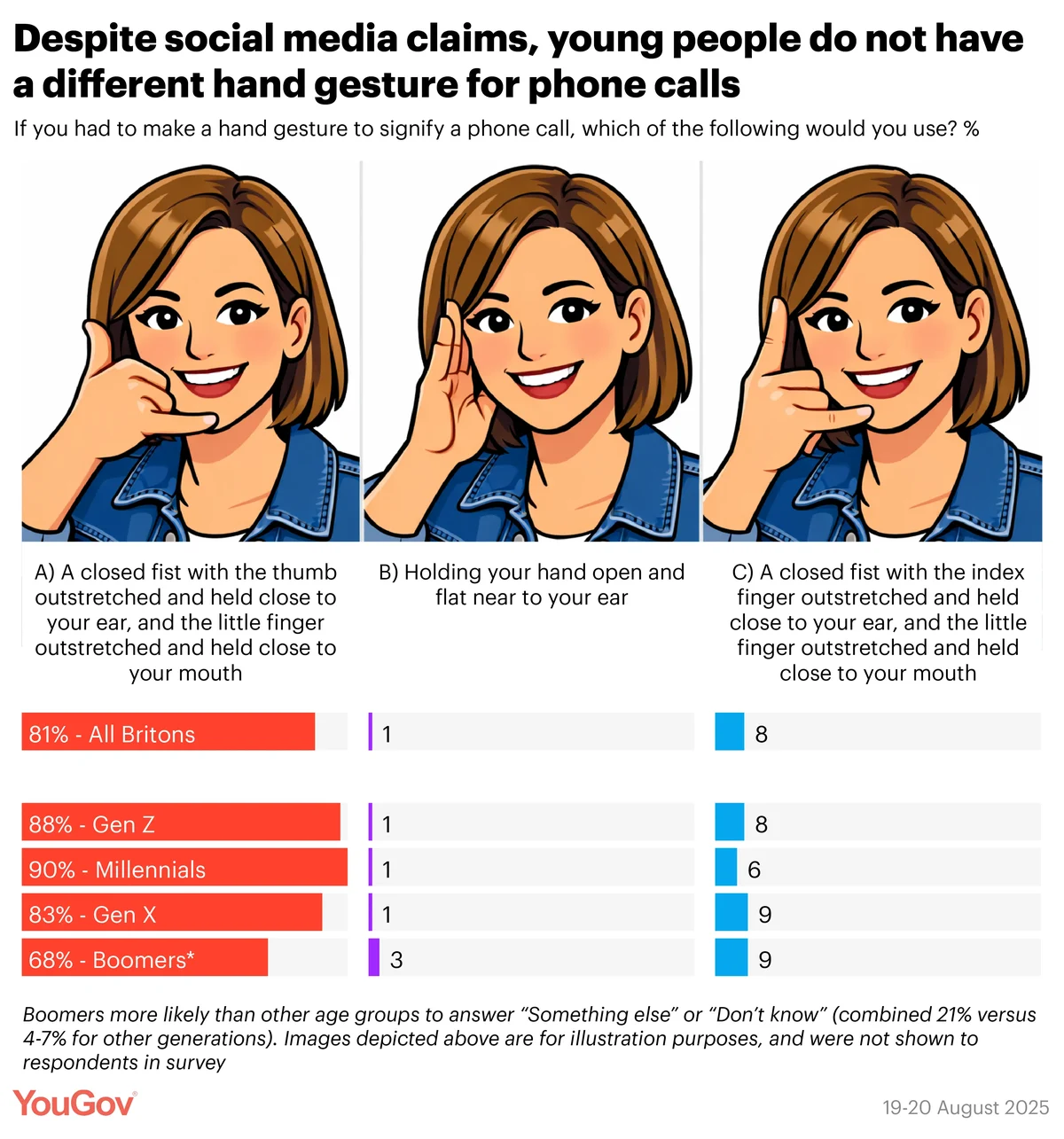
Claims have been made for years now that because Gen Z have grown up with smartphones, and have therefore never used a traditional telephone handset with a receiver, that they use a different hand symbol to denote a phone call.
This theory claims that the Gen Z symbol for a phone call is a flat palm held next to the face, mimicking a smartphone.
However, the results of our poll debunk this idea, with a mere 1% of Gen Z saying they use this hand sign – a figure given at about the same rate by other generations.
Instead, 88% of Gen Z say they use the traditional gesture of a closed fist with outstretched thumb and little finger – while another 8% use a variant with the index finger and little finger.
Gen Z are uncomfortable making phone calls: true
Another way in which Gen Z come in for significant criticism is their greater anxiety around making phone calls, with the i's Rebecca Reid scolding youngsters “if you can’t make a phone call you need to grow up”.
Unlike our prior myths, this perception is largely grounded in reality. While Gen Z do admit to being uncomfortable making phone calls, this only applies to calling strangers. This is part of a wider age trend; while 67% of Baby Boomers say they are comfortable making phone calls, this falls with each generation, to just under half of Millennials (49%) only a third of Gen Z (33%).
Almost two thirds of Gen Z (65%) say having to make a phone call to a stranger makes them feel uncomfortable.
However, the differences between generations diminish substantially when it comes to calling family and friends, which only 15% of Gen Z say makes them feel uncomfortable, compared to 11% of Millennials and 5% of Boomers.
Again though, while the vast majority of Gen Z say they feel comfortable calling loved ones (82%), we again see a declining level across the generations who are “very comfortable” doing so, from a high of 77% among Boomers down to 55% of Millennials and 48% of Gen Z.
But is this reticence to make phone calls about the medium? Or is it rather about confidence in communicating more generally?
While the degree differs depending on the form of communication involved, our study finds that young people are – to varying degrees – also less likely to say they are comfortable getting in touch with a person by video call, or even by email or text.
There is a noticeable difference in the most preferred means of communication between generations. Asked their preferred way of getting in touch with friends and family, 62% of Baby Boomers say it would be by telephone, a figure which falls successively with each generation to only 17% of Gen Z.
By contrast, younger generations much prefer email, text or instant message (65% of Gen Z) for getting in touch with friends and family.
Approximately the same number across the generations say that they most like to make a video call (10-14%), while barely anyone chooses voice notes or written letters (0-2%).
When it comes to contacting those outside of the people’s personal circles, or strangers, email/text becomes the preferred form of contact for all generations.
Interested in taking YouGov surveys? What do you think about younger people feeling uncomfortable making phone calls, the impact that smartphones have had on children, and everything else? Have your say, join the YouGov panel, and get paid to share your thoughts. Sign up here.
Interested in commissioning YouGov research? We connect in real-time with real people around the world to gather their thoughts, behaviours, and opinions, to ensure that our research data is powered by reality. Explore our survey services here.
Photo: Getty