Even if their safe return could be guaranteed, 49% of Britons would refuse an opportunity to go to the Moon
Key takeaways
- 57% of Britons feel returning to the Moon is of little to no importance for humanity
- Even imagining a scenario in which their safe return could be guaranteed, 49% of Britons say they would not want to go to the Moon
- “Not interested” is the most common reason for Britons to not want to visit the Moon, with others concerned there would be nothing to do once they got there
- 37% of Britons believe it’s likely that humans will land on Mars in their lifetime
Today, Artemis II is scheduled to launch, which will take humans beyond low Earth orbit for the first time since 1972, on course for a fly-by around the Moon. This is part of NASA’s Artemis programme, which aims to return humans to the Moon as a stepping stone for establishing a permanent base there and, eventually, human missions to Mars.
But while these objectives might have been a long time in the making, they are relatively low on what the British public believe should be the priorities of the space programme.
Nearly six in ten Britons (56-57%) feel it’s not very or even not at all important for humanity to send astronauts either back to the Moon or onto Mars, with 60% feeling similarly about attempting to establish a long-term physical presence on our only natural satellite.
This compares to just 21% of Britons believing it’s of little to no importance for humanity to explore space for scientific purposes and 31% feeling it’s not particularly important for humanity to have a physical presence in space, such as through the International Space Station.
Even searching for the possibility of extra-terrestrial life ranks higher up the cosmic agenda for Britons, with just 50% of Britons seeing it as being not very or not at all important to humanity.
Not just is there a feeling the programme’s objectives are not particularly important, Britons also tend to feel they are unlikely to be achieved any time soon.
While 76% of Britons believe it is likely that humans will land on the Moon again during their lifetime, just 37% expect humans to land on Mars and only 16% see it as more likely than unlikely that humans will live in long-term habitats on the Moon or another planet.
Younger Britons are noticeably more likely to expect to see Neil Armstrong’s achievements replicated on the red planet, with 60% of 18-24 year olds and 43% of 25-49 year olds believing it’s probable that humans will land on Mars in their lifetimes, relative to 30% of 50-64 year olds and 22% of over 65s.
This is a noticeable contrast to expectations about living to see humans inhabit other celestial bodies on a long-term basis, which just 16-17% of Britons in all age groups see as a likely prospect.
Would Britons want to go the Moon?
But regardless of whether humanity will make it back to the Moon, would Britons be willing to go themselves, if their safe return to Earth could be guaranteed?
It’s a possibility that near divides the public, with 44% of Britons saying they would be willing to make the small step themselves, while 49% say they would not want to undertake the roughly half-a-million mile round trip to our celestial neighbour.
It has much greater appeal for men, with 58% saying they would go if they had the opportunity, roughly double the 31% of women who would be similarly open to taking the trip for themselves.
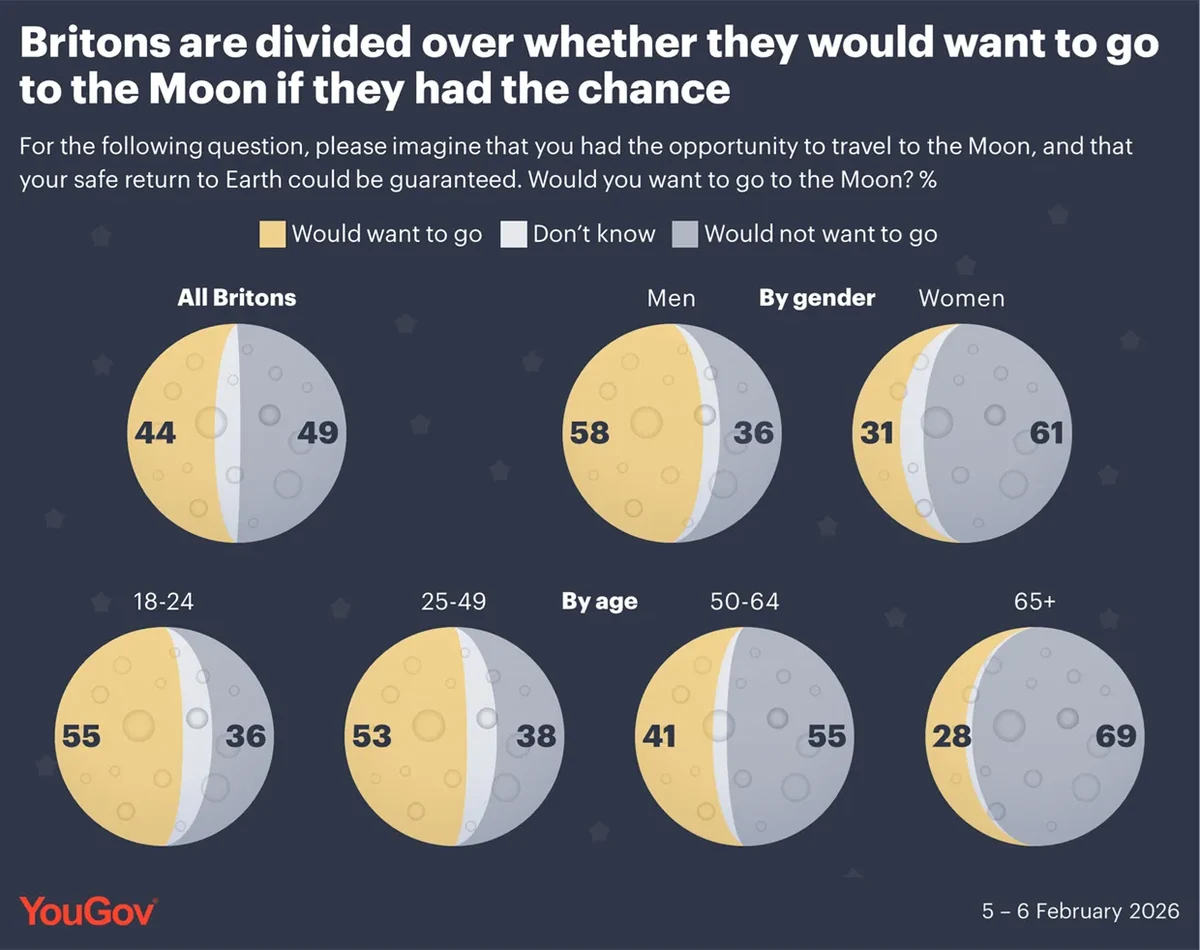
Younger generations are also more open to the hypothetical, with 53-55% of those in the under 50 age groups saying they would be willing to go to the Moon if given the chance, compared to just 41% of 50-64 year olds and only 28% of the over 65s.
Why do half of Britons not want to visit to the Moon?
Considering the risk-free nature of our hypothetical question, some might be intrigued by the instinct of 49% of Britons to say ‘no’ to such a unique opportunity. So we asked this half of the public to tell us in their own words why they would not want to visit the Moon.
A simple lack of interest in visiting is the most common reason, expressed by 23% of those who would decline the opportunity to go.
The desolate nature of the lunar landscape was also a frequent reservation, with 6% saying they would not want to visit as there’s nothing to do once there, while 8% said there would be no point or benefit in going. For some, this contrasts with more Earthly attractions, with 5% saying there are places on Earth they would like to visit first, alongside 4% who simply said they were happy on Earth.
A perception that such a trip would be wasteful also came up, with 3% viewing it as a waste of money, 2% as a waste of their time and 1% as a waste of resources. An adjacent worry about the environmental damage it could cause was cited by 3% of those who would not want to pay the Moon a visit, with another 2% saying we should fix the Earth’s issues first before playing among the stars.
Despite our hypothetical question explicitly guaranteeing a safe return, fully 8% of those who said they would turn down the opportunity rejected the premise that their safety could be ensured. Additionally, 7% said they would be scared, nervous or anxious about the trip, even if they could be kept safe.
Some expressed more specific fears, including 3% who said a fear of flights or heights put them off the particularly long-haul flight to our closest cosmic companion, while another 3% said they were too claustrophobic or agoraphobic to be able to cope with a trip that would keep them confined in such a small capsule for days.
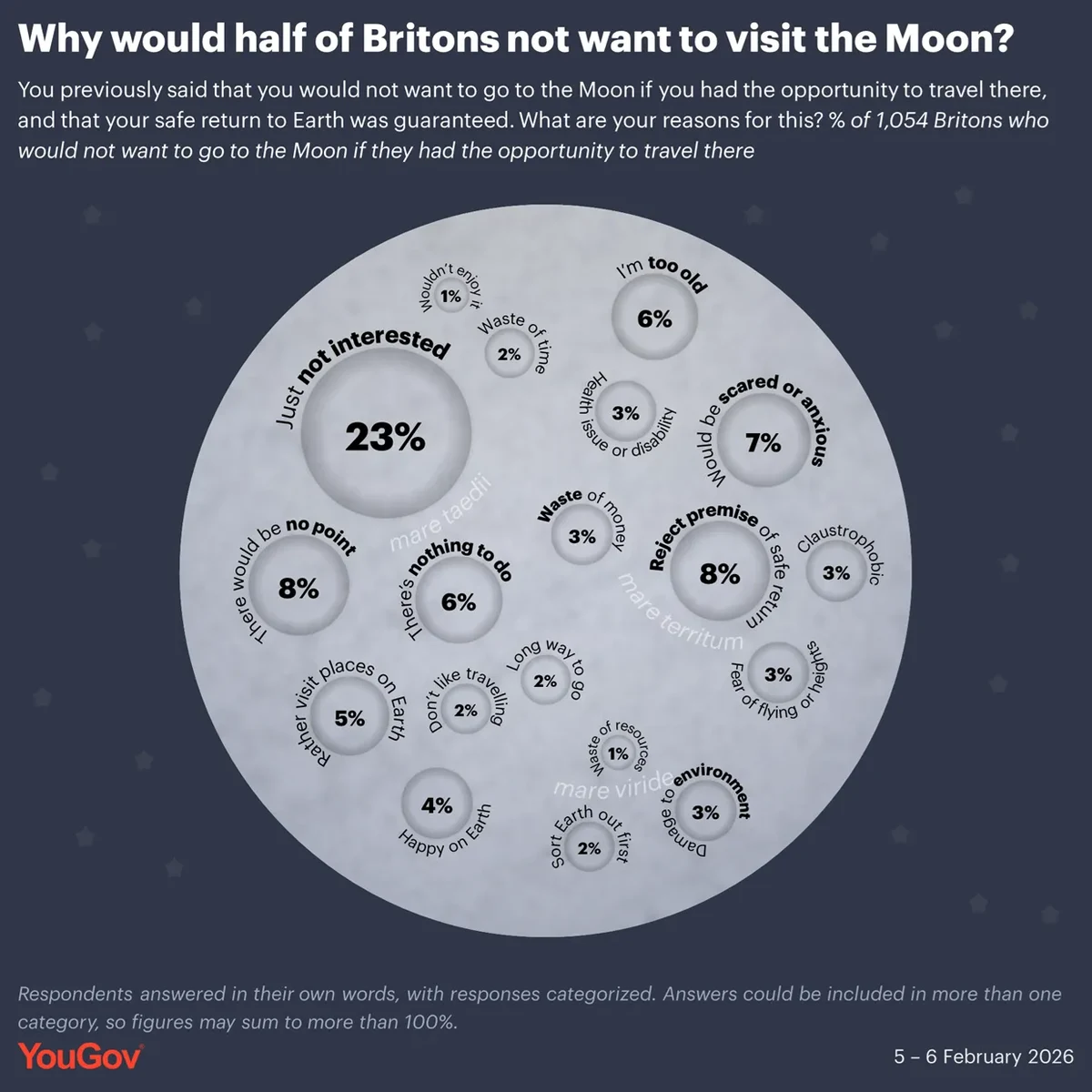
With a turning down of the hypothetical more common among older people, it’s perhaps unsurprising that age concerns were cited by some: 6% of all those who said they would not want to visit the Moon, rising to 16% of decliners over 65.
Issues relating to health, disabilities or the physical toll of space travel were additionally expressed by 3% who do not wish to be flown to the Moon.
A handful of respondents gave alternative reasons for not wishing to make a lunar getaway, including one who singled out the fact “there are no pubs on the moon”.
One person, though, might find the latter stages of the Artemis programme more to their taste, saying they don’t want to visit the Moon because “it’s been done. I’d go to Mars though.”
Interested in taking YouGov surveys? What do you think about going to the Moon, space travel in general, and everything else? Have your say, join the YouGov panel, and get paid to share your thoughts. Sign up here.
Interested in commissioning YouGov research? We connect in real-time with real people around the world to gather their thoughts, behaviours, and opinions, to ensure that our research data is powered by reality. Explore our survey services here.
Photo: Getty