Manchester has the strongest case in the eyes of Britons
Key takeaways
- 66% of Britons believe Manchester has a strong case for being considered Britain’s second city, compared to 48% for Birmingham and 49% for Edinburgh
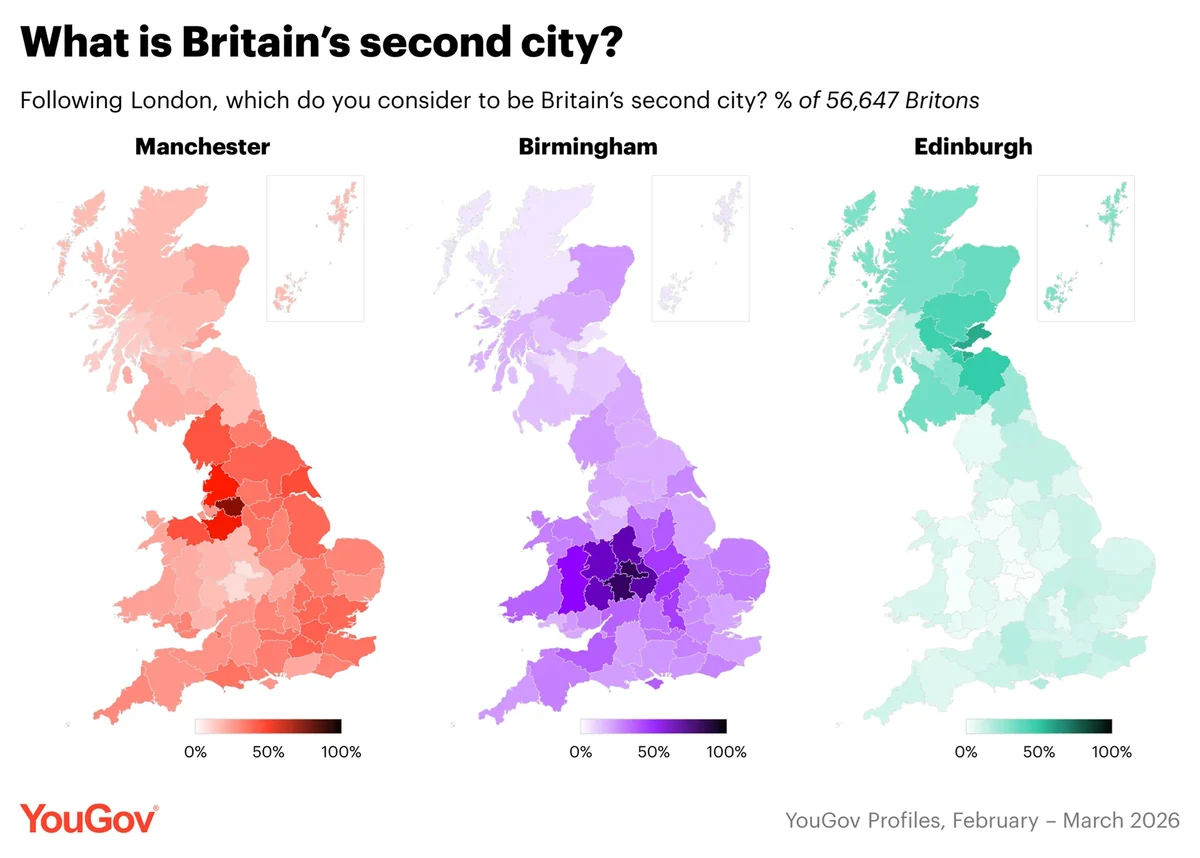
- When picking the city they most consider to be Britain’s second city, the public are divided, with 34% saying Manchester and 30% opting for Birmingham
- Belief Birmingham is the second city is concentrated around the West Midlands, while support for Manchester’s case is more widespread
- Most Scots (56%) view Edinburgh or Glasgow as the UK’s second city, with 16% of Welsh people believing Cardiff fills the role
- Younger Britons are more likely to consider Manchester to be Britain’s second city than older Britons
The debate over which city should hold the unofficial title of “Britain’s second city” has raged for almost as long as London has been the first city.
In recent years, politicians and the media have tended to give the moniker to Birmingham, which is of course the second largest by population, with David Cameron outright stating it was “Britain’s second city” while he was prime minister. Nonetheless, Manchester still sees the title as being theirs, while other cities have occasionally staked a claim, including an argument that it should go to at least one of Edinburgh, Cardiff or Belfast, as the United Kingdom’s other capitals.
To get to the bottom of the issue, a new YouGov study including more than 55,000 Britons investigates which urban areas the public feel have the strongest claim to being the second city.
Which is the UK’s second city, according to the British public?
When it comes to which city Britons consider to be the UK’s second city, the public are largely divided, with 34% saying Manchester and 30% opting for Birmingham. Edinburgh is the only other city which a significant number of Britons give the title to, with 12% saying they consider Scotland’s capital to also be Britain’s second city.
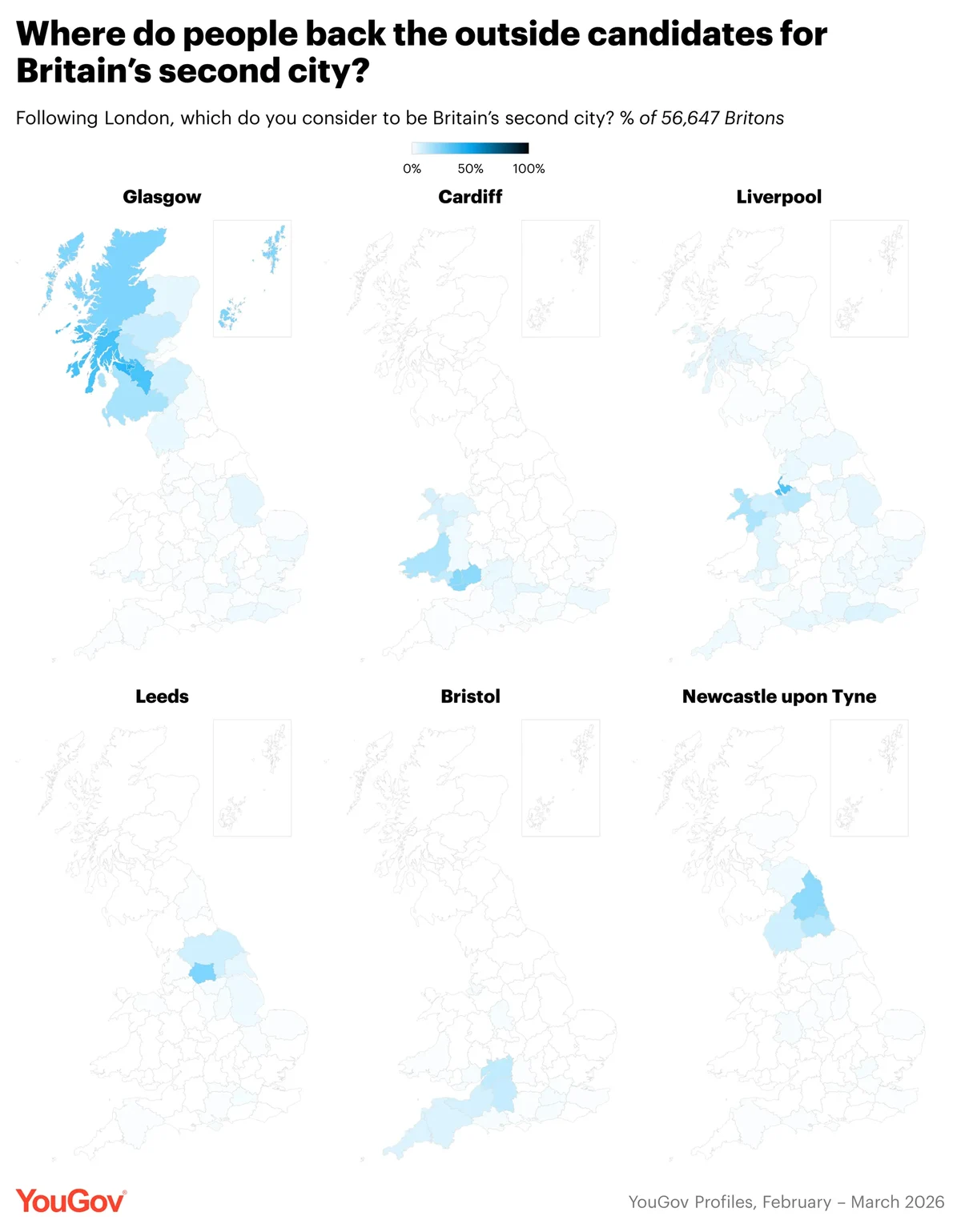
While Glasgow and Liverpool were both once referred to as the second city of the British Empire, either city today only gets the vote of 3% of Britons.
Perhaps unsurprisingly, the answer to this question varies significantly depending on where you are in the country.
Belief that Birmingham is Britain’s second city is concentrated in and around the West Midlands, with at least two thirds of people in all six counties in the region (67-86%) feeling it deserves the title. A tendency to favour the Midlands metropolis also extends into the surrounding counties, being the most common view in mid-Wales, Buckinghamshire, Gloucestershire, Leicestershire, Northamptonshire, Nottinghamshire and Somerset.
Manchester’s claim likewise finds its strongest support on its home patch (77% in Greater Manchester), though this does not extend to every part of the North West, with the people of Merseyside being more likely to consider Liverpool (34%) the second city than Manchester (27%).
Nonetheless, considering Manchester to be second city is the most common view across a reasonably wide spread of England, including places as far afield as Cornwall, Cumbria, Kent and Yorkshire, as well as in Clwyd and the Glamorgans in Wales. London itself also tends to favour the “world’s first industrial city” to be its deputy over its Brummie rival, by a margin of 42% to 27%.
Scotland, however, has its own views. Edinburgh is the top choice in most of the country, including being backed as the UK’s second city by 57-58% in both Fife and the city itself. Glasgow is the most common answer in Dunbartonshire, Glasgow and Renfrewshire, with Lanarkshire divided 35% to 30% between the two.
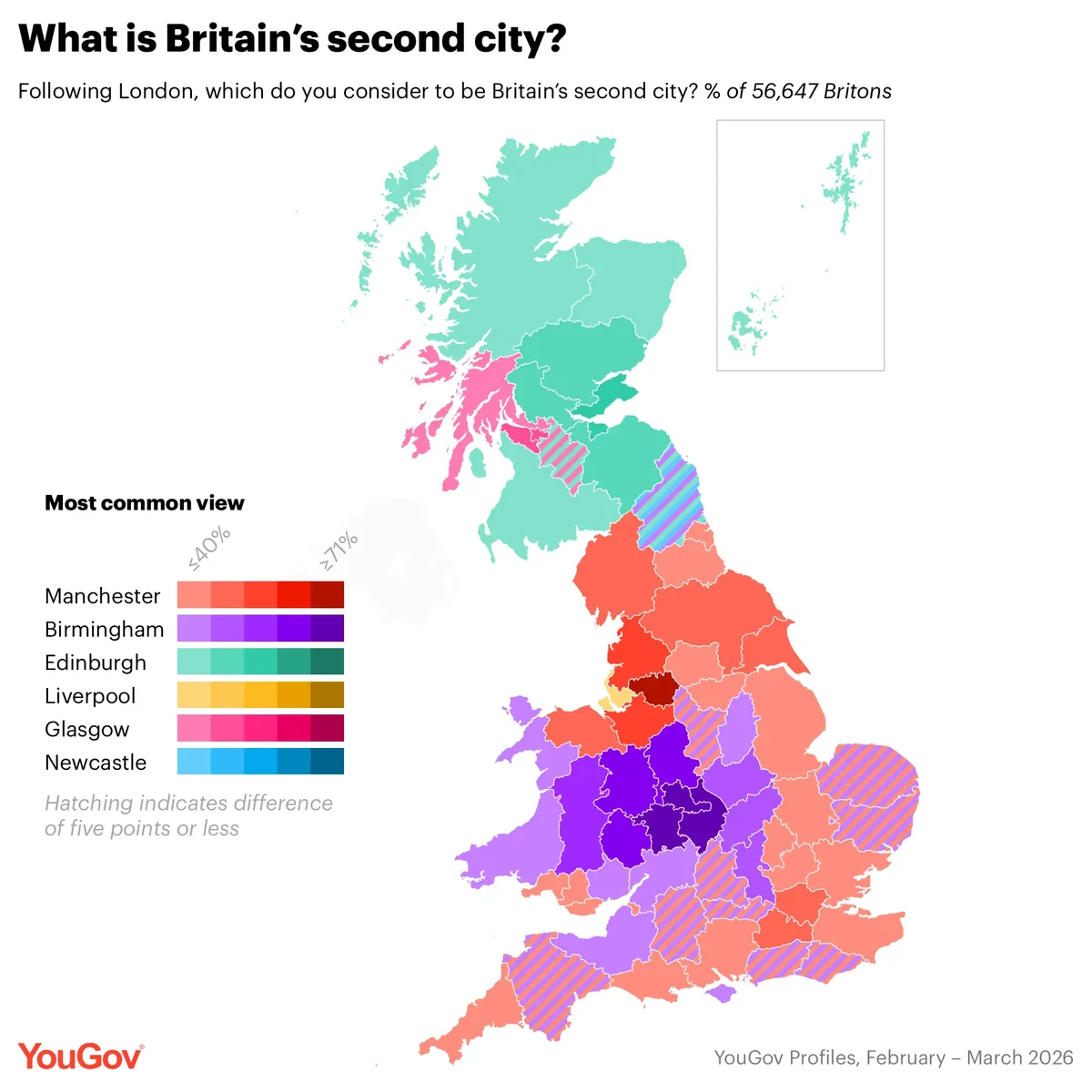
Overall, 36% of Scots view Edinburgh as the UK’s second city, while 20% consider such a role to be filled by Glasgow. There’s not a total rejection of the major English cities, though, with 18% of Scots giving the title to Manchester and 14% to Birmingham.
Wales does not have quite the same level of enthusiasm for its capital, with just 16% of Welsh people considering Cardiff to be Britain’s second city, behind both Manchester (30%) and Birmingham (28%).
Support for Edinburgh doesn’t entirely stop at the Scottish border, with 24% of people in Northumberland and 16% in County Durham considering the Auld Reekie to be Britain’s second city, as well as double-digit proportions in most counties in the south of England.
A few other cities have local bastions of support, with Newcastle upon Tyne being seen as the second city by a fifth of people in Northumberland and Tyne and Wear (20-22%), with smaller proportions tending towards the Toon in Durham (14%) and Cumbria (9%).
Beyond Merseyside, Liverpool’s appeal as ‘second city’ extends to Cheshire (13%) and north Wales (9-16%), while peaking at 44% among those living in the city itself.
Just over a fifth of people in Gwent, Mid Glamorgan and South Glamorgan (22-23%) see Cardiff as Britain’s silver city, while 10-12% of people in Bristol, Gloucestershire and Wiltshire consider this role to fall to Bristol. Although 25% of people in West Yorkshire believe Leeds is Britain’s second city, it has few backers elsewhere.
Younger Britons favour Manchester over Birmingham to be Britain’s second city
Beyond geographical differences, there’s also a small generational divide over the title of second city.
Among younger Britons, Manchester is the clear favourite, with 42% of 18-24 year olds seeing it as Britain’s second city, relative to just 24% favouring Birmingham. Older Britons are more evenly divided, but with Birmingham edging out Manchester for the silver city medal among over-65s by a margin of 35% to 29%.
Belief that Edinburgh is the titleholder is more consistent across the generations, with 10-12% of all age groups seeing it as Britain’s second city.
Which cities do Britons believe have the strongest case to being the ‘second city’?
The debate over Britain’s second city is not likely to be resolved any time soon, and the various contestants will continue to press their cases. But how do the public feel about the strength of their respective claims?
Here, Manchester is a clear favourite, with two thirds of Britons (66%) feeling it has a strong case for being considered Britain’s second city. Birmingham meanwhile is near-tied for second place with Edinburgh, with around half of the public (48-49%) viewing either city’s claims as strong, relative to 34-37% seeing them as weak.
A third of Britons (33%) see Liverpool as having a reasonable claim to the title, with 27% believing there’s a strong argument for giving it to Glasgow. Beyond Edinburgh, the UK’s other capital cities fare less well, with only 18-22% feeling that either Cardiff or Belfast have decent claims to being the UK’s second city, putting them on a par with York, which 19% feel has a robust case.
There is still a regional dimension to this question, but only in the West Midlands do more people believe Birmingham has a strong case for being the UK’s second city than say so of Manchester (82% vs 64%). In no other region do more than half of the public (51%) feel Birmingham has a reasonable claim to the title, while belief that Manchester has a strong case does not fall below 49% in any region.
In Scotland, Edinburgh is seen as having the strongest case, with 62% of Scots believing it has a legitimate claim to being the second city title, putting it ahead of Manchester (49%), Glasgow (47%) and Birmingham (38%).
Other contenders are likewise backed most in their home regions, including 38% of North Easterners seeing Newcastle as having a strong case for being considered the UK’s second city, 35% of Welsh people believing Cardiff has good claim, and 28% of South Westerners feeling Bristol has a reasonable case.
This is also true in Yorkshire and the Humber, which is home to several cities that have laid a claim to the title, but the proportions in the region that see Leeds (38%), York (33%) or Sheffield (20%) as having a strong case for being the second city are much less than the 72% who feel it is Manchester across the Pennines that has a legitimate claim.
What do Britons think makes a second city?
Perhaps key to explaining why having a population roughly twice the size of Manchester’s doesn’t immediately settle the debate in Birmingham’s favour is that just 14% of Britons consider population size to be the most important factor in determining a second city.
Instead, 21% say economic impact is the most important criteria for determining which city is Britain’s second, while 18% feel historical importance matters most, and 16% believe cultural impact should be the most decisive factor.
Those who think Birmingham has a very strong case for being considered Britain’s second city are particularly likely to feel that population size matters most in settling the question, with 32% saying so, relative to just 11% of those who consider either Edinburgh or Manchester to have a very strong case.
Manchester’s champions are instead particularly likely to feel economic impact matters most of all (30%), while historical importance is disproportionately the deciding factor among those who see Edinburgh as having a compelling argument (also 30%).
Around a quarter of those who think Manchester or Edinburgh have very strong cases (24-25%) also see cultural impact as being the most important factor, relative to 16% of Birmingham’s backers.
Interested in taking YouGov surveys? What do think about Birmingham, Manchester, and everything else? Have your say, join the YouGov panel, and get paid to share your thoughts. Sign up here.
Interested in commissioning YouGov research? We connect in real-time with real people around the world to gather their thoughts, behaviours, and opinions, to ensure that our research data is powered by reality. Explore our survey services here.
Photo: Getty