



With a new report by medical leaders claiming that the dangers posed to children of social media use rank “alongside smoking and wearing seatbelts in cars as a unifying force for the medical profession”, there have been renewed calls for a total ban on social media for under 16s.
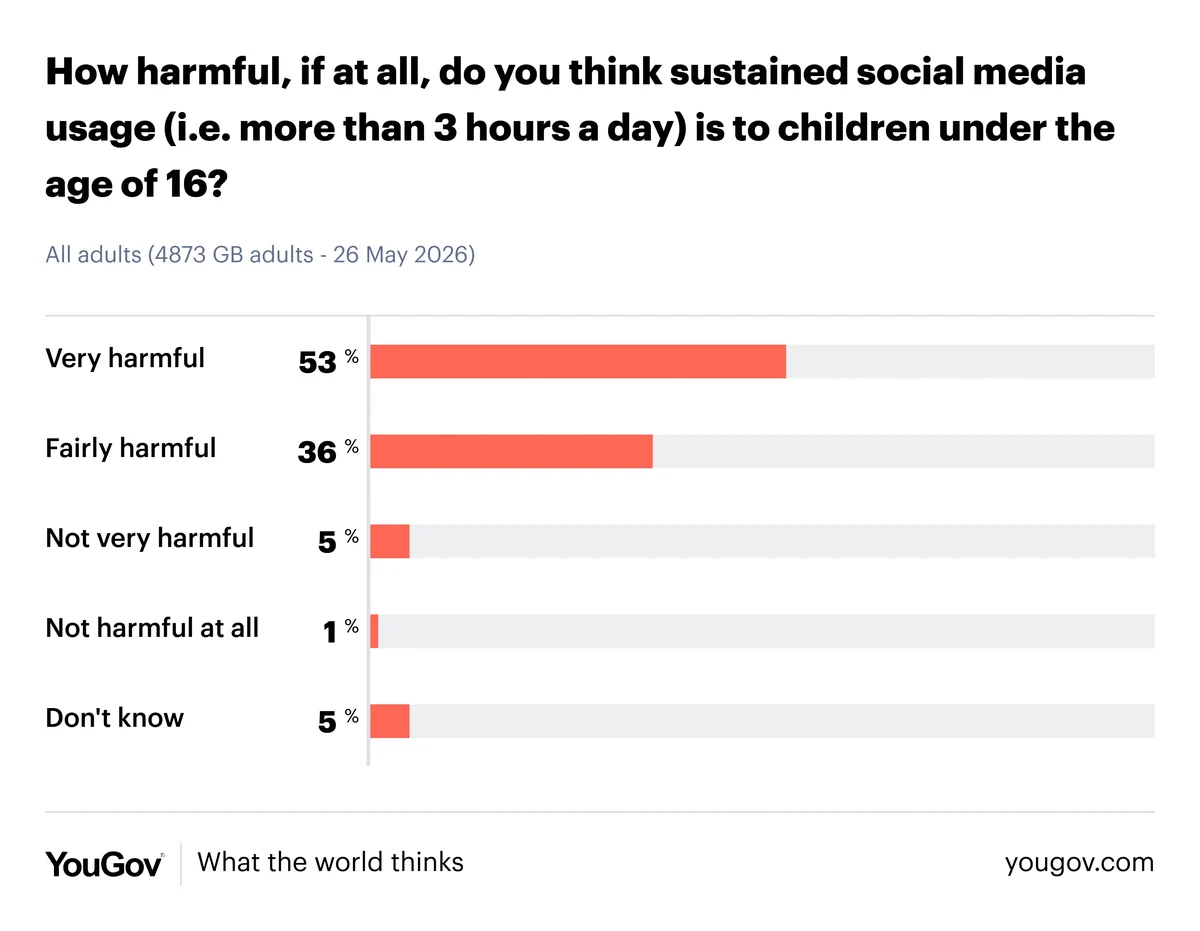
Previous YouGov polling has shown that the public are receptive to a ban, with the latest data showing that Britons overwhelmingly see sustained social media usage as harmful to children, with 53% believing it is very harmful and a further 36% thinking it is fairly harmful.
But what do Britons think the harms actually are? To dig deeper into adult perceptions of the risks faced by children who are using popular social media platforms, we used our new YouGov AI Interviewer tool to ask respondents simply: “what do you think are the biggest harms from social media use for under-16s?”
The AI agent then conducted interviews with each respondent, following up on their responses, in order to provide “the why” behind what Britons think. Our qualitative analysis of attitudes, including quotes, can be found below, along with examples of respondent interviews in their entirety.
Inappropriate content exposure
One of the biggest concerns for respondents was the potential for exposure to inappropriate content, such as graphic violence, pornography and other material not deemed suitable for children.

“the amount of porn that is pedaled on instagram is disgusting. far too many onlyfans girls use instagram to promote their degeneracy and kids are seeing it. boys then think its normal and thats how girls SHOULD behave and then young girls are also feeling the same” – Man, 25-34, South East England
“Children do not have the experience to tell generated content from real content and often haven’t been exposed to harmful themes like drug use or self harm in their normal life. Exposure and watching videos like this can cause harm to them” – Woman, 25-34, East of England
“It was unhealthy for my child. She was sent pornography at 13” – Women, 55+, North West England
“Ai slop giving a false impression of reality” – Man, 55+, South East England
“Images of self harm or other extreme material. Bigoted and hateful misinformation masquerading as truth. Fallacies that confuse minds that are developing and learning. False representations of actual social interactions and societal expectations/norms” – Woman, 25-34, Scotland
“It’s easy for people to bypass the age verification or find other ways to access unmoderated pornography. Such early exposure to that and harmful social media influencers is changing societal views in our youngest generation. Acceptance of harmful sexual activity is now normalised. I’m talking about dangerous practices such as strangulation” – Woman, 45-54, South West England
“It appears to be largely unregulated and children can access anything they want - parents don't seem to set any limits. They are subject to radical, violent and sexual images.” – Woman, 55+, Yorkshire and the Humber
Misinformation and toxic ideologies
And it’s not just inappropriate content that’s a worry. Many respondents were alarmed at the possibility of children succumbing to misinformation and toxic political ideologies, with concerns that algorithms and artificial intelligence (AI) are having an impact on impressionable young users.
“Because it's easier to access propaganda. Because idiots with dangerous views and a smartphone can take advantage of disengaged youth or teens who feel disenfranchised. Newspapers, TV and radio news have sets of standards and laws - it's like the wild west on tiktok in terms of fact checking. Sure, there's some interesting stuff out there but you've got to sift through some complete bullshit and lies.” – Woman, 35-44, Wales
“There is a lot of propaganda which can give people a false impression of the world they live in.” – Man, 45-54, South East England
“Very bad role models such as the Tate brothers. Too much violence, misogyny and access to unsuitable adult content.” – Woman, 55+, East of England
“Platforms want people to watch more of their content and seem to quickly channel viewers down stronger angles. For example, how quickly young boys can be led to watching videos about extreme views of masculinity, sexism and how women are seen/should be treated.” – Man, 25-34, North West England
“Children may trust online content too easily because AI can now create realistic images, videos, voices and text. This makes it harder to spot what is fake, edited or misleading. I worry they may believe misinformation, scams or harmful opinions without questioning the source or motive. They dont know a world before this” – Woman, 35-44, North West England
Cyberbullying and online harassment
It’s not just things that children can pick up from adults that concerns Britons about social media, many respondents are also alarmed at the ability of children to use social media to bully each other, with the ability of the smart phones to make bullying an all-day occurrence a frequent worry.
“Kids share embarrassing content about each other. It reaches a lit of people quickly and everyone piles on. Parents aren’t always aware. Bullying used to stop at the school gate, now it follows you home on your phone.” – Woman, 35-44, North East England
“It can happen at any time of day or night. It can be anonymous. It can be difficult to escape from. It is easy for people to join in and not necessarily see or think about the consequences of their actions.” – Woman, 55+
“It does not differ in form however with online bullying it is more difficult for the child to avoid as it is able to reach into the home at all hours of the day and week” – Man, 55+, North West England
“Young people and young teens not being as socially aware or emotionally mature as some adults is also an issue - they're not always thinking of their digital footprint. I know of young teens who've had terrible experiences with intimate photos and videos being shared, of sextortion etc” – Woman, 35-44, Wales
“Bullying on the media can involve far more bullies. Off media, it's usually one or two, which can be seen by adults. Online, many people can join in & it isnt seen.” – Woman, 55+, South West England
Mental health and wellbeing
Social media having a negative impact on children’s mental health is a fear shared by many Britons, with some worried that it is leading to increased levels of anxiety, depression and isolation, though a few people stressed the benefit social media can have for minority communities.
-
“The biggest harm is severe mental health damage and depression driven by constant negative social comparison and chronic sleep deprivation” – Man, 25-34, North West England
“It's extremely addictive and can contribute to poor mental health as you are constantly comparing yourself to other people e.g. Instagram, Snapchat, TikTok, Facebook.” – Woman, 25-34, Scotland
“I think screen time generally causes anxiety. But then add in the FOMO power of social media and the fact that it shows a distorted/ curated version of reality and of course it causes stress.” – Man, 35-44
“It creates a cycle of mental issues and increased isolation. However it dose have a positive effect in many ways for minorities such s trans people” – Woman, 16-17, Scotland
“It's engineered to keep you engaged. Like gambling.” – Man, 55+, South West England
“I am so glad I was a teenager before social media. I don't think I would have survived the trauma” – Woman, 55+, South East England
“I think social media has contributed to the increase in children claiming a transgender identity and on that topic there needs to be a public enquiry as the damage to children is so great.” – Woman, 45-54
Social and interpersonal development
As well as the impact of social media on children’s mental health, many respondents said they were concerned about it eroding social skills, particularly in terms of face-to-face communication, with some projecting it would end up having significant societal impacts.
“They aren't speaking to one another like previous generations therefore they lack oracy skills. This means they avoid direct conversations with people and won't perform as well in interviews and the workplace.” – Man, 35-44, North East England
“spending more time on tech gadgets & less time socially interacting with people in real life has an impact on wellbeing. they're outside less, they're not developing some of the same levels of independence and resilience as my generation” – Woman, 35-44, Wales
“People seeking likes more than socialising face to face” – Man, 45-54, South East England
“I suppose the focus on online interactions instead of in person may lead to children losing the ability to relate to others which will have an impact when they move into the world of work.” – Woman, 55+, South East England
“Watching young people today unable to properly communicate verbally with people. Being stuck inside on consoles or vr headsets or phones and tablets. All doing the same internet social media crazes whilst thinking they are all being so original. They don’t know who they are or what they like and it doesn’t bode well at all for the future of society.” – Man, 45-54, Scotland
“They're like zombies, walking into you, walking into objects and crossing roads without looking as they're so obsessed” – Man, 45-54, East Midlands
Regulation and oversight
Beyond the potential impacts of social media, many respondents additionally expressed concerns that the companies that run popular social media platforms are not doing enough to tackle the issues. There was some disagreement, though, about whether it was the government’s role to regulate social media, with some saying it should really be down to parents to monitor their children.
“companies needs to be more responsible, but they are not going to be until they are fined otherwise, so government has to step up and regulate them more, and fine them” – Woman, 35-44, London
“Platforms need to spend a lot more money policing harmful content. They will take down copyrighted material within minutes, so they should be able to do this for harmful content.” – Woman, 45-54, East of England
“There is no way that government can stop children interacting with social media, matter what barriers they try and put in place. Kids grew up with technology. The onus must be on the platform owners to monitor creator content.” – Man, 55+, Yorkshire and the Humber
“It wouldn’t be easy but the companies need to take more responsibility for what they allow on their platforms and should be held to account when bad things happen. Fines and prison sentences for those at the top.” – Woman, 55+, London
“Yeah, the government is looking at this all wrong. Get tougher on the problem (bullies and nonces) and let kids be kids.” – Man, 45-54, North West England
“Big tech companies should not be allowed to self regulate.” – Woman, 25-34, London
“i feel if there are any problems with children using social media, it is up to the parents and not the government to regulate that behavior […] parent's literally brought the children into this world, a government is not here to tell parents how to bring up their children” – Man, 55+, Scotland