
Key findings:
- UNICEF's overall Index score increased by 8 points, rising from 20.0 in early April to 28.0 on 31 May during the Soccer Aid campaign.
- UNICEF's Impression score rose by 13.9 points, climbing from 26.4 to 40.3 between 11 April and 31 May, reflecting stronger public sentiment.
- Word of Mouth (WOM) Exposure nearly doubled, increasing from 2.0% to 3.8% between 1 April and match day, an almost 90% increase.
- Women were more likely than men to consider donating to UNICEF on match day, with Consideration at 25.6% among women versus 19.0% among men – a gap of 6.6 percentage points.
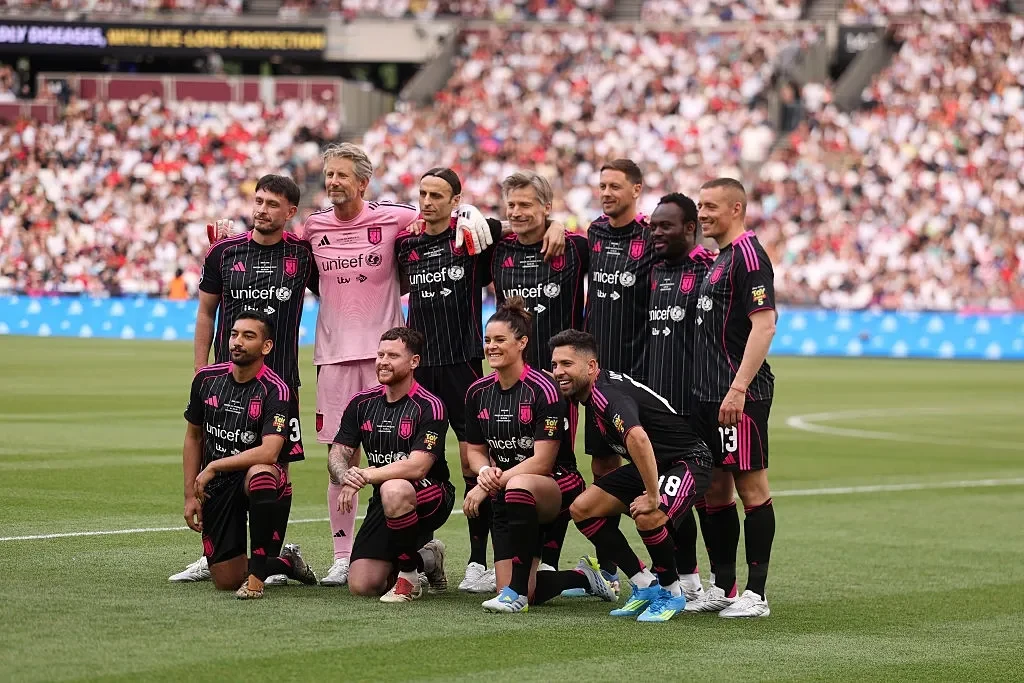
The 2026 edition of Soccer Aid marked the 20th anniversary of UNICEF's flagship fundraising football match, with ITV dedicating a week of build-up coverage ahead of the event at the end of May. YouGov CharityIndex data shows that this sustained attention translated into measurable gains in public perception, illustrating how major cultural events can influence opinion in real time.
Public sentiment for UNICEF recorded growth across all key metrics
At the beginning of April, UNICEF's Index score (which takes the average of our Impression, Value, Quality, Reputation, Satisfaction, and Recommend scores) stood at 20.0 points. By 31 May, the day of the event, it had risen to 28.0, an increase of 8 points.
The UN agency's Impression score, which tracks overall sentiment, followed a similar trajectory, increasing from 26.4 on 11 April to 40.3 on 31 May (+13.9 points). Meanwhile, Buzz – measuring whether people have heard something positive or negative about the organisation recently – rose from 4.8 to 7.5 over the same period.
The data suggests that sustained visibility around Soccer Aid helped strengthen public perceptions of UNICEF across a two-month period.
Word of Mouth (WOM) Exposure and Ad Awareness scores also strengthened for UNICEF throughout the period
One of the clearest signs of growing engagement can be seen in Word of Mouth (WOM) Exposure.
On 1 April, just 2.0% of the public reported hearing people talk about UNICEF. By game day, that figure had risen to 3.8%, representing a nearly 90% increase in exposure to conversations about the charity.
UNICEF's Ad Awareness also strengthened during the period, increasing from 6.3% on 1 April to 9.8% on 31 May and continued to rise in the days immediately following the event.
Consideration to donate to UNICEF peaked well before the match itself
Perhaps most interestingly, UNICEF’s Consideration score – the proportion of people who would consider supporting the charity – reached its highest levels well before the match itself.
Consideration climbed from 20.8% on 1 April to a peak of 27.1% on 5 May. While the measure softened later in May, it again gained points close to the event date and remained above April levels through much of the build-up period.
Gen Z recorded the strongest UNICEF Ad Awareness scores
Ad Awareness among Gen Z was highly volatile during the build-up period, with awareness climbing from 3.8% at the start of April to a pre-event peak of 26.8% on 3 May before falling back.
A second uplift in UNICEF’s score around Soccer Aid weekend, culminating in 23.6% Ad Awareness on 31 May, indicates that the event sustained engagement among younger audiences.
Millennial awareness rose to 11.6% on 31 May and continued to rise to a peak of 19.0% post event, while Gen X’s Ad Awareness score declined during the period.
Men recorded higher Ad Awareness levels, but women recorded higher Consideration scores
Football has traditionally attracted a stronger male fanbase, making Soccer Aid an interesting test case for whether a football-led fundraising event can resonate with female audiences.
UNICEF’s Ad Awareness among men remained higher overall, peaking at 12.1% on 1 June.
However, Ad Awareness among women tracked closely behind throughout much of the campaign – reaching a peak of 10.5% on 2 June.
The gender differences were even more pronounced when looking at Consideration. Throughout the period, women were consistently more likely than men to say they would consider donating £1 to UNICEF if asked tomorrow.
On 1 April, Consideration among women stood at 26.3%, compared with 14.3% among men. The gap remained remarkably consistent throughout the build-up to Soccer Aid and was still evident on match day itself. On 31 May, female Consideration stood at 25.6%, compared with 19.0% among men – a difference of 6.6 percentage points.
Twenty years after Soccer Aid first kicked off, the latest YouGov CharityIndex data suggests the event remains a powerful play for reaching audiences – driving strong Ad Awareness among Gen Z, and elevated Consideration scores among women.
Methodology: YouGov BrandIndex collects data on thousands of brands every day. Index score is an average of Impression, Value, Quality, Satisfaction, and Recommend scores. Index score is reported as net scores from –100 to +100, based on daily UK surveys weighted by age, gender, region, social grade, and ethnicity. Figures cover the period 1 April – 4 June 2026, with sample size ranging from 41 to 1,229.
Images: Getty Images