

How many Britons say they have ever cheated on a partner?
There are two main ways in which people can be cheated on: physically (i.e. sex with someone else) and emotionally (i.e. forming a deep emotional or romantic connection with another person).
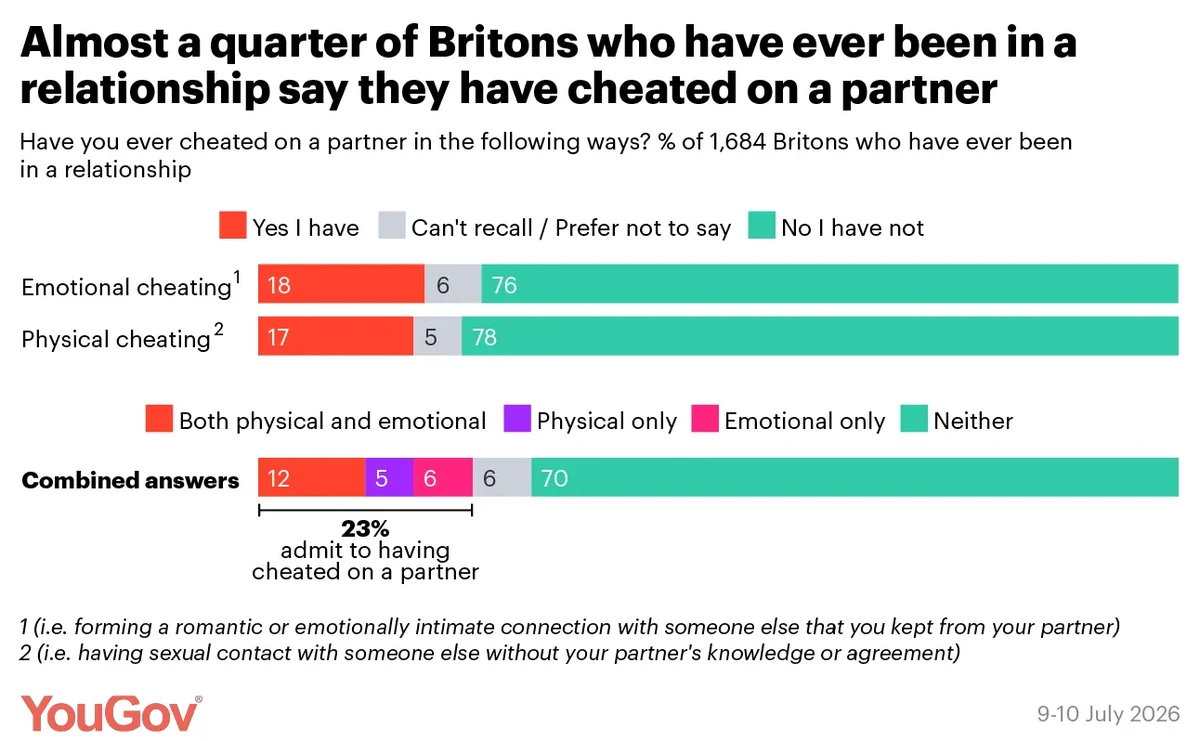
Almost a quarter of Britons (23%) who have ever been in a relationship confess to having cheated on a partner. This includes 17% who have sexually cheated on their significant other and 18% who have emotionally cheated on their partner – 12% admit to having done both.
Which is worse: sexual cheating or emotional cheating?
Britons tend to say that they would find sexual infidelity worse than emotional cheating. Four in ten (40%) say it would be worse if their partner had a sexual affair where they didn't have feelings for the other person, than if they had an emotional affair where they weren’t having sex with the other person (25%).
While men are much more likely to say they would be more bothered by a sex-only affair (46%) than by purely emotional cheating (20%), women are much more divided, at 35% and 29% respectively.
Can it be ok to take back someone who has cheated?
Britons are divided on the prospect, with 37% saying there are circumstances where it is reasonable to take someone back after they cheated, while 41% draw a hard line, saying it is never reasonable to do so.
The generations differ the most noticeably on this matter. While 47% of the over-60s say there are cases where it is reasonable to forgive a cheater, this falls to 22% of the under-30s. This is consistent with previous YouGov findings which suggest older Britons are much less inclined to rock the boat when it comes to potential relationship drama and break ups.
Men are also more likely to think it can be reasonable to take back someone who cheated (41%) than women are (33%).
Is it ever acceptable to cheat on a partner?
The plot of the first Sex and the City movie infamously suggests that the main characters think it is Miranda’s fault that her husband had a one-night stand, due to the intimacy in their marriage fading.
Indeed, one in nine Britons (11%) say that there are circumstances where it is acceptable to cheat on a partner. This figure is consistent across social groups.
However, fully 76% of people say there is no justification for infidelity to a partner.
What counts as cheating?
But what constitutes cheating in a relationship? We asked about 12 different behaviours, giving three answer options for each: 1) that this is cheating, 2) that this is harmless, or 3) that while this behaviour is not harmless, it is not actively cheating.
Unsurprisingly, having sex with someone other than your partner is almost universally considered to be cheating, at 94%.
But consensus isn’t so strong across other behaviours.
Is sending nudes to another person cheating?
Sending nudes to another person is also overwhelmingly considered cheating (82%), although 11% place this in the less serious tier of ‘not harmless but not cheating’.
Is it cheating to use dating apps like Tinder while in a relationship?
People give similar answers when it comes to using a dating app while in a relationship, which 80% consider cheating, and 12% the slightly less serious category.
Is kissing someone else cheating?
Kissing someone else is seen as cheating by 73%, with 16% seeing it as non-cheating but not harmless.
Is it cheating to secretly message or meet up with an ex?
Secretly messaging or meeting up with an ex-partner is seen as cheating by 69%, with one in five (22%) feeling this is not harmless but not cheating.
Is it cheating to form an emotional attachment with someone else?
On the emotional cheating side of the spectrum, 52% consider “forming a deep emotional attachment to someone else” to be cheating, while 32% see it as problematic if not actively cheating.
Is it cheating if you develop romantic feelings for someone else, even if you don’t act on them?
Developing romantic feelings for another person, but not acting on them, is seen as cheating by 40%, although now 44% classify this as the less serious category of ‘not harmless but not cheating’.
Is having a crush on someone else cheating?
Having a crush is seen as far less serious. While 15% consider this cheating, the most common response now is that this is not harmless but not cheating, at 48%. Indeed, 29% don’t see any problem with having a crush, deeming it harmless.
Is talking to models on OnlyFans cheating?
Almost half of Britons (47%) say it would be cheating for a person to “directly engage with sexual content creators” like on OnlyFans. A further 33% have a problem with this, even if they concede that it does not actively constitute cheating, while only 6% see it as a harmless activity.
Is sexting with AI chatbots cheating?
The fact that AI chatbots aren’t real people won’t wash with 30% of people, who deem romantic or sexual conversations with such entities as cheating. A further 41% say this is still not harmless, even if it is not actively cheating, while only 10% take no issue with the practice.
Is flirting cheating?
Only 17% of Britons believe in the concept of ‘harmless flirting’. While only 26% of people would go so far as to consider it cheating, by far the most common answer is that it is not harmless, even if it is not cheating, at 50%.
Is it cheating to fantasise about sex with other people?
One in six (16%) consider the act of fantasising about sex or intimacy with someone else to be cheating. Another 44% say this is not harmless, even if it is not itself cheating, while 29% see this as a harmless behaviour.
Where do men and women differ on what counts as cheating?
Across every scenario, women are more likely than men to consider each activity cheating. The most noticeable difference is when it comes to directly engaging with sexual content creators like OnlyFans models. Most women (57%) say that doing so is cheating, compared to only 37% of men.
Women are also much more likely than men to disapprove of engaging in sexual conversations with artificial intelligence. In this instance, 38% of women say this is cheating, relative to 22% of men.
Likewise, women are particularly more likely to be bothered by a partner having additional romantic and emotional attachments. Six in ten women (60%) say that a partner forming a deep emotional attachment with someone else is cheating (compared to 43% of men), and similarly 48% of women say developing romantic feelings for someone else, even if nothing physical happens, is cheating, versus 32% of men.
Where do the generations differ on what counts as cheating?
Unlike men and women, there is no clear trend among age groups on cheating scenarios, with some cases seeing agreement across our three age groups and others prompting notable differences.
By far the most noticeable difference between generations is when it comes to kissing someone else. While all age groups see this as cheating, the oldest Britons stand out with only 53% saying so, compared to 78-86% among younger age groups. Instead, the oldest Britons are much more likely to consider this ‘not harmless but not cheating’ (31%) than their younger counterparts (6-13%).
By contrast, the under-30s are noticeably more likely to think that flirting with someone else is cheating (45%), as well as developing a crush (27%) or fantasising about someone else (27%). Young people are also particularly likely to think that engaging with OnlyFans creators is cheating, at 57%.
Where do the generations differ on what counts as cheating?
Unlike men and women, there is no clear trend among age groups on cheating scenarios, with some cases seeing agreement across our three age groups and others prompting notable differences.
By far the most noticeable difference between generations is when it comes to kissing someone else. While all age groups see this as cheating, the oldest Britons stand out with only 53% saying so, compared to 78-86% among younger age groups. Instead, the oldest Britons are much more likely to consider this ‘not harmless but not cheating’ (31%) than their younger counterparts (6-13%).
By contrast, the under-30s are noticeably more likely to think that flirting with someone else is cheating (45%), as well as developing a crush (27%) or fantasising about someone else (27%). Young people are also particularly likely to think that engaging with OnlyFans creators is cheating, at 57%.
Interested in taking YouGov surveys? What do you think about relationships, society in general, and everything else? Have your say, join the YouGov panel, and get paid to share your thoughts. Sign up here.
Interested in commissioning YouGov research? We connect in real-time with real people around the world to gather their thoughts, behaviours, and opinions, to ensure that our research data is powered by reality. Explore our survey services here.
Photo: Getty