

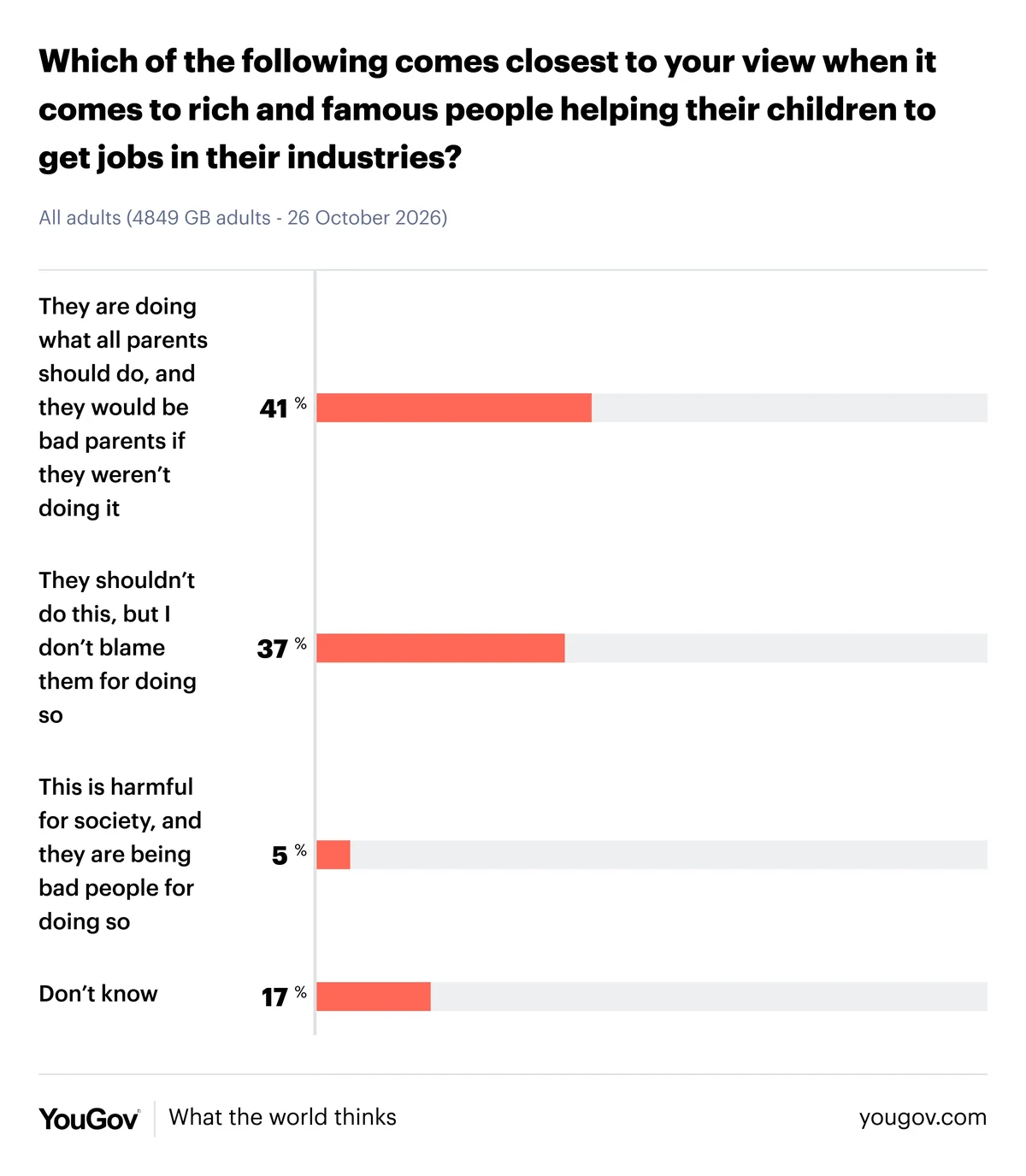
With Sylvester Stallone saying "you’re not a good parent if you haven’t performed a little nepotism" the British public are split on the rich and famous getting jobs for their children.
41% of Britons agree with Stallone, saying that “they are doing what all parents should do, and they would be bad parents if they weren’t doing it”.
While a similar number (37%) say “they shouldn’t do this, but I don’t blame them for doing so”.
Only 5% are entirely critical, saying “this is harmful for society, and they are being bad people for doing so”.
The question splits the public politically, with 51% of Reform voters and 59% of Tories siding with Stallone, compared to only 36-38% of Labour and Lib Dem voters, and just 29% of Greens.
Instead, those who backed the main left wing parties in 2024 are most likely to say such nepotism is wrong, but that they also can’t blame celebrity parents for indulging, at 45-46%.
But what do Britons make of rich and famous people helping their children? To find out, we used our new YouGov AI Interviewer tool to ask respondents: “Following on from our question about rich and famous people helping their children, at what point do you think it stops becoming acceptable for such parents to help their children (if at all)?”
The AI agent then conducted interviews with each respondent, following up on their responses, in order to provide ‘the why’ behind what Britons think. Our qualitative analysis of attitudes, including quotes, can be found below, along with examples of respondent interviews in their entirety.
When help stops being acceptable
Many respondents named a point at which help from rich and famous parents stops being acceptable.
When it comes at the expense of more deserving people
Some said help becomes unacceptable when it takes jobs, roles or other opportunities away from people who are more talented, better qualified or more deserving, including those without wealthy or famous parents.
- “when they only use their children in specific roles and remove the choice of other talented srtists, actors and singers” – Woman, 18-24
- “When they’re giving opportunities that could’ve been given to a normal person, away to their children.” – Man, 25-34
- “When they push them forward over other ordinary hard working people, who don’t have a “lucky birth”” – Woman, 55+
- “If it comes at the cost of talented working class people getting a job” – Man, 35-44
When the child isn’t up to the job
Some drew the line at children being given roles they lack the talent, skills or qualifications to do well, saying help is fine only if the child can genuinely do the job.
- “if someone is given all this money and fame they should be good at what they do, no matter who their family is” – Woman, 18-24
- “I actually don’t think it’s bad to help their children, I just think they do need to be suitable intellectually otherwise it can become harmful if they’re in roles they’re not cut out for purely because of their parents” – Woman, 25-34
- “Everyone would want to help their children, its just if they have no ability and still get work that it becomes unacceptable” – Man, 55+
- “If the kids are useless at what they do.” – Man, 45-54
Opening doors is fine, guaranteeing the outcome is not
Some distinguished between acceptable help, such as introductions, contacts or an entry-level start, and unacceptable help, such as skipping interviews and auditions, pressuring employers, bribery or breaking the law.
- “If it gets in the way of other peoples jobs and lifes like getting an interview for there kids okay but righing it so they get the job isn't” – Woman, 18-24
- “It is unacceptable if the parent finds a way to get round the job requirements. So if the child does not meet the academic or experience standards then the child should not be put forward in the first place. Door opening is fine. Pushing them through when they aren't qualified is not.” – Man, 45-54
- “Putting their children's names forward for a position is fine. Forcing the employers to give the job is not.” – Woman, 45-54
- “It’s ok for parents to do ‘an introduction’, following that, it’s up to the individual to sell themselves” – Woman, 55+
Children need to stand on their own two feet
Some said help should taper off once children are adults or able to support themselves, or becomes a problem when it leaves them spoilt, entitled or unwilling to put in the effort.
- “I think it's fine for parents to keep helping but kids need to learn, once they're adults,.they cannot rely on them or expect them to help so much” – Man, 18-24
- “You can help as a parent to a point but your children need to find their own way and make it by themselves rather than everything being handed to them.” – Woman, 45-54
- “Helping children too much leads them to being entitled & strips them of the desire & enthusiasm to work hard & get where they want to be” – Woman, 45-54
- “When their children have everything handed to them on a plate without having to do anything at all.” – Woman, 45-54
When help never stops being acceptable
Some respondents said there is no point at which it stops being acceptable for rich and famous parents to help their children.
Helping your children is what any parent would do
Some said supporting your children is simply a parent’s role, and something people would do whatever their wealth or fame.
- “That is your child you are responsible for them from the moment you have them till forever” – Woman, 18-24
- “I think it’s fine, I get why people may be annoyed but I think it’s completely normal and any of us would do the same thing if we were in that position.” – Woman, 25-34
- “I don’t think it could ever stop being acceptable, my parents helped me get my first proper job and started my career because of their contacts. I couldn’t be against this” – Man, 35-44
- “I brought them into this world, I should look after them” – Woman, 55+
It’s their money and their business
Some said how wealthy or famous parents help their children is a private matter for the family, and nobody else’s business.
- “Its not other peoples business. Its up to individuals how, when and if they help their children” – Man, 55+
- “It is no one's business what people do in their own family” – Woman, 55+
- “Do not really care, their money to do as they please with it” – Man, 55+
Other themes
Some felt help is particularly unacceptable in politics and other public roles.
- “A politician helping their child get a position in politics that they have no business having” – Woman, 18-24
Some others drew the line at parents pushing their children into careers they do not want.
- “If they are forcing them into something they don’t want to do” – Man, 35-44
Some said parents can help, so long as their children are open about the advantages they have had.
- “I think it is fine for rich people to help their kids - just don't claim that they haven't had any extra advantages, because that's insulting.” – Man, 45-54
Some said help should not extend to shielding children from the consequences of wrongdoing.
- “I really don't know, but it shouldn't extend to protecting them from criminal actions” – Man, 55+