
News that the minimum wage is set to rise to £13.20 for over-21s in the forthcoming Budget has raised complaints that it is becoming increasingly unaffordable for businesses to take on staff.
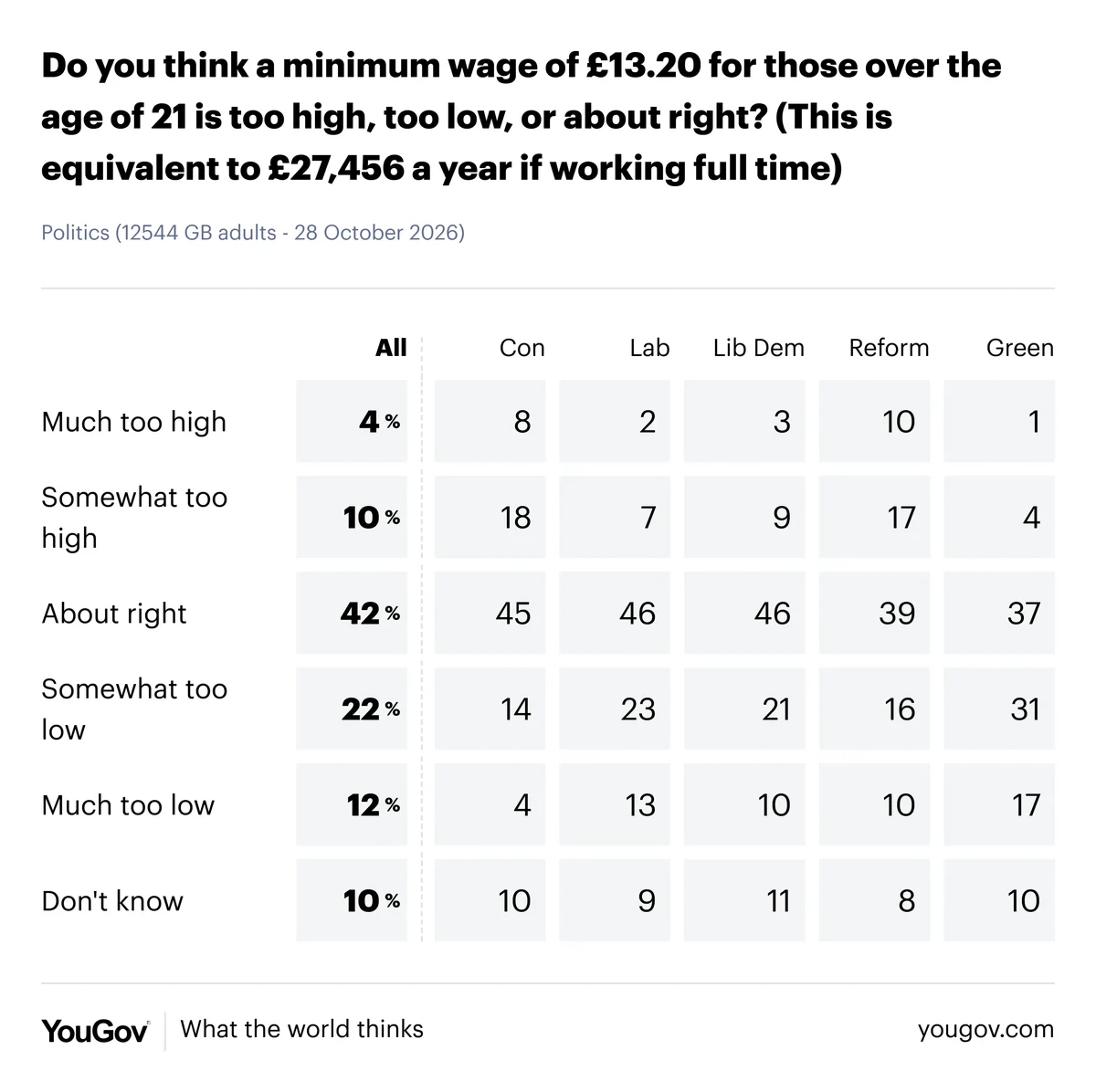
Asked about the new rate of the minimum wage, our poll finds that 42% of Britons feel that it is about right, compared to 34% who think it is too low and only 14% who say it is too high.
But what do Britons make of trying to balance pay and employment when it comes to the minimum wage? To find out, we used our new YouGov AI Interviewer tool to ask respondents: “Where do you stand on the balance between trying to raise wages and trying to make it affordable for businesses to take on new employees?”
The AI agent then conducted interviews with each respondent, following up on their responses, in order to provide ‘the why’ behind what Britons think. Our qualitative analysis of attitudes, including quotes, can be found below, along with examples of respondent interviews in their entirety.
Wages need to keep up with the cost of living
Many respondents, especially those who leaned towards raising wages, said the minimum wage has to cover rent, bills, food and other essentials. Some described people they know cutting back or struggling as prices have risen.
- “Within my household and households I know there are people on minimum wage and they are struggling with the cost of living. Raising the minimum wage will help these people with the high costs of essentials.” – Woman, 18-24
- “Rent is in excess of £1000 and then some down south with the north at a minimum of £800 this means that most people spend more than half of there wages on rent bills are escalating so people can’t afford the basics” – Woman, 35-44
- “People are making choices between heating their homes and food on the table.” – Woman, 25-34
- “Due to cost of living people will struggle to live if it doesn't keep pace with inflation” – Man, 25-34
Small businesses need help, but big firms can afford it
Some drew a line between large companies, which they felt could absorb higher wage costs, and small businesses with tighter margins. Some wanted the government to ease the pressure on smaller firms through cuts to employer National Insurance, business rates or other taxes.
- “They make disproportionately larger profits so they can manage economic hits better than small businesses” – Man, 18-24
- “Larger businesses should be able to afford it, smaller businesses should have business rate cuts to allow them to pay a living wage” – Man, 45-54
- “I ran a small business and wanted to give the staff a decent wage but increases in tax, insurance contributions and other benefits like maternity leave made it hard” – Man, 55+
- “There has to be an incentive for people working since nobody goes to work because it feels good. We all go in for the pay. People have to be able to afford to live, and big businesses can afford to pay it. There should be some kind of exemptions on NI contributions from small businesses to give them the opportunity to grow” – Woman, 25-34
Higher wages mean fewer jobs, especially for young people
Some, mainly those who leaned towards making it affordable for businesses, warned that a higher wage floor leads firms to hire fewer people, cut staff or close. Some said young and inexperienced workers lose out first, as employers choose experienced staff for the same cost.
- “If they are employing less people because of higher wages then those with the most experience will be more favourable to employ” – Woman, 18-24
- “It’s common sense, if you are forced to pay a minimum wage why would you take the risk on a young inexperienced employee?” – Man, 45-54
- “I was made redundant years ago when a business went bust. It is not a comfortable place to be. I was also made redundant last year after the NI hikes made businesses cut staff to reduce costs” – Man, 55+
- “There won’t be jobs if businesses can’t afford to hire” – Woman, 25-34
Businesses can afford it – and those that can’t aren’t viable
Some, mainly those who leaned towards raising wages, argued that companies making large profits, paying shareholders or rewarding executives can afford to pay staff more. Some went further, saying a business that cannot pay a living wage is not a viable business.
- “Ceos and owners are paid too much. If you can pay then millions, you can pay the workers fairly” – Man, 18-24
- “People have to earn a fair wage for working. Many companies make millions of pounds a year and pay huge bonuses to their top wage earners, and yet balk at paying even minimum wage to the rest of their workforce” – Woman, 55+
- “If a business cannot afford to pay a living wage, it is not a viable business.” – Man, 55+
- “If they are making massive profits and do not have a big tax bill they have more money to pay their staff a higher wage but they are just greedy” – Woman, 45-54
Wage rises just push up prices
Some argued that businesses pass higher wage costs on to customers, so increases in the minimum wage feed into prices and leave workers no better off.
- “we are going through cost of living and the economy is going down. its a big cycle of everything costing more and businesses having to make money so all there stuff costs more also” – Woman, 18-24
- “My local cafe put their prices up and put a notice in their window that this was due to the minimum wage being increased. Talking to the cafe owner today when the wages go up in the budget so will his prices again.” – Woman, 55+
- “Because raising wages just forces businesses to raise the prices to incorporate the costs which forces the rest of the country to put up their prices to, then the people on minimum wage can’t afford to live, so it’s just a viscous circle, the government just uses that tactic to get votes without fixing real problems” – Man, 35-44
- “The only way to make things affordable is to stop putting up wages as every time wages go up prices go up and on the cycle goes” – Man, 55+
Taxpayers shouldn’t have to top up low pay
Some said low pay ends up being topped up by Universal Credit and other benefits, which they saw as taxpayers subsidising employers. Others argued that work needs to pay more than benefits.
- “If people aren’t paid enough for their time, they won’t feel motivated to work and will claim benefits. Businesses pay management loads and they make huge profits” – Woman, 18-24
- “Many people on the minimum wage receive gouvernement benefits - why should the tax payer subsidise private industry?” – Man, 55+
- “I think that wages are too low. People literally can’t live on what they are paid and then have to claim UC to top up their wages. The UK’s benefits bill would be lower if businesses stepped up and paid a fair wage.” – Woman, 45-54
- “I feel it's better that a person who's working should be able to survive on the money they earn, rather then having to be topped up with state benefits.” – Man, 45-54
Other themes
Some respondents made smaller points. These included the idea that higher pay puts more money into the economy through spending, concern that the gap between minimum wage jobs and skilled or qualified roles is closing, worries about AI and automation replacing jobs, and calls to let the market set pay or to raise the tax-free threshold instead.
- “increasing wages will lead to people being able to spend more money in the local and national economy instead of sending it all to predatory landlords” – Man, 35-44
- “I am a teacher so know what the pay is and the demands of the job. If I could go and get an easier, unskilled job for the same pay, it wouldn't make sense.” – Woman, 35-44
- “I think a too-high minimum wage, especially with rising use of AI can lead to unemployment” – Woman, 18-24
- “There should be no minimum wage. The free market should set wage levels. Minimum wages just hurt businesses and everyone” – Man, 45-54
Photo: Getty