No potential combination of parties has won over a majority of the public, though support is highest for a Labour-Lib Dem coalition
Key takeaways
- Britons tend to oppose all of the coalition combinations polled, except a Burnham-led Labour-Lib Dem coalition, which evenly splits Britons 42% to 42%
- Majorities of Labour, Lib Dem and Green voters would in principle support Labour-led coalitions involving either or both of the two smaller parties
- Most Conservative and Reform supporters would back a Badenoch-led coalition between the two parties, but Tories are opposed if Farage was in charge
- Nonetheless, Britons still have a preference for single-party governments over coalitions by a margin of 53% to 25%
- Belief Reform are a ‘main party’ in Britain today has fallen from 61% to 44% since May
While support for the two traditional parties of government has recovered slightly from an all-time nadir in recent months, it’s still the case that no individual party holds the support of significantly more than a quarter of likely voters, leaving open the possibility of a hung parliament at the next election.
In such a scenario, parties have a range of options, including a full coalition government comprised of multiple parties. However, several hypothetical coalition arrangements have been ruled out in recent weeks, with Kemi Badenoch saying she would rather call a second election than form a coalition with Reform UK and Andy Burnham saying Labour would refuse partnerships with the Greens unless the latter rescinds its recent motion that ‘Zionism is racism’.
But do the public and voters feel the same way about potential coalitions? New YouGov polling reveals how Britons feel about hypothetical coalitions, as well as how this has shifted over what has been a dramatic year for the British party system.
Which coalitions would Britons most support?
Labour-led progressive coalitions
Of the potential coalition combinations polled, none hold support from a majority, or even a plurality, of the public. Nonetheless, some are less unpopular than others.
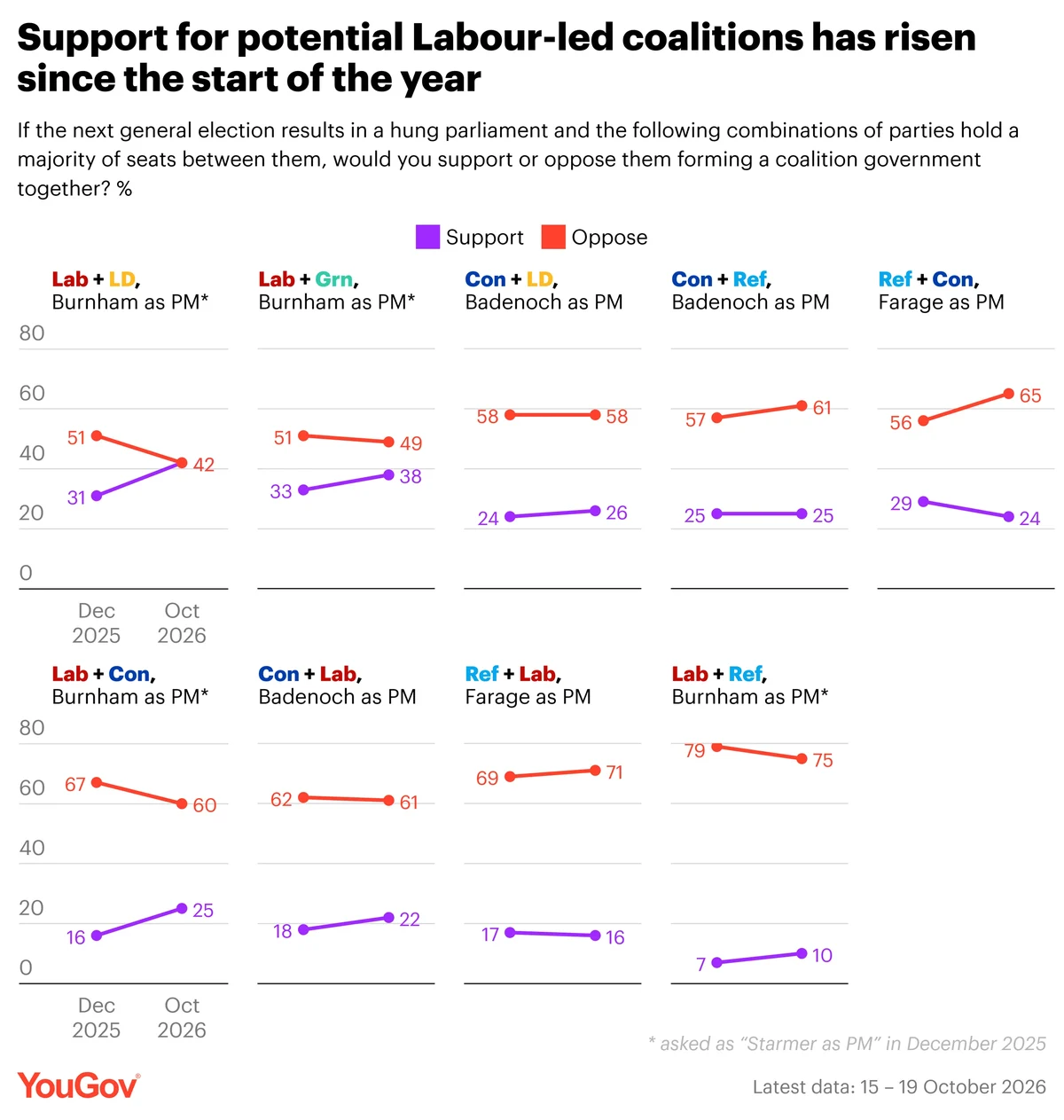
A coalition between Labour and the Lib Dems, in which Labour were the largest party and Andy Burnham was the prime minister, splits the public, with 42% saying they would be supportive of such a government being formed in a hung parliament and another 42% being opposed.
Adding the Greens into the mix, to create a three-party Burnham-led government, does not massively alter opinion, though slightly more Britons say they would be opposed to such a government being formed (44%) than would be accepting of it (39%).
Additionally including the SNP and Plaid Cymru to form a full rainbow coalition reduces support further, to 33%, with 49% opposed to such a combination. A Labour-led coalition with just the Greens attracts the same level of opposition, although 38% would be willing to back a Burnham-Polanski government.
Although none of these coalitions may have support from the public as a whole, they are all backed by at least 68% of those currently intending to vote Labour, 60% of those currently supporting the Greens and 57% of those favouring the Lib Dems.
Conservative-led coalitions with Reform UK or the Lib Dems
Conservative-led coalitions are less popular, with just a quarter of Britons (25-26%) being in favour of Kemi Badenoch presiding over coalitions with either the Liberal Democrats or Reform, relative to around six in ten (58-61%) being opposed to such arrangements.
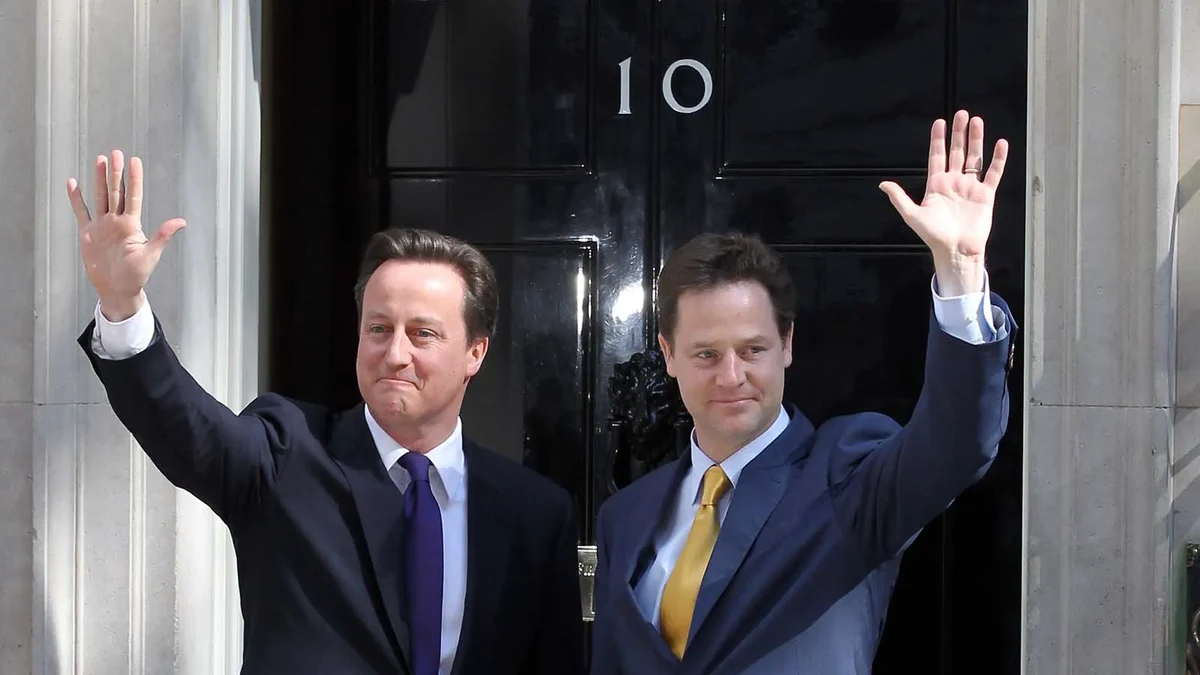
Most current Conservative supporters would support either arrangement, though more are in favour of the party forming a coalition with the Lib Dems (68%) than Reform (60%), and with at least 28% opposed to either coalition. Lib Dem supporters do not return the favour, with 58% of those currently intending to vote for the party opposed to a repeat of the Cameron-Clegg government, although 36% are in favour.
By contrast, 63% of Reform’s current supporters are supportive of the party being the junior partner in a Badenoch-led government, though a greater 87% would be supportive of a coalition with the Tories in which Reform were the largest party and Nigel Farage was at Number 10. Current Conservative supporters would not be so keen on this arrangement, with only 33% supportive of the Tories backing up a Farage-led government, while 64% would be opposed.
Regardless, just 24% of Britons would support such a government, while 65% would be opposed, leaving it one of the most unpopular potential coalitions polled.
Grand coalitions between Labour and the Conservatives
So-called ‘grand coalitions’ between the traditional parties of the centre-left and centre-right have become commonplace in some European countries. Here, there’s little appetite for a grand coalition within either Labour or the Conservatives, a lack of enthusiasm that’s shared by the public: just 22-25% of Britons say they would in principle support grand coalitions led by either Burnham or Badenoch, relative to 60-61% being opposed.
Half of current Conservative supporters (52%) say they would be able to tolerate one, if Badenoch was in the driving seat, relative to just 23% being supportive of a Burnham-led grand coalition. Among those currently intending to re-elect Labour, even a Burnham-led coalition with the Tories splits opinion 44% to 49%, with support falling to just 14% if Labour were the junior partner.
Reform UK and Restore Britain coalition
Also improbable, but more so on parliamentary arithmetic grounds, would be a coalition between the two rightmost notable parties in Britain: Reform and Restore Britain. While it would have its supporters, including 87% of those currently inclined to vote Reform, this would amount to just 23% of all Britons, with roughly two thirds (65%) opposed to such a right-wing government.
Coalitions between Labour and Reform UK
Perhaps the most unworkable of all the combinations polled, a coalition between Labour and Reform UK would please few people. Farage being prime minister in a Reform-Labour coalition is backed by only 16% of Britons, while a mere 10% are supportive of a Burnham-led version. The six point discrepancy is largely explained by the dramatically differing attitudes of Reform supporters to the two scenarios, with 53% prepared to accept a Farage-led coalition, but only 10% in favour if it were Andy Burnham overseeing the alliance.
Indeed, a Labour-led coalition with Reform is the most uniformly disliked coalition polled, being opposed by 82-86% of those currently intending to vote for any of the five major parties.
How has support for potential coalition governments changed?
Much like opinion towards the parties themselves, attitudes towards these potential coalitions are not static, and in some cases has shifted significantly since the end of last year.
For instance, public division on a Labour-led coalition with the Lib Dems (net support = 0) is a marked shift from last December, at which time net support for such a government stood at -20. Support has risen among those who voted for each of the five main parties in 2024, though the largest increase is actually among those who backed the Greens, among whom net support is up 54 points since December, likely reflecting their particularly distinct relative opinions of Keir Starmer and Andy Burnham.
Naturally, this growing enthusiasm for Labour-led coalitions among Green voters extends to a Labour-Green coalition, for which net support has grown 61 points since the end of the last year. However, there’s been no growth in enthusiasm among 2024 Labour voters (down seven points), in contrast to their 13 point increase in support for a coalition with the Lib Dems.
By contrast, Britons have become less inclined towards a Farage-led Reform-Tory coalition, with net support for such a government falling from -27 to -41 since last December. This includes 2024 Conservative voters going from being effectively divided on the question (+5) to being clearly opposed (-13).
Conservative voters have also become less receptive to a Badenoch-led Tory-Reform coalition, with net support falling 15 points since the end of last year to +23, even if those who voted Reform at the last election have become more open to the idea, with net support doubling to +22.
While the idea of a ‘grand coalition’ between Labour and the Conservatives still has few fans, a Labour-led version has become less objectionable with this year’s change in Labour leadership, with net support rising from -51 to -35. Attitudes to a Badenoch-headed red-blue coalition have shifted far less significantly (from -44 to -39).
Would Britons prefer a single-party government or a coalition?
Nonetheless, despite most Britons being open to at least one of the potential coalitions polled, the public’s preference is still for single-party governments. A majority of Britons (53%) would rather Westminster governments were formed by one party alone, relative to just 25% favouring a situation where two or more parties governed together in coalition.
A preference for one-party rule includes 73% of 2024 Conservative voters, 67% of those who backed Reform UK and 57% of those who voted Labour into power, as well as around four in ten of those who voted Lib Dem (43%) or Green (38%) at the last election.
Do Britons believe the UK still has a two-party system?
While trends in recent voting intention polls still have a way to go before a ‘return to a two-party system’ can be truly declared and the likelihood of a hung parliament falls, perceptions of the party system are already heading that way.
Labour and the Conservatives are now the only two parties that a majority of Britons believe are ‘main parties’ in the country today, with 86-90% putting them in this category, in both cases up eight points since May.
By contrast, having reached a peak of 61% in the aftermath of May’s devolved and local elections, the proportion of Britons who see Reform as a ‘main party’ has plunged 17 points to 44%. This is, though, still more than the 34% who see the Lib Dems as being in this category, the lowest level this parliament, and the 16% who believe the Greens are a ‘main party’, down eight points from May.
See the full results here and here
Methodology
- Sample size: An online survey of 4,591 adults aged 18+ living in Great Britain
- Fieldwork: 15 to 19 October 2026
- Commissioned by: YouGov
Click here for more information about how we carry out research
Interested in taking YouGov surveys? What do you think about Andy Burnham, Nigel Farage, Kemi Badenoch, and everyone else? Have your say, join the YouGov panel, and get paid to share your thoughts. Sign up here.
Interested in commissioning YouGov research? We connect in real-time with real people around the world to gather their thoughts, behaviours, and opinions, to ensure that our research data is powered by reality. Explore our survey services here.
Photo: Getty