
Experiment shows Euro membership and budget rebate substantially affect how many people say they would vote to rejoin
Key takeaways
- Terms of hypothetical rejoin deal make a great deal of difference to voting intention, with the rejoin vote lead ranging from +33 to -8 across 18 scenarios YouGov tested
- Whether or not the UK has to join the Euro or can get its budget rebate back substantially affect willingness to rejoin; whether or not we join the Schengen area makes little difference
- Conservative-Remain, Labour-Leave, and Lib Dem voters are particularly sensitive to the terms of a deal
In recent weeks, Andy Burnham has signalled that he would like to see the UK rejoin the EU. While the prime minister has ruled out any changes before the next general election, he has said it is possible that a future Labour manifesto could feature a rejoin referendum.
Recent YouGov research has already shown that when a generic rejoin referendum question is posed, 52% say they would vote to rejoin and 27% to remain out.
But it is not yet clear what the terms of a rejoin deal would look like. Radosław Sikorski, Polish foreign minister and deputy prime minister, has said that the UK would ‘not get the same deal as it had before’. However, Michel Barnier – the EU's former Brexit negotiator – has said that it is “perfectly possible” that the UK might have opt-outs on the Euro and Schengen, although he has predicted that a new rebate would be “off the table”.
To test how differing terms of a rejoin deal affect willingness to rejoin the EU, we ran a voting intention experiment asking how Britons would vote in a rejoin referendum using three different variables.
As part of the question, we provided a standard boilerplate statement of what rejoining the EU would entail…
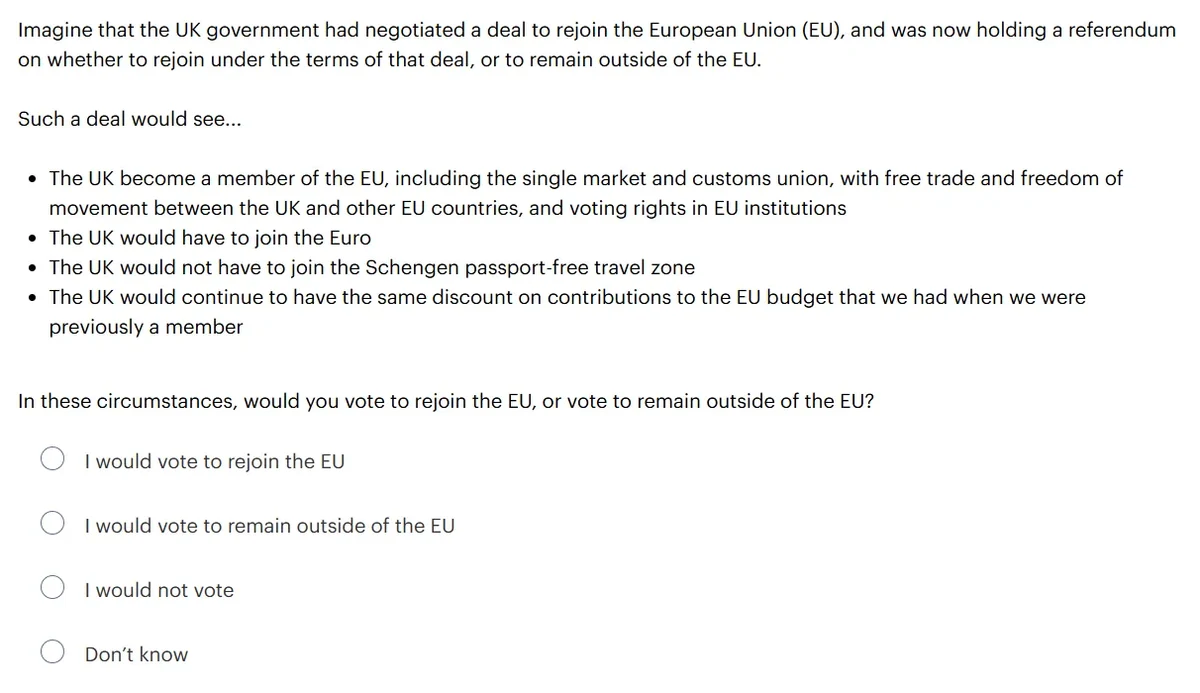
Imagine that the UK government had negotiated a deal to rejoin the European Union (EU), and was now holding a referendum on whether to rejoin under the terms of that deal, or to remain outside of the EU. Such a deal would see:
- The UK become a member of the EU, including the single market and customs union, with free trade and freedom of movement between the UK and other EU countries, and voting rights in EU institutions.
… as well as three variables that were randomly changed each time.
- Euro membership
- The UK would have to join the Euro
- The UK would theoretically have to join the Euro at some point in the future, but in practice would not do so
- The UK would not have to join the Euro
- Schengen membership
- The UK would have to join the Schengen passport-free travel zone
- The UK would theoretically have to join the Schengen passport-free travel zone at some point in the future
- The UK would not have to join the Schengen passport-free travel zone
- Budget rebate
- The UK would continue to have the same discount on contributions to the EU budget that we had when we were previously a member
- The UK would no longer have a discount on contributions to the EU budget like we had when we were previously a member
In these circumstances, would you vote to rejoin the EU, or vote to remain outside of the EU?
This amounts to 18 different combinations. Respondents were sequentially shown a random selection of three of these combinations and asked how they would vote each time.
Example of randomised question scenario as seen by respondents
Our research finds that the composition of the deal makes a great deal of difference to voting intention, with the results ranging from a rejoin lead of 33 to a remain out lead of eight points.
A return to the UK’s previous membership status – whereby we would regain our budget rebate, and continue to opt out of the Euro and Schengen – sees 56% of Britons saying they would vote to rejoin, versus 26% saying they would vote to remain outside the EU.
Strictly speaking this is not the highest rejoin scenario, with the variant where we joined the Schengen area getting a 58% vote for rejoin. However, the difference between the two is within the margin of error – as indeed it is for the 55% rejoin score for the same scenario except we are only theoretically bound to join Schengen but in practice would not do so.
At the opposite end of the table are the three scenarios whereby the UK would have to join the Euro as well as losing its rebate. In the cases where they are accompanied by not having to join Schengen, or only theoretically having to join Schengen, only 35-36% would vote to rejoin, compared to 43% who would vote to remain outside the EU. In the scenario where the UK would have to join Schengen, the result is closely split, on 40% rejoin vs 41% remain out.
Euro membership and the budget rebate noticeably impact willingness to rejoin the EU; Schengen membership does not
Looking across the scenarios shows that the rebate and Euro make a clear difference to support, while Schengen matters much less.
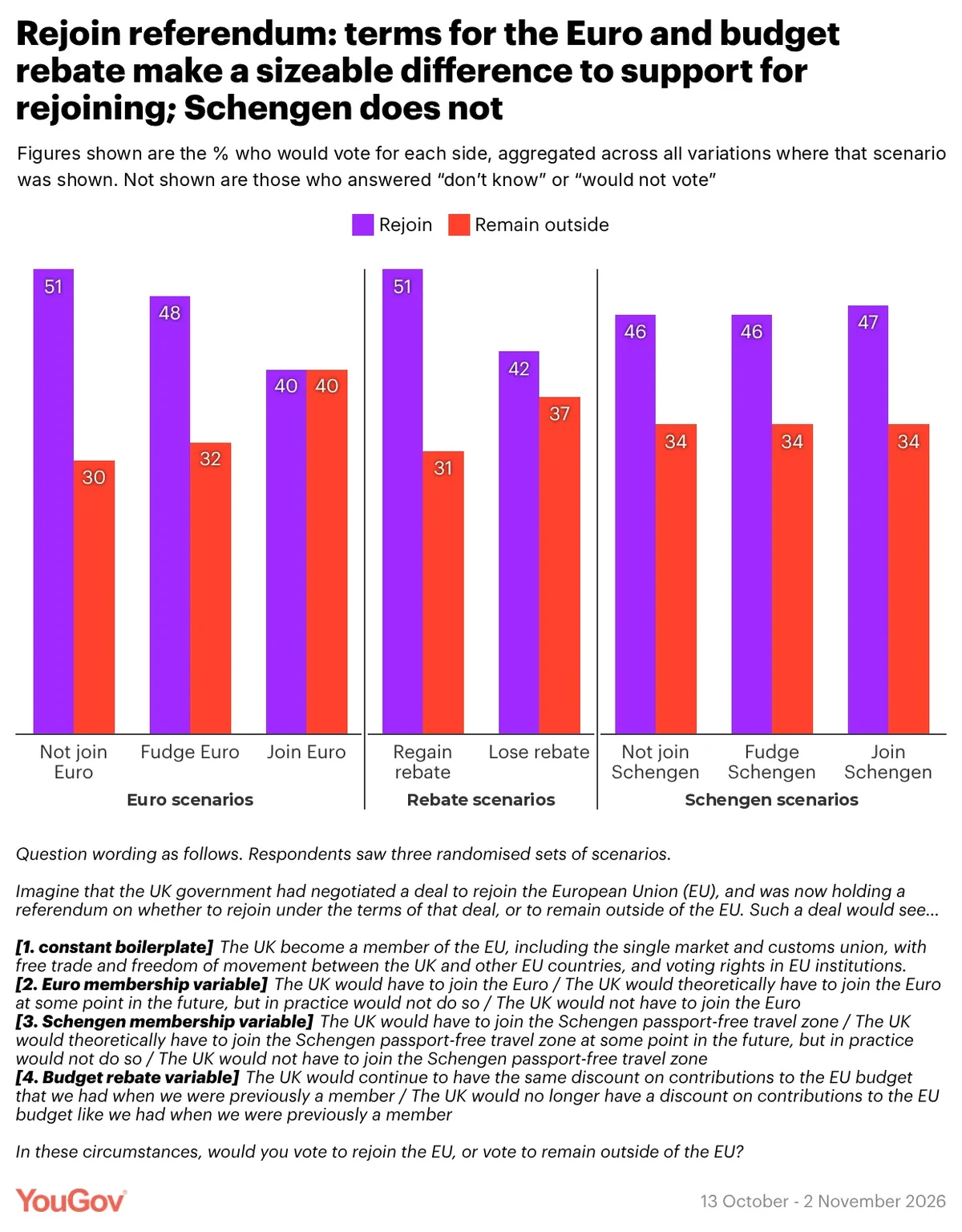
In scenarios where the UK would not have to join the Euro, the aggregate rejoin vote stands at 51%. This shifts only marginally to an aggregated 48% in the ‘fudge’ scenario where the UK commits to joining the Euro in theory but not in practice. The aggregate remain out vote shares stand at 30-32% in these scenarios.
However, in scenarios where the UK has to join the Euro, the aggregate rejoin vote plummets to 40%, with the remain out vote rising to 40%.
Likewise, in the scenarios where the UK would regain its previous EU budget rebate the aggregate rejoin vote stands at 51% and the remain outside vote just 31%; in scenarios where the UK does not regain the rebate this 20pt lead falls to just five points, at 42% to 37%.
By contrast, the Schengen variable barely moves the dial, with an aggregate rejoin vote of 46-47% across each Schengen scenario, and 34% saying they would vote to remain out in all three cases.
Which groups are the most sensitive to the specific terms of a rejoin deal?
To examine the sensitivity of various groups to the specific terms of the deal, we again turn to the aggregated data, so as to reduce noise caused by some of the smaller sample sizes. For demonstration purposes, we have only examined the change in vote based on the Euro membership scenarios, as these are the ones that resulted in the highest level of variation for almost all groups.
Among the whole public, the difference in the rejoin lead ranges from +21 in aggregated scenarios where the UK does not have to join the Euro to ±0 across those scenarios where it does.
At the top end, those voting groups that could be considered to have voted against type – i.e. 2024 Conservatives who had voted to Remain in 2016, and likewise Labour Leavers – are the most sensitive to the terms of the deal, particularly when it comes to Euro membership.
Among Tory Remainers, the rejoin lead stretches from an aggregate of +30 if the UK did not have to join the Euro to -7 if it did, a gap of 37pts. Likewise, for Labour Leave voters, there is a 33pt drop in rejoin’s lead from an aggregate of +11 when not joining the Euro to -22 if doing so.
Looking at singular voting groups only, Lib Dem voters are the most sensitive to the Euro aspect of the deal, with a 32pt range between the highest and lowest aggregate rejoin vote leads. This figure stands at 27pts among Labour as well as Remain voters, 25pts among Tory voters, and 22pts among Green voters. By contrast, the terms of the deal don’t shift Reform voters much, at only 11pts.
Attitudes towards the rebate tell a similar story, albeit with the degree of difference generally being smaller, with the most notable difference being the higher rank of Conservative Leavers, who are as sensitive to losing the rebate as they are to joining the Euro (a 17pt difference between scenario comparisons, in both cases).
Ultimately, this experiment shows that the widespread anti-Brexit sentiment in the UK should not be mistaken for an unconditional desire to return to the EU. The terms of a deal clearly have the potential to impact the vote shares at a future referendum, and both sides will seek to frame such terms to their advantage.
Of course, other factors will also be at play, including the competence of any eventual campaigns, but also events outside of the control of British politicians, such as the stance taken by EU and European leaders, most notably with the far-right Marine Le Pen in France - the current favourite to win the French presidency next year.
Methodology
- Sample size: An online survey of 12,150 adults aged 18+ living in Britain
- Fieldwork: 13 October - 2 November 2026
- Commissioned by: YouGov
Click here for more information about how we carry out research
Interested in taking YouGov surveys? What do you think about how Brexit has gone, rejoining the European Union, and everything else? Have your say, join the YouGov panel, and get paid to share your thoughts. Sign up here.
Interested in commissioning YouGov research? We connect in real-time with real people around the world to gather their thoughts, behaviours, and opinions, to ensure that our research data is powered by reality. Explore our survey services here.
Photo: Getty