Londoners support ULEZ for congestion charge area, but not for all of Greater London
Key takeaways
- Londoners support ULEZ applying to the congestion charge zone by 59% to 30%, but are divided on it being applied to the whole area within the North and South Circular roads, and oppose it applying to the whole of Greater London by 52% to 34%
- 44% of Londoners say ULEZ has contributed to improving air quality in the capital, though 34% believe it’s made no real difference
- 48% of regular car drivers in London believe transport policy tends to favour public transport users at their expense
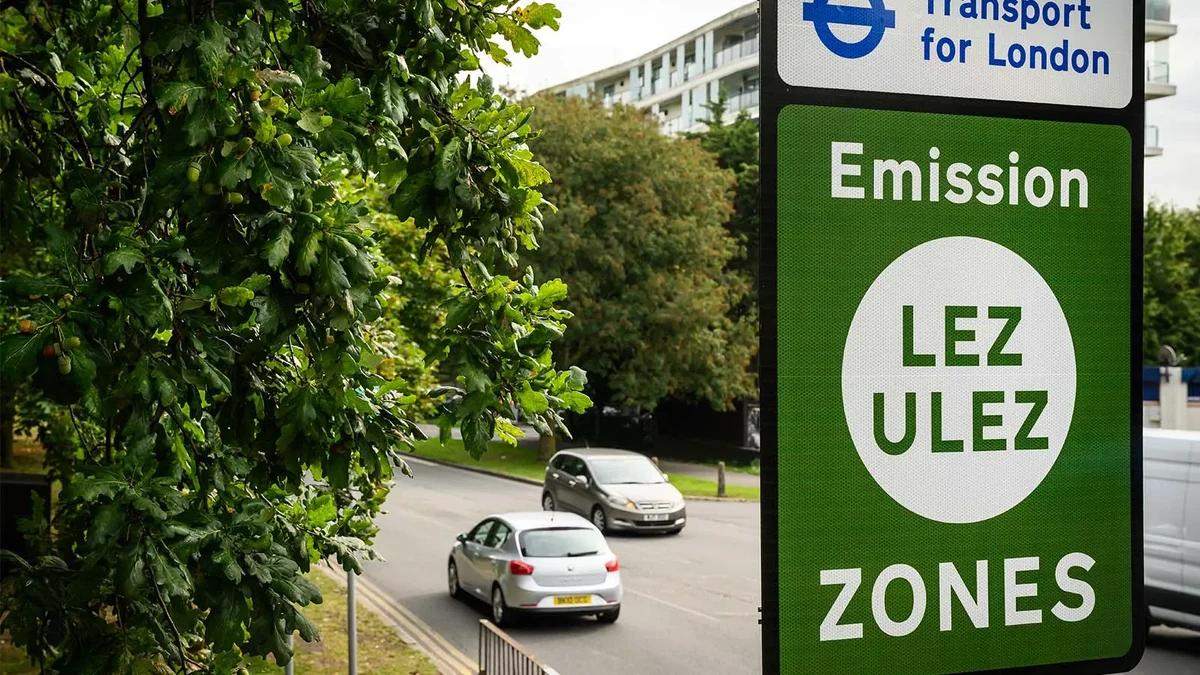
London’s Ultra Low Emission Zone (ULEZ) policy has proved controversial since it was first introduced, but particularly since it was expanded to cover all of Greater London in 2023. While the policy is viewed by experts as having contributed to the significant improvement in air quality in London over the last decade, opponents see it as unfair to drivers, particularly those who live around the borders of the region, with some even resorting to damaging the ULEZ cameras.
The political debate shows no sign of disappearing, with James Cleverly, the frontrunner to be Conservative candidate in the 2028 mayoral election, saying that – if he won – he would launch a full review of the policy, which requires vehicles that fail to meet certain emissions standards to pay a daily fee of £12.50 to travel in the zone. So what do Londoners make of ULEZ?
Do Londoners support ULEZ?
ULEZ as it was first introduced in 2019 is popular, with 59% of Londoners supporting it covering the central London congestion charge area, relative to just 30% being opposed to such a policy.
The same is not true, though, of the subsequent extensions. Londoners are divided 44% to 40% on ULEZ covering the inner London area between the North and South Circular ring roads, while being opposed by a clear margin of 52% to 34% to ULEZ covering the entirety of Greater London.
Attitudes vary in different parts of London, with those who live in outer London consistently more likely to oppose ULEZ than those who live in the inner London boroughs. This includes a full 58% of outer Londoners being against the policy applying to the whole of Greater London, relative to just 44% of inner Londoners, 40% of whom support a blanket ULEZ.
Whereas inner Londoners tend to support ULEZ applying to the area within the North and South Circulars by a margin of 48% to 32%, this intermediate level of the policy divides outer Londoners 42% to 45%. Nonetheless, clear majorities in both parts of the London region (57-60%) support ULEZ applying within the innermost congestion charge zone.
Another key divide in support for ULEZ is, perhaps unsurprisingly, whether or not you’re a regular driver. Even with the initial central London policy, just 50% of those who drive a car at least once a week support the zone applying, which, given the relatively small sample of people who drive this frequently in the capital, is not statistically significantly greater than the 43% who are opposed. By comparison, those who don’t drive or drive less than once a week support the policy by a ratio of three to one (66% vs 22%).
When it comes to an inner London ULEZ, regular drivers are opposed by 55% to 40%, in contrast to infrequent or non- drivers being supportive of the policy by a similar margin (50% vs 32%). Both groups are opposed to ULEZ covering all of Greater London, though this is by 65% to 30% among regular drivers and by just 47% to 37% among other Londoners.
What impact do Londoners believe ULEZ has had?
Earlier this year, Sadiq Khan hailed the success of ULEZ by pointing to an independent study that found a significant reduction in toxic air pollution and related deaths in the capital since the policy was introduced, though one of the report’s authors stated that “despite this progress, air pollution remains a serious public health risk”.
Londoners tend to feel that ULEZ has contributed to improving air quality in London, though this perception is far from universal. More than four in ten (44%) associate ULEZ with a positive impact on the city’s air quality, though with 34% saying that, as far as they are aware, ULEZ has made no real difference, and 19% saying they “don’t know” about any impact.
There is a clear relationship between this perception and support for ULEZ.
Londoners who understand ULEZ to have improved air quality back all three stages of the policy, including being twice as likely to support it applying to the whole of Greater London than to oppose what is the current extent of the zone (62% vs 31%).
By contrast, those who believe that the policy has made no difference to air quality oppose ULEZ in all its forms, including being against it applying to just the congestion charge zone within London’s innermost ring road by 54% to 41%.
Perhaps less intuitive is the relationship between the perception of ULEZ’s impact on air quality and people’s feeling about the overall package of policies intended to improve air quality in London.
Londoners as a whole are fairly evenly split between those who feel such policies have gone too far (23%), are about right at present (26%) and have not gone far enough (27%). However, those who believe ULEZ has helped improve London’s air quality are around twice as likely as those who feel it’s had no impact to believe that such policies have still not gone far enough (38% vs 21%).
Nearly half (45%) of those who think ULEZ has not improved air quality believe policies to improve air quality have gone too far, relative to a mere 8% of those who see ULEZ as having contributed to cleaner air in London.
Do London car drivers believe there’s a “war on the motorist”?
James Cleverly’s pledge to launch of full review of ULEZ was part of his wider platform of ending what he termed Labour’s “war on the motorist”, accusing Sadiq Khan of running a “vindictive assault” on drivers.
Belief that motorists are getting the short end of the wedge in London transport policy is, though, a minority view, with just 34% of Londoners feeling that policy has tended to favour public transport at the expense of motorists, though this does rise to 48% of regular car drivers, among whom it is the plurality opinion.
A further third of the capital’s residents (33%), including 29% of regular car drivers, think there’s been no particularly strong bias in policy either way. Only 8% of Londoners feel it’s motorists who’ve been the main beneficiaries of the city’s transport policies.
See the full results here
Methodology
- Sample size: An online survey of 1,257 adults aged 18+ living in Greater London
- Fieldwork: 1 to 8 October 2026
- Commissioned by: YouGov
Click here for more information about how we carry out research
Interested in taking YouGov surveys? What do you think about ULEZ, London in general, and everything else? Have your say, join the YouGov panel, and get paid to share your thoughts. Sign up here.
Interested in commissioning YouGov research? We connect in real-time with real people around the world to gather their thoughts, behaviours, and opinions, to ensure that our research data is powered by reality. Explore our survey services here.
Photo: Getty