
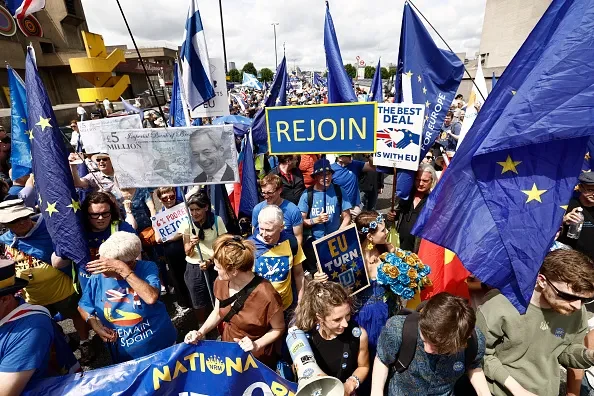
The public think a rejoin referendum is acceptable within five years, but are split on whether trying to return to the EU is a priority
Key takeaways
- 54% of Britons think it would be acceptable to have a rejoin referendum in the next five years
- But public are split on whether attempting to rejoin the EU should be a priority for the government: 37% say it is the right priority, 45% say it is not
- Most Britons think the process of rejoining the EU would take five years or less
- 47% of Britons think rejoin side would win in a referendum, only 13% think remain out would win
- 58% of Britons think Britain was wrong to vote to leave the EU, and 63% see Brexit as a failure
- 49% think rejoining the EU would make the UK better off economically, but only 31% think they would personally be better off financially as a result
On Friday Andy Burnham will take part in the second UK-EU summit in Brussels, with an aim to “push for deals to cut costs and red tape for British farmers and businesses, support industry and boost growth”.
The summit comes amid a backdrop of renewed discussion on the UK’s relationship with the EU, with Burnham having ignited speculation that he could at some point seek to bring the UK back into the European fold, potentially with a referendum commitment in Labour’s next election manifesto.
That being the case, new YouGov research explores public opinion regarding a new referendum, including whether the public see it as acceptable to hold one, if they consider it a priority, and what they think the result would be.
Most Britons think a rejoin referendum in the next five years would be acceptable
Our survey finds that 54% of Britons think, in principle, that it would be acceptable to have a rejoin referendum in the next five years, with only 33% who would deem it unacceptable.
In fact, these figures are little different to the number who think it would be acceptable to hold another vote in the next 10 years (52%) or the next 25 years (51%).
We might otherwise have expected this overall acceptable figure to increase for the longer time periods, as eurosceptic opponents concede that enough time has passed that it is legitimate for another vote to be held.
Indeed, we do actually see this happening, with the number of 2016 Leave voters becoming more accepting as the timescales increase, from 32% for a referendum in the next five years to 44% in the next 25 years (this latter figure actually representing the plurality opinion for that time period).
But at the same time this figure is counteracted by 2016 Remain voters becoming less likely to say another referendum is acceptable, from 75% within the next five years to 67% for 10 years and 59% for 25 years. Clearly this group are expressively responding a desire to have a referendum as quickly as possible.
Britons are divided on whether attempting to return to the EU is a priority at this time
While YouGov research has shown clear support for rejoining the European Union, do the public see it as a priority at the current time?
Britons are slightly more likely to say rejoining is not a priority right now (45%) than to think it is (37%).
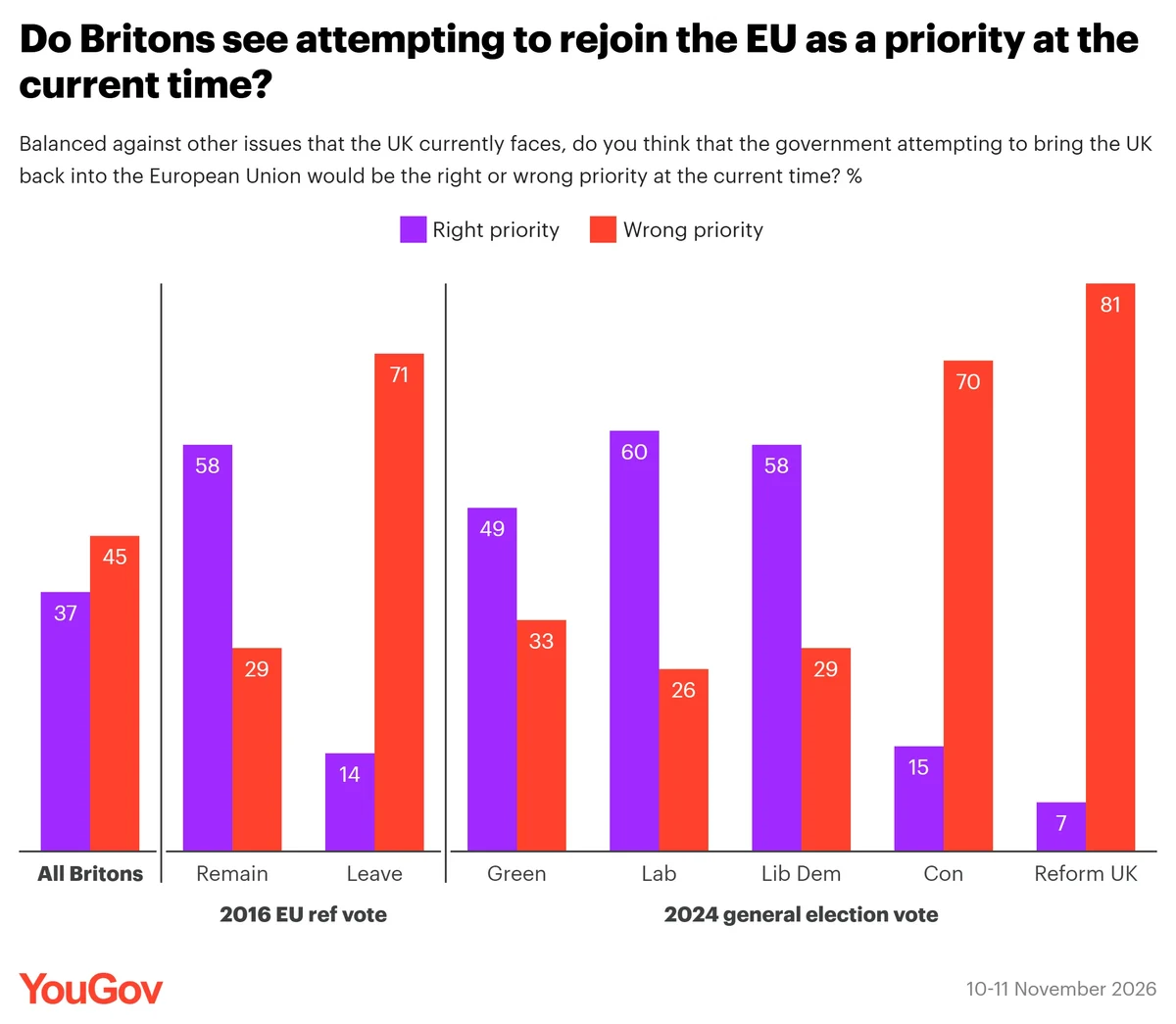
Seven in ten Leave voters (71%) say rejoining is not currently a priority, while a smaller majority of Remain voters think it is (58%) – almost three in ten Remain voters think rejoining should not be top of the agenda right now (29%).
Among 2024 Labour voters, 60% think rejoining should be a priority at the moment, alongside 58% of Lib Dems and 49% of Greens.
YouGov’s ‘most important issues’ tracker has likewise shown that Britain’s relationship with the EU is not a top issue for the public at the present time, with only 14% saying so as of our most recent wave – a far cry from the 52% who say the economy and 46% immigration.
(Our standard most important issues tracker used the answer “Europe” until early July 2016 and then “Britain leaving the EU” thereafter; a separate test using the alternative wording “Britain rejoining the EU” saw 15% pick that option – within the margin of error of the standard wording)
How long do Britons think the process of the UK rejoining the EU would be likely to take?
Last week Michel Barnier, the EU’s chief negotiator during Brexit, suggested that the UK could rejoin the EU in as little as four years. The UK would be the first country to re-join the EU, so there is no clear guide for how long the process would take, but timescales from application to join the EU to acceptance have ranged from less than three years (for Finland, starting 1992) to more than 22 years for North Macedonia (starting 2004).
So what are expectations among the British public?
The most common answer from the timescales we provided is that the UK could be back in the fold within five years, with 28% taking this particular view. About as many people (30%) think it would take even less time than this, with 13% thinking it could happen within three years, another 13% thinking it would take no more than two years, and 4% expecting the whole affair could be wrapped up within a year.
By contrast, only 17% give a longer timescale than five years.
Britons generally expect that the rejoin side would win a referendum
Asked which side they think would triumph, 47% of Britons think that the rejoin campaign would be the victors, including 18% who think this is “very likely”. Only 13% expect the campaign for the status quo would win, while 24% deem the situation currently too close to say.
Most Remain voters (58%) think that the rejoin side would win, while Leave voters are split between the 34% who think the same and the 31% who think things are too close to call – a further 20% think the ‘remain outside’ campaign would triumph.
Britons think the EU would demand the UK join the Euro and Schengen, and refuse to give us back our rebate
Previous YouGov research has shown that the terms of a rejoin deal could make a great deal of difference to public willingness to return to the EU. Our survey finds that two thirds of Britons (67%) think that the EU is likely to require that the UK join the Schengen passport-free travel zone, and 61% think it likely we would lose our previous rebate.
Fewer (49%) think we would likely have to join the Euro, although this still outnumbers the 33% who don’t think this is likely.
What do Britons think a rejoin referendum process should look like?
Previous YouGov research has shown that the public overwhelmingly say that a new referendum should be required before the UK rejoins the EU, but what do they think that process should look like?
The public are relatively split between the three options we offered.
Three in ten (30%) think the UK should first apply for a deal and negotiate terms, and then subsequently have a referendum on whether or not to join on those terms.
But 21% think the referendum on whether to rejoin should come first, and, in the event that the public votes to return, the government should subsequently apply, negotiate terms, and join on the basis of whatever they agree.
And 26% want to see referendums take place at both stages, with a first referendum to establish whether or not we should rejoin in principle, after which point the government would negotiate terms with the EU (assuming a rejoin victory in the first referendum), and then a second referendum would be held on whether or not to join those terms.
The plurality preference among Remain voters (38%) is for the one-referendum-at-the-end option, while for Leave voters it is the two-referendums option, at 36%.
What do Britons think rejoining the EU entails?
While it may be politically expedient for a government seeking to return to the EU to hold a referendum before doing so – in order to prevent criticisms that they are unilaterally overturning the will of the people as expressed in 2016 – they are under no obligation to do so.
However, the public themselves are not aware of this fact. Four in ten (41%) are under the impression that a referendum would be legally required before the UK could rejoin the EU, with only 24% correctly identifying that this is not the case.
While the public are aware that rejoining the EU would mean freedom of movement from the EU to the UK (75%) and vice versa (74%), and that tariffs and customs checks on goods flowing each way would be scrapped (59-60%), there is more confusion on independent trade policy.
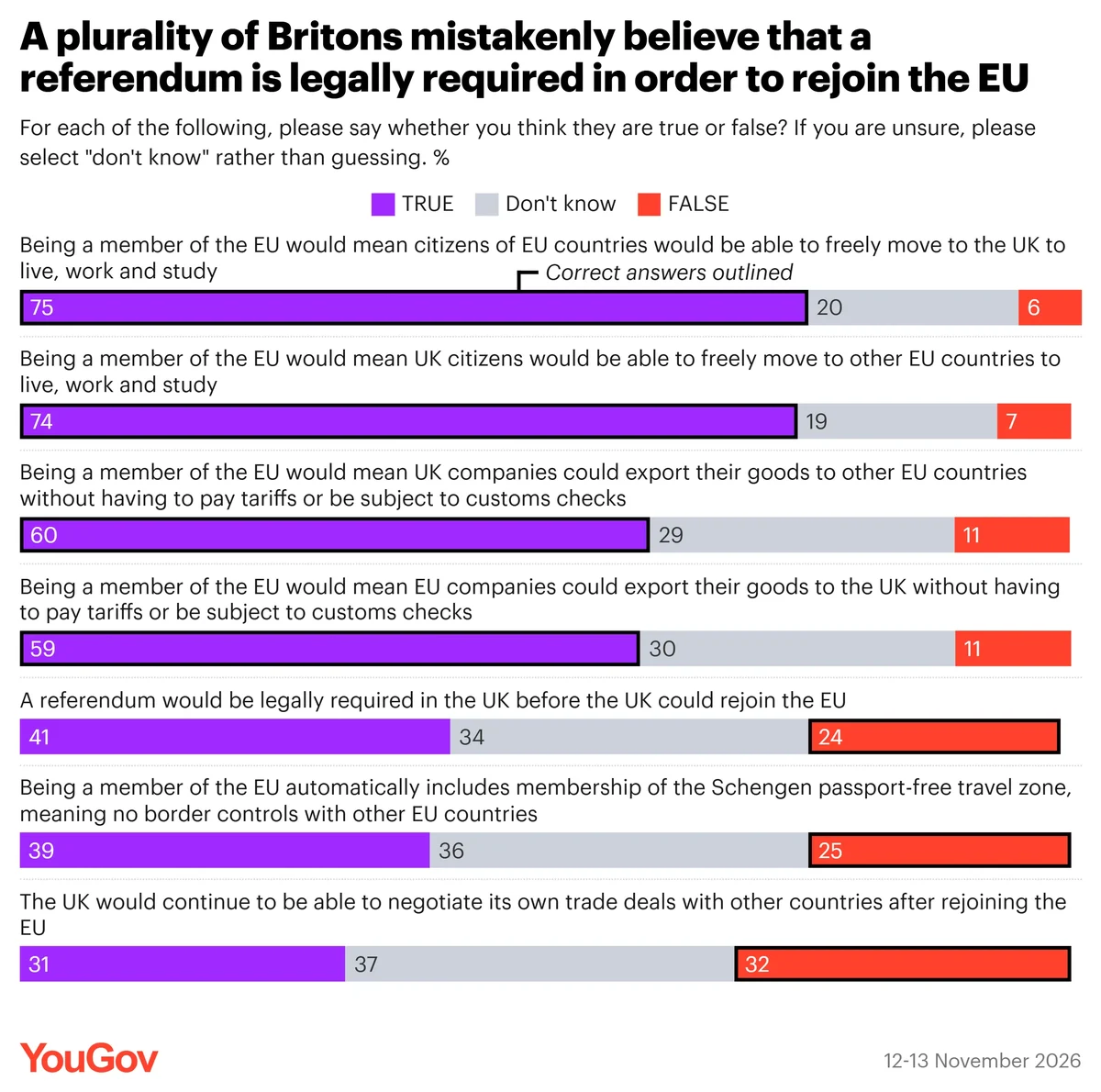
Despite having been a talking point of the original 2016 referendum campaign, ten years on the public are split between the 31% who think the UK would be able to continue to negotiate its own trade deals with other countries after rejoining the EU, and the 32% who correctly state that this is not the case.
Our final true/false question also identified that a significant portion of the public (39%) mistakenly believe that being in the EU means automatic inclusion within the Schengen passport-free travel zone – despite the UK having never participated when it was previously a member. Only a quarter (25%) correctly identify that Schengen membership is not an inextricable part of being in the EU.
Do the public support joining the Euro and Schengen in general?
While our polling has shown that the prospect of having to adopt the Euro weakens support for rejoining the EU, and that entering the Schengen travel agreement makes little difference, to what degree do the public support those policies in general?
Only 19% of Britons say they support joining the Euro, regardless of whether it is a condition of joining the EU, while 70% are opposed. Even among the most supportive voter groups, the number in support (27-31%) is still only half the level of opposition (59-65%).
In contrast, the public back joining the Schengen passport-free travel zone, which would remove border controls between the UK and EU countries. Half (52%) say they would support such a move – regardless of whether or not it is connected to rejoining the EU – while a third are opposed (33%).
Schengen divides the electorate, with 66-75% of Remain, Labour, Lib Dem and Green voters in support, but only 21-33% of Leave, Conservative and Reform voters saying the same.
Most Britons think Brexit has been a failure, and that it was the wrong decision
Our latest tracker data shows that 58% of Britons now say that the UK was wrong to vote to leave the EU, with only 32% still thinking it was the right decision. Among Leave voters, one in five (20%) now think the decision to leave was the wrong one, as well as 29% of 2024 Tories and 12% of 2024 Reform voters.
More than six in ten Britons (63%) brand Brexit more of a failure than a success, with only 9% holding the opposite view. One in five (21%) see it as being neither.
Almost nine in ten Remain voters (88%) see Brexit as primarily a failure, alongside 31% of Leave voters – although this latter group are most likely to say it has been neither a success nor failure, at 42%. Nevertheless, only 21% of Leave voters deem Brexit a success.
What impact do Britons think rejoining the EU would have?
Of the six areas we asked about – all direct mirrors of questions we asked about the perceived impact of Brexit before the UK left the EU – the largest benefits to rejoining the EU are economic, with 49% thinking the economy would be better off and 46% thinking it would be good for jobs.
Those who voted against separation from the continent in 2016 are especially likely to think the economic impact would be positive (74%) and likewise the effect on jobs (70%).
However, with Andy Burnham saying that one of the key tests for returning to the EU is whether it would make a tangible difference to people's own lives, it is notable that only 31% think they personally would be better off financially if we rejoin the EU – the lowest of the six questions we asked about.
Slightly more (36%) think that rejoining the EU would make no real difference to their own personal finances. Even among 2016 Remain voters, fewer than half (44%) think that they would personally benefit financially from a return to the EU.
Elsewhere, Britons are also relatively split on the impact of rejoin on the NHS and British influence internationally. Similar numbers say the impact on the health service would be positive (34%) as say there wouldn't really be any (30%). Likewise, for the 37% who think rejoining the EU would boost British influence, 34% don't think it would have an impact one way or the other. Among those who voted Remain in 2016, 53% think the impact on the NHS would be positive and 60% say the same for British influence.
When it comes to immigration, the public are again split between 37% who think rejoining the EU would lead to greater levels of migration, and 36% who think it will not change much. Of the six areas we asked about, this is the only one for which a majority of 2016 Leave voters came down on one side of the argument or the other, with 58% saying they think rejoining the EU would lead to more immigration.
See the full results
Methodology
- Sample size: Online surveys of 2,258 adults, 2,019 adults, and 2,178 adults aged 18+ living in Britain
- Fieldwork: 2-3 November, 10-11 November, and 12-13 November 2026
- Commissioned by: YouGov
Click here for more information about how we carry out research
Interested in taking YouGov surveys? What do you think about how Brexit has gone, rejoining the European Union, and everything else? Have your say, join the YouGov panel, and get paid to share your thoughts. Sign up here.
Interested in commissioning YouGov research? We connect in real-time with real people around the world to gather their thoughts, behaviours, and opinions, to ensure that our research data is powered by reality. Explore our survey services here.
Photo: Getty