



The government has recently been recommending that every household keeps at least three days' worth of food and water at home, alongside items such as a radio.
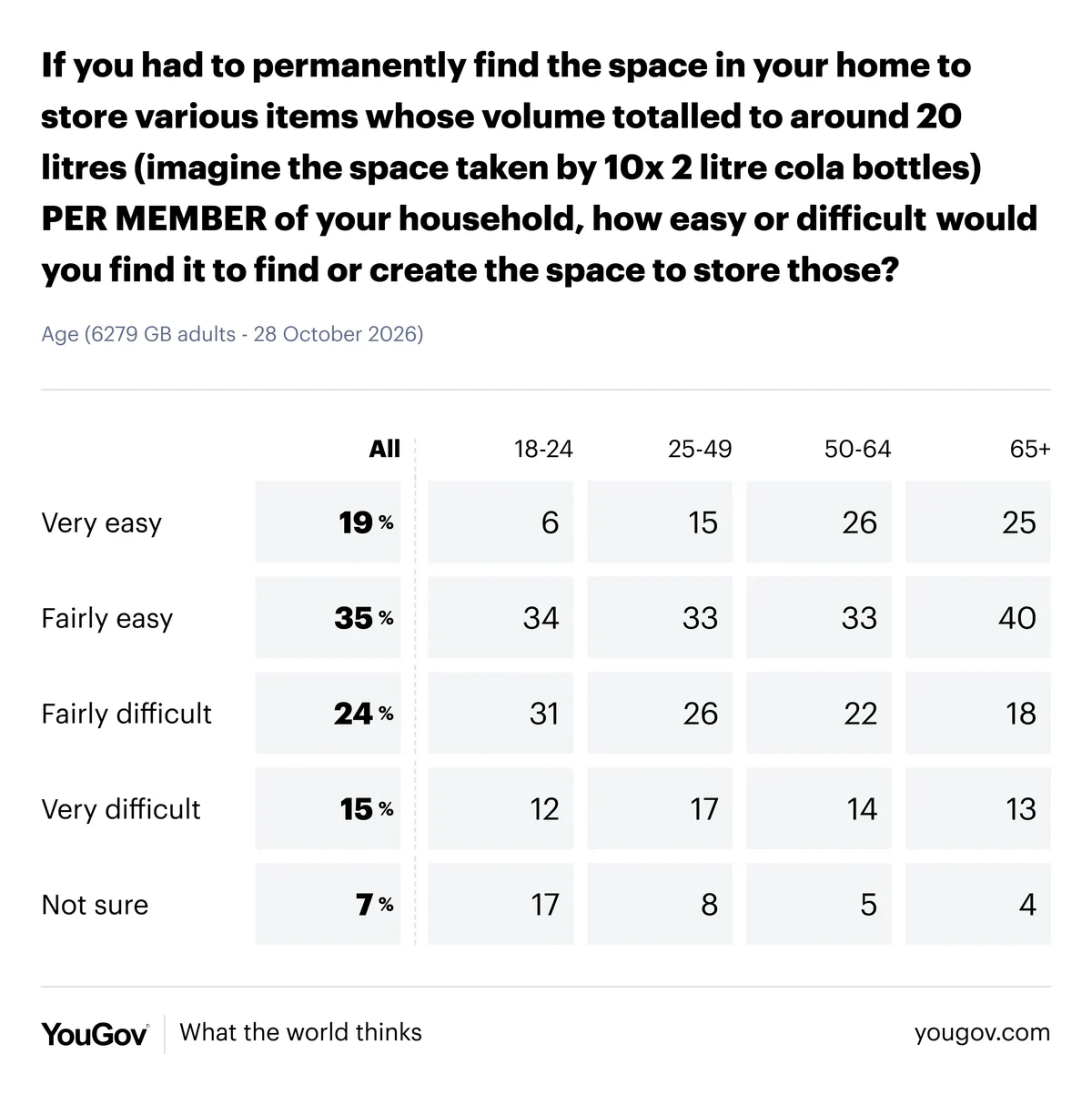
Using a rough guide of 20 litres of volume per member of the household, we asked the public how hard they would find it to make or create space to permanently store emergency provisions
One in five Britons (19%) say it would be very easy to do so, while a further 35% say it would be fairly easy
While for 24% it would be fairly difficult, and another 15% would find it very difficult
Younger Britons are much less likely to say it would be “very easy”, ranging from 6% of 18-24 year olds to 15% of 25-49 year olds and 25-26% of the over-50 age groups
But what do Britons make of the advice? To find out, we used our new YouGov AI Interviewer tool to ask respondents: “What do you think about the government's recommendations that everyone should stockpile at least 3 days worth of food and water in their home, alongside other items like radios?”
The AI agent then conducted interviews with each respondent, following up on their responses, in order to provide ‘the why’ behind what Britons think. Our qualitative analysis of attitudes, including quotes, can be found below, along with examples of respondent interviews in their entirety.
A sensible precaution in an uncertain world
Many think keeping a few days' worth of supplies is simply sensible, pointing to storms, power cuts, cyber attacks and a less stable world as reasons to be ready.
- “It seems sensible to have some stored items since some of the country’s infrastructure has not been well maintained, weather patterns are more unpredictable and the world seems politically less stable.” – Woman, 55+
- “It makes sense. We are in a more dangerous time than any since the late 70s. It is a cold shower for a society that has become complacent about security. Being ready for as many eventualities as possible makes sense.” – Man, 55+
- “being in the north west during storm Austen. Was difficult to go out and buy shopping etc, and there were large puddles and parts of the university flooded” – Man, 18-24
- “Lets say Russia attacks our digital systems, banks are gone. Supermarkets are gone. In this case I will use stockpiles if I cannot access my bank or supermarket” – Man, 18-24
Panic buying and memories of Covid
Some worry that the advice will set off a rush on the shops, or say it already has. Some also compare it to the pandemic, when the public were told not to stockpile.
- “It will encourage panic buying like during the pandemic.” – Woman, 18-24
- “I think it is frightening people and the shelves in the supermarket of loo paper are empty AGAIN” – Woman, 55+
- “It's causing panic buying in some people and, like during the covid pandemic, it brings out the worst in people - the "I'm alright Jack, blow anybody else" effect.” – Woman, 45-54
- “We were advised to stop stockpiling when it was covid, so why is it ok now?!” – Woman, 45-54
Scaremongering and an overreaction
Some dismiss the advice as scaremongering, or as unnecessary for where and how they live. Others put the alarm down to the way the media has covered it rather than the advice itself.
- “Not doing any of it, won't live my life being scare mongered” – Woman, 55+
- “It’s scaremongering - it’s unlikely to be needed in the near future here” – Man, 55+
- “Doesn’t interest me, I live in central london and we don’t have power outages and there are loads of shops nearby so I’m not worried” – Man, 25-34
- “The media has used it to pedal an alarmist narrative” – Man, 18-24
Why now?
Some are unsettled less by the advice than by its timing and the lack of explanation, and some suspect the government knows of a threat it isn't sharing, and want to be told what the advice is preparing them for.
- “The fact that we’re vaguely being told to stockpile with no larger reason or public motive” – Man, 18-24
- “I think the government know more than they are telling us.it has been mentioned we should store more food and water for bad weather, but as we’ve been having storms my whole life , my question is what has changed” – Man, 55+
- “We have had international unrest before. The gov has never before told us to stockpile supplies.” – Man, 55+
- “I think that’s fine. But they should’ve provided more specifics. And I think it’s notable that they’ve not really commented on what’s driving this recommendation. People deserve to understand the threats” – Woman, 35-44
Cost and space
Some say the advice assumes money and room that a lot of households don't have. Those in small flats, shared or social housing, and those already struggling with the cost of living, see it as out of reach.
- “i think this is insane and i don't even have the money to be buying all of that in the first place” – Woman, 18-24
- “How do I pay for it on a fixed state pension” – Woman, 55+
- “I think it is really difficult when you live in a very small social housing Home by myself with no garage space we don’t even have a garage. We don’t even have a garden shed. There’s no room to store anything at all.” – Woman, 45-54
- “My house is already overcrowded, I'd need to buy a shed to put this stuff in.” – Man, 55+
Already prepared
Among those who say they already keep supplies at home, or have acted on the advice, some say the habit is long-standing, citing rural living, a well-stocked larder handed down from parents, or simply buying in bulk.
- “Very sensible idea. As we live in a rural area where supermarkets are over an hours' drive away we already do this. Both our water and electricity go off occasionally anyway” – Woman, 55+
- “I GENERALLY HAVE A GOOD SUPPLY OF FOOD AND DRINKS ANYWAY AS I FOLLOWED THE EXAMPLE OF MY GRANDPARENTS AND PARENTS IN HAVING A WELL STOCKED LARDER AND FOOD CUPBGOARDS” – Woman, 55+
- “Already have that tend to buy stuff in bulk since it’s cheaper” – Man, 18-24
- “I have taken the advice and spent about £40 on stocking up on essentials and I am keeping them in our garage. I haven’t yet able to wind up radio as I believe they are going to be a premium cost at the moment with so many people wanting to buy them, but I will get one in the next few weeks.” – Woman, 45-54
The government should do more itself
Some feel the advice shifts responsibility onto households. They want the government to invest in infrastructure and defence, or to hold and hand out supplies itself, particularly for those who can't afford them.
- “It's typical nanny state. Tell me the level of risk and leave it to me to decide what I need to store. For a serious attack on infrastructure, 3 days' supply will be inadequate. Do your job as a government - invest in resilience and defence so that this stockpiling is unnecessary.” – Man, 55+
- “They should provide people, the families that can't afford to in specific, with those emergency stockpile for free.” – Woman, 18-24
- “I do not agree I think local police stations should have containers filled with emergency provisions for their population.” – Man, 55+
- “I think that it’s designed to instill fear amongst the population, but the fear is misplaced. If I need a stockpile of food it will be due to failing infrastructure, not a hostile foreign nation. That will be the fault of the UK Government for the past 30+ years” – Man, 25-34
Other themes
Some also raised whether three days is long enough, food going past its use-by date, how to cook without power, and the UK catching up with other European countries.
- “I agree with the idea but find 3 days an odd choice. I wouldn’t consider a situation requiring 3 days or less of food and water an emergency.” – Man, 25-34
- “seems a bit over the top. I used to stock up on certain items but I kept finding that they began to get close to the best before date so had to use them” – Man, 55+
- “If you have a power cut you can’t use most of your things to cook items, it also will create people panic buying like covid times” – Woman, 25-34
- “good idea we have been behind europe on this issue” – Man, 55+