First YouGov MRP since Andy Burnham became PM projects Labour would win 241 seats, while the Conservatives would win 130 and Reform UK 123
Key takeaways
- Labour would be the largest party in a hung parliament, were an election held tomorrow, winning 241 seats in our model’s central estimates
- Such a result would be a net loss of 170 seats for Labour on the 2024 election, but is up from our MRP this time last year, which projected the party would be reduced to just 144 seats and showed Reform UK within touching distance of a majority
- Reform UK are now neck-and-neck with the Conservatives, with the parties respectively on 123 and 130 seats in our median projection
- Our central projection shows the Lib Dems on 71 seats, the SNP on 40, Plaid Cymru on 15, and the Greens on nine
- 37% of constituencies are decided by margins of five points or less in our central estimate, with this rising to 67% of seats projected to be won by Reform UK
YouGov’s first MRP model since Andy Burnham entered Downing Street projects that, if an election were being held tomorrow, Labour would be the largest party in a hung parliament, though would likely need the help of at least two additional parties to form a majority in the House of Commons.
The central projection of our latest model, which uses data from nearly 17,000 Britons in fieldwork from 23 August to 18 September 2026, shows Labour on 241 seats, substantially down from the 411 the party won in the 2024 election (a net loss of 170) and 85 seats short of the 326 required for an overall majority. Nonetheless, these figures do represent a significant recovery from this time last year, when our MRP’s central estimate showed Keir Starmer’s Labour leading in just 144 seats.
By contrast, this fresh model shows Reform UK falling back sharply over the last year, when they were within touching distance of a majority. The median estimate of today’s MRP shows Nigel Farage’s party winning in 123 constituencies, 188 fewer than in our September 2025 version, though this is still a large gain on the five they won in 2024.
Reform’s main challenge has now returned to being whether it can become the largest party on the right, with the Conservatives taking a similar 130 seats in our model’s central estimates. Such a result shows little progress on the Tories’ 2024 result (121 seats), though is a turnaround from last autumn, when our model projected they could fall to being the fourth largest party in parliament on a mere 45 seats.
As always, our model overall projects a range of outcomes, though even Labour's upper bound result of 274 seats, the most optimistic case for the party, still leaves it 52 short of an overall majority. Nonetheless, Labour's lower-end estimate of 197 seats is still greater than our model’s highest plausible expectations for either Reform (166) or the Conservatives (150).
If an election were occurring tomorrow, this latest data suggests Reform could expect a minimum of 86 seats, while a lower-end estimate for the Conservatives of 105 seats means that a worst-ever result for the party could not be ruled out.
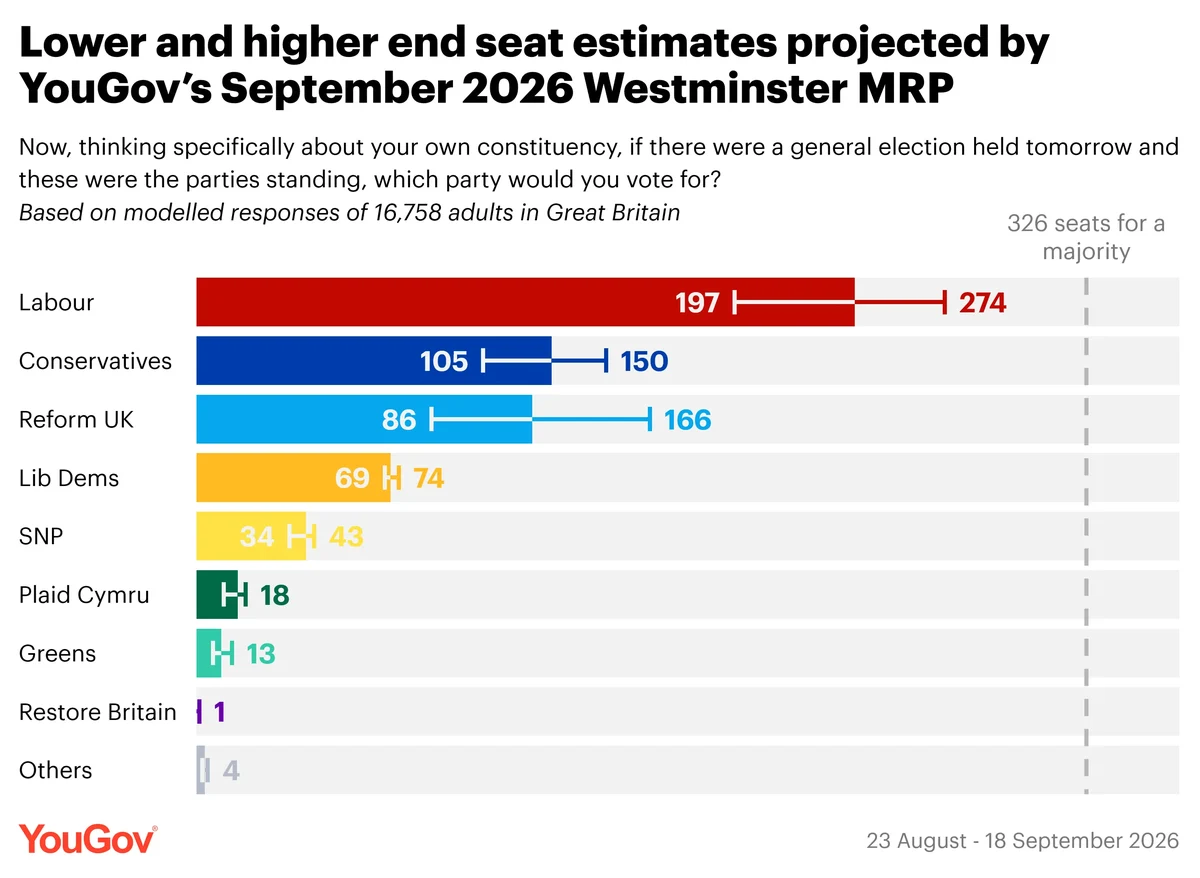
What our model leaves is a scenario where Labour would need the help of other parties to pass its legislation in the House of Commons, with such a role almost certain to be filled by the other ‘progressive’ parties.
The largest of these would be the Liberal Democrats, who nearly replicate their 2024 election result in our model, holding 71 constituencies in the central estimate, with a narrow overall range of between 69 and 74 seats. However, the Lib Dems alone are unlikely to be sufficient for a majority, with Labour and the Lib Dems winning more than half of MPs between them in just 33% of our model’s simulations.
After losing support in recent months, the Greens are not currently set to prove much of an addition to a left-of-centre majority, though are on track to make modest gains at a future election, leading in nine seats in our MRP’s central projection, up from the four won two years ago.
Instead, short of a small number of sympathetic MPs from Northern Ireland, whose partisan composition is not calculated by our model, it’s likely that Labour would need to turn to one or both of the Scottish or Welsh nationalist parties in order to secure an overall majority.
Both the SNP and Plaid Cymru are on course to mirror their victories in May’s devolved elections, which were accurately predicted by YouGov’s MRPs. Having fallen to nine seats in the 2024 election, our model projects the SNP would win 40 seats today, while Plaid Cymru would nearly quadruple their Westminster representation to a record 15 MPs.
In 82% of our model’s simulations, Labour, the Lib Dems and the SNP hold a majority of seats in the House of Commons, while all five major ‘progressive’ parties hold a collective majority in 98% of the MRP’s projections.
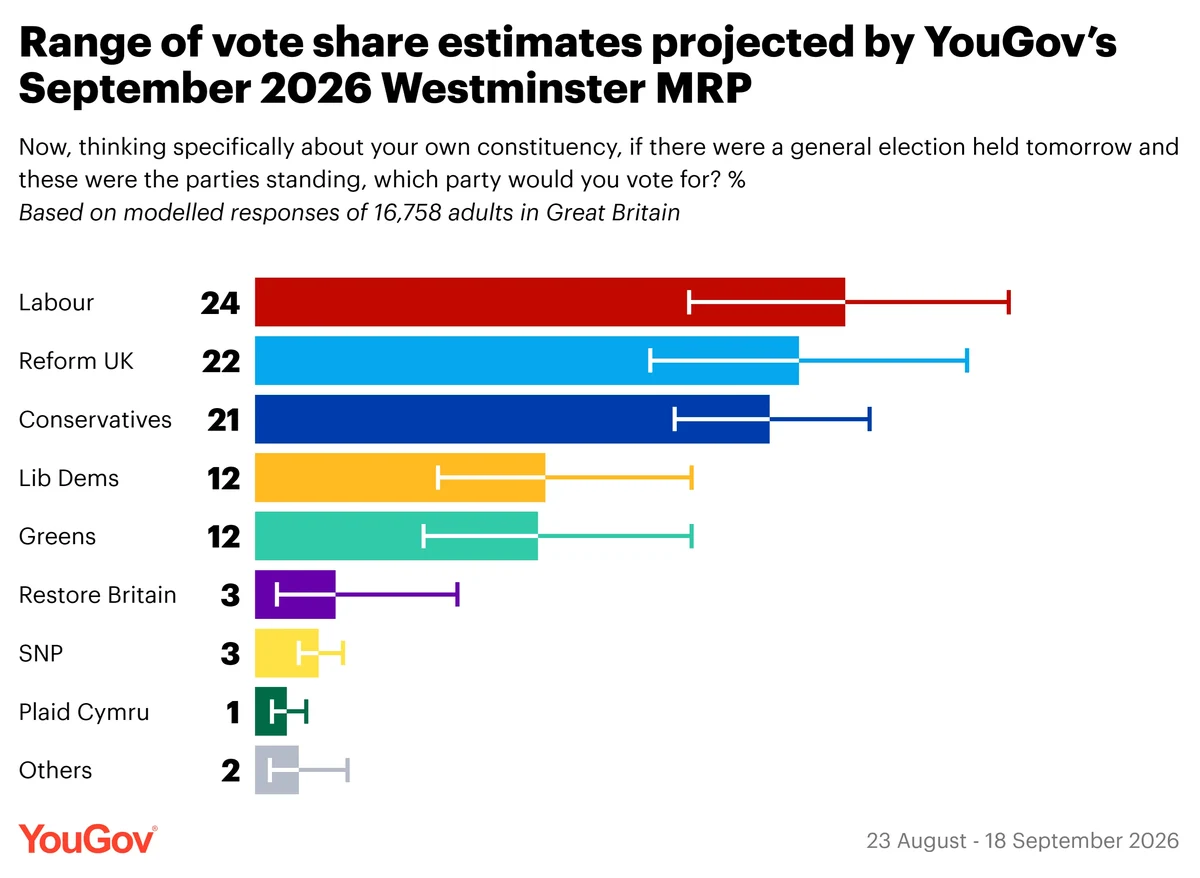
Seats, however, only tell part of the picture, and Labour’s leading position is no longer apparent when looking at vote shares. Our model’s central estimate shows that the party would win just 24% of the vote were an election occurring tomorrow, well within the margins of error of the 22% projected for Reform UK and the 21% for the Conservatives. The Lib Dems and Greens both hold median vote share estimates of 12%.
Small margins and tactical problems
What adds to our model’s uncertainty is the closeness of so many of the constituency contests. In the central projection, 234 seats (37% of the total) are decided on margins of five points or less, with the average majority being just ten points, down from 16 points at the 2024 election, which was already notable for its high number of narrow victories.
This is a particular problem for Reform, which YouGov research has repeatedly found is especially vulnerable to tactical voting. Exactly two thirds of the seats the party wins in our model’s central projection (67%) are done so by a margin of five points or less, relative to comparable figures of 37% for the Conservatives, 33% for Labour and just 7% for the Lib Dems.
Of these 82 narrow wins for Reform, 68 are projected gains from Labour. In these seats, our model suggests an average of 16% of likely voters currently intend to back the Lib Dems or Greens; our latest tactical voting study finds that, in a constituency contest which appeared to be between Labour and Reform, around two thirds of such voters (63-68%) would switch to backing Labour. In most of these seats, were this pattern repeated, it would be enough to overcome Reform’s current advantage, even when accounting for Conservatives (averaging 19% of the vote in such seats) being more likely to tactically switch to Reform (37%) than Labour (18%).
Constituency contests
Although tactical voting has the potential to decisively shape a future election campaign, at present, it’s not a consideration many voters are making, leaving some seats open to being decisive battlegrounds between the parties over the next few years.
Particular focus within Labour will be paid to the 172 of their 411 seats they are currently projected to lose, which include 102 to Reform, 29 to the SNP, 25 to the Conservatives, 11 to Plaid Cymru and five to the Greens. Though it should be remembered this does not reflect the respective rates at which the party is losing voters to other parties.
Health secretary Yvette Cooper is among those currently at risk, with her Pontefract, Castleford and Knottingley constituency projected to be gained by Reform, while Labour trail both Plaid Cymru and Reform in the seats of Wales secretary Stephen Kinnock (Aberafan Maesteg) and Northern Ireland secretary Chris Bryant (Rhondda and Ogmore).
Elsewhere, the Conservatives are on course to lose 13 seats to Reform, including those of shadow cabinet members Richard Holden (Basildon and Billericay), Julia Lopez (Hornchurch and Upminster), and Victoria Atkins (Louth and Horncastle), as well as two to the SNP and one to the Lib Dems (Romsey and Southampton North).
Notably absent from this list are the seats won in 2024 by Conservative MPs who went on to defect to Reform, such as Suella Braverman, Robert Jenrick and Danny Kruger. Our model estimates these constituencies would be won by the Conservatives if an election were held tomorrow. In these seats, as well as others with specific constituency factors, such as those that have changed hands in by-elections or have high-profile independent or minor party candidates, we advise a much greater level of caution in our constituency-level estimates. Although our industry-leading MRP methodology is built around each constituency’s individual demographic characteristics and general election voting record, hyper-specific factors are harder to model and, at this stage of a parliament, it is not possible to prompt for the names of individual candidates in all seats. As such, these figures should not be taken as a prediction of the upcoming by-election in Holborn and St Pancras.
Within the nations and regions
One of the most notable features of the devolved and local elections this May was the sheer scale of the collapse in Labour’s support in the devolved nations, particularly in Wales, where the party suffered its first defeat in a major election in over a century. While our model shows some signs of a ‘Burnham bounce’ in England, this appears to be more muted elsewhere, likely making it harder for Labour to win a majority in a future election.
In Scotland, Labour are reduced to just seven seats in our central estimate. This is down from winning 37 of Scotland’s 57 Westminster constituencies two years ago, the first time the party had won a Scottish election since 2010. Instead, the SNP’s dominance looks set to be reestablished north of the border, with a projected win in 40 seats (+31 from 2024), while the Lib Dems hold five (-1), the Conservatives lead in three (-2), and Reform are ahead in two (+2), albeit by narrow margins.
Labour are on course for an even bigger defeat in Wales, being reduced to just two seats in our model’s median projection, down from 27 in 2024 and compared to three in our MRP last September, which was overall more pessimistic for the party. Such a result would be Labour’s worst Westminster result in the country since 1906. Instead, the Welsh political map is now largely divvied up between Plaid Cymru, who are projected to win 15 seats (+11), and Reform, who lead in 14 (+14). The final seat, Monmouth, is a Conservative gain in our central estimates, though by a narrow margin.
Across England, Labour could be expected to lose a third of their seats, if an election were held tomorrow, being reduced to 232 English MPs in our median projection, a net loss of 115. They would still, however, be the largest party in the country, with the Conservatives leading in just 126 seats in our model (+10), Reform ahead in 107 (+102), the Lib Dems winning in 66 (+1), while the Greens are currently up in nine (+5).
The picture is not, however, uniform across England, with Labour holding up particularly well in London, where they would be projected to win 51 of the capital’s 75 seats on current voting intentions, a loss of eight. Gains in north west and west London bring the Conservatives up to 13 Greater London seats in our model (+4), while the Lib Dems could be expected to retain their six south west London seats. In the eastern parts of the region, Reform are estimated to be currently ahead in four seats, having won no seats in the capital in 2024.
Labour are also performing relatively strongly in Andy Burnham’s backyard of Greater Manchester, leading in 24 of the county’s 27 seats in our model, a loss of just one from the last election. The Lib Dems keep hold of their two seats in Stockport, while the Greens take the final seat. Notably, this is a substantial recovery from our MRP last September, which projected Labour under Starmer could be reduced to 10 seats in the city region, while Reform were ahead in 15.
Across the wider North West, Labour lose just 12% of the seats they won in 2024 in our model’s central projection, though this is relative to 25% across the North of England as a whole and compared to nearly half in the Midlands (49%) and the South of England outside of London (47%).
See the full constituency-level MRP results here
See the unweighted baseline data used for the model here
Methodology
- Sample Size: An online survey of 16,758 adults aged 18+ in Great Britain
- Fieldwork: 23 August to 18 September 2026
- Commissioned by: YouGov
MRP (multi-level modelling and post-stratification) constituency projection models first estimate the relationship between a wide variety of characteristics about prospective voters and their opinions – in this case, which party they will vote for at the general election – in a ‘multilevel model’. It then uses data at the constituency level to predict the outcomes of seats based on the concentration of various different types of voters who live there, according to what the multilevel model says about their probability of voting for various parties (‘post-stratification’).
Click here for more information about how we carry our research
Interested in taking YouGov surveys? What party would you vote for if there was an election tomorrow? What do you think about British politics in general, and everything else? Have your say, join the YouGov panel, and get paid to share your thoughts. Sign up here.
Interested in commissioning YouGov research? We connect in real-time with real people around the world to gather their thoughts, behaviours, and opinions, to ensure that our research data is powered by reality. Explore our survey services here.
Photo: Getty