Although attitudes to Kemi Badenoch have improved over the last year, the Conservative party’s image remains poor
Key takeaways
- The proportion of Britons willing to consider voting Conservative has risen by six points over the last year (to 28%), though the proportion giving them as their main voting intention is only up two points (to 14%)
- When Britons are asked to describe Kemi Badenoch in their own words, 40% use at least one negative term, while 31% use one or more positive terms
- “Strong” and “intelligent” are the most common positive terms to describe Badenoch, while “nasty”, “useless” and “rude” are among the top negative descriptors
- The Conservatives’ image remains largely negative, though there have been small improvements in the number of Britons feeling the party has a clear purpose, is competent, is in touch or is strong since Badenoch became leader
- Just 20% of Britons believe the Conservatives are ready for a return to government, while 59% feel they are not
On Sunday, party conference season turns to the Conservatives, a party that has been decidedly upbeat in recent months, despite suffering historic losses in the devolved and local elections in May and still having little evidence to show of an advance on their worst-ever election result in 2024.
Indeed, over September, an average of just one in seven Britons (14%) gave the Tories as their main voting intention in our polls. While this is up two points from their low point between June and September last year, the party is yet to average above their level of support in the three months prior to the May 2025 local elections (15%).
Of course, vote shares are relative, and the drop in Reform UK’s support in recent months does mean that, according our MRP election model, the Conservatives could now be expected to near-replicate their 2024 result in an imminent general election, rather than be relegated to fourth party status as per last autumn.
Additionally, the Conservatives have begun to raise the ‘ceiling’ of their support, with the proportion of Britons willing to consider voting for the party at a future election averaging 28% in September, up six points from twelve months previously. This is the highest level in our tracker since November 2024, the month Kemi Badenoch became leader, again highlighting the party has somewhat recovered from the setbacks of 2025, but not much further.
What do Britons think of Kemi Badenoch?
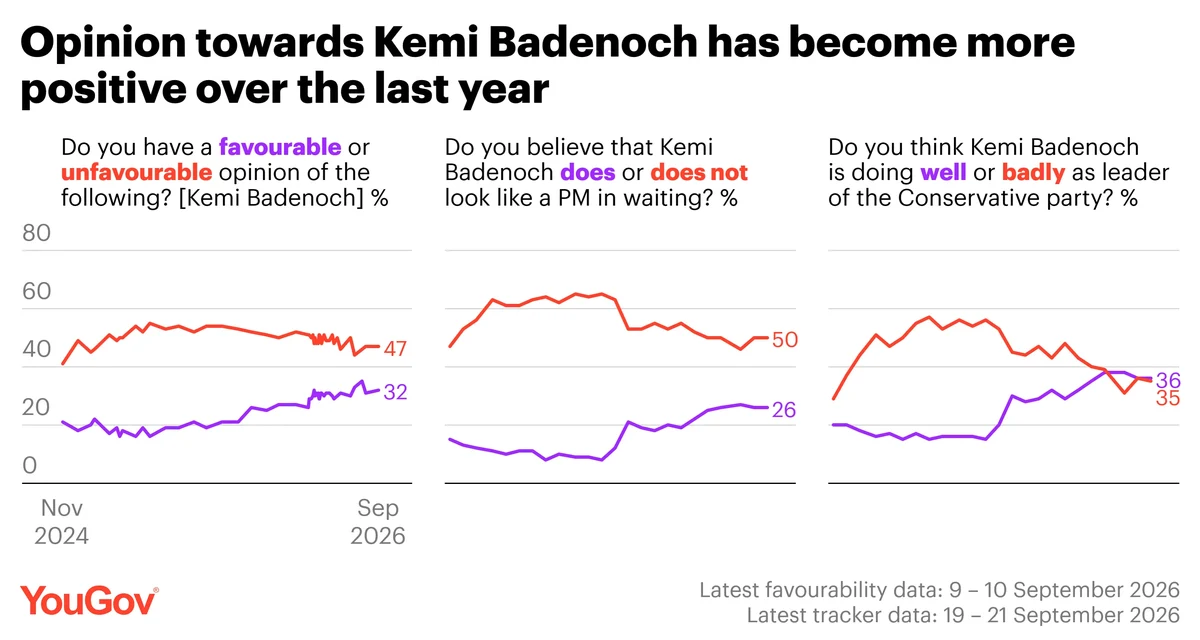
Rather than an increase in support, it is leader Kemi Badenoch who is reportedly the greatest cause for optimism within the party. As YouGov analysis has previously shown, opinion towards Badenoch has undoubtedly improved over the last year, though with our trackers suggesting this trend has somewhat levelled off since June.
In our latest figures, Britons are divided 36% to 35% over whether Badenoch is doing well or badly as Conservative leader. However, Britons also tend to have an unfavourable opinion of Badenoch by a margin of 47% to 32%, while a full half (50%) think she does not look like a prime minister in waiting, roughly double the 26% who feel she does.
Relative to this time last year, these are all substantial, though unequal, improvements. Badenoch’s net favourability rating is up 20 points (to -15), while her net perceived job performance score has jumped up 39 points over the last twelve months (to +1).
How would Britons describe Kemi Badenoch?
To attempt to explain this growth in popularity for Badenoch, as well as why not everybody has been won over, we asked Britons to describe Kemi Badenoch in three words.
Overall, four in ten Britons (40%) use at least one negative term to describe the Tory leader, with one of the most common themes being a perceived unpleasantness. Words like nasty or mean crop up in 4% of three-word descriptions of Badenoch, while 3% refer to her as rude, and references to her being aggressive, arrogant, cold, evil or unlikeable are each made by 2% of the public.
Some critics focus on her performance as leader, with 4% referring to her as useless, 3% as not very good and 2% as incompetent, while other common complaints include boring (4%), out of touch (3%), or that she is negative or critical (2%).
Three in ten Britons (31%) include one or more positive terms in their description, with two undoubtedly standing out: strong and intelligent, which both feature in 7% of rough sketches of Badenoch. That she is articulate, confident and determined are also among the top compliments, each being paid by 3% of the public.
Despite having been opposition leader for nearly two years, it’s apparent that Badenoch has not broken through to everyone yet, with three in ten Britons (29%) unable to provide a three-word description of her, giving variations of either don’t know (20%) or even “who?” (9%). Additionally, among the neutral terms used by a further 18% of Britons, most are simple vague descriptions, such as the 9% only identifying her as the Tory leader.
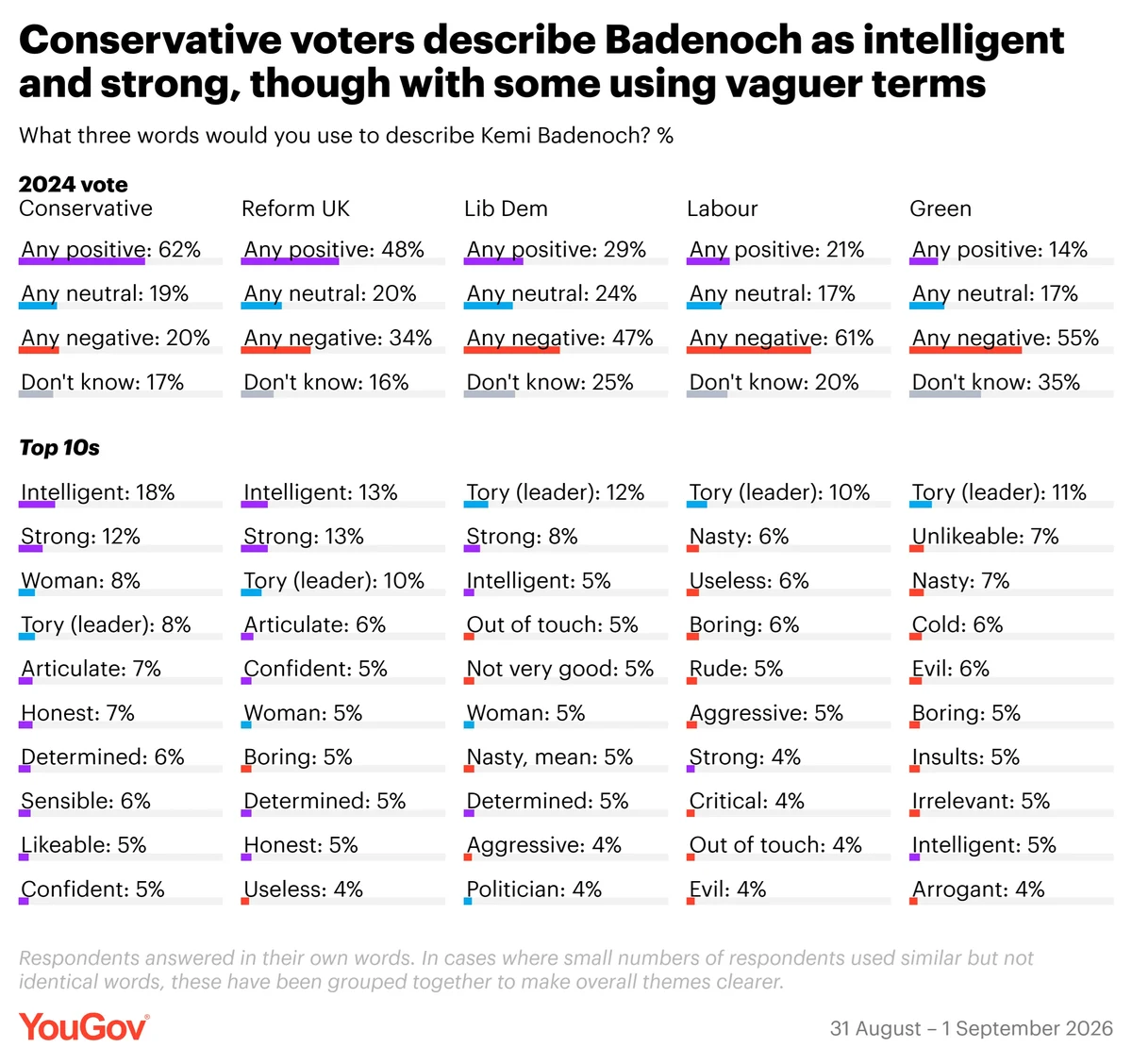
Conservative voters’ descriptions of Badenoch are largely positive, with 62% of those who backed the party in 2024 including at least one complimentary term in their three-word sketch, including 18% using variations of intelligent and 12% using strong. Other common praise includes articulate, honest, determined and sensible, each used by 6-7% of Tory voters in their descriptions.
Nonetheless, a lack of familiarity is still evident among some Conservative voters, with 17% saying they were unsure how to describe Badenoch and 19% opting for one or more neutral terms that prominently include references to her being a woman or merely the Conservative leader. There are also some Tories not entirely happy with her leadership, with 20% including a critical term in their description, though no individual negative word is used by more than 2%.
Reform voters tend to be positive, with 48% depicting Badenoch using one or more favourable terms, with intelligent and strong once again among the most prominent (both used by 13%), though with 34% using negative terms, such as boring and useless.
Those who voted Lib Dem in 2024 tend to be negative, with 47% using negative terms, although 29% use at least one positive word, while clear majorities of Labour and Green voters (55-61%) are at least partly critical in their three-word description, with nasty, evil and boring among the top barbs in both groups.
What do Britons think about the Conservatives?
However, while attitudes towards Kemi Badenoch might be softening, opinion towards the Conservatives is still largely negative, with improvements lacking in some key areas.
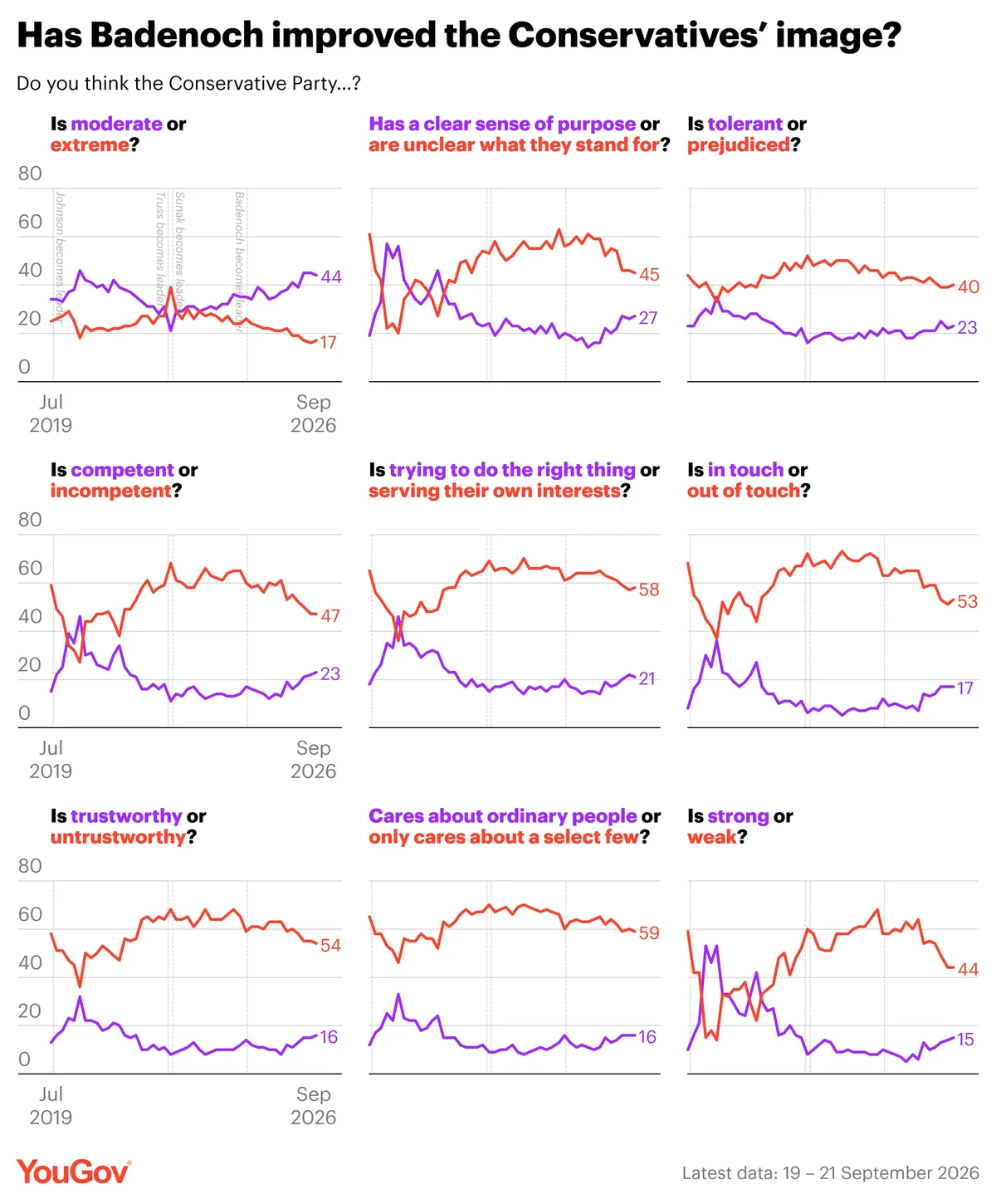
Nearly six in ten Britons (58-59%) see the Conservatives as caring only about a select few or serving their own interests, relative to just 16-21% feeling the party is trying to do the right thing or cares about ordinary people. Majorities (53-54%) also view the Tories as out of touch and untrustworthy, compared only one in six (16-17%) finding them trustworthy or in touch.
The public also tend to see the Conservatives as incompetent (by a margin of 47% to 23%), unclear in what they stand for (by 45% to 27%), weak (by 44% to 15%) and prejudiced (by 40% to 23%), though are more likely to believe the party is moderate (44%) than extreme (17%).
In some cases, there has been an improvement in the party’s image on Badenoch’s watch. Since just before she became leader, there have been significant increases in the proportion of Britons who see the Conservatives as moderate (up nine points), feel they have a clear sense of purpose (up seven), believe they are competent (up six), and think they are in touch or strong (both up five).
However, this trend is far from across the board, with no statistically significant increase over this period in the proportions of Britons believing the Tories care about ordinary people, try to do the right thing, are tolerant or are trustworthy.
Regardless of improvements in some areas, there are still significant minorities of even 2024 Conservative voters who are dissatisfied with certain aspects of the party. Nearly a quarter (22-24%) feel the Tories are unclear in what they stand for, care only about a select few or are weak, while less than half (47%) believe the party is trustworthy.
Among those who voted Reform at the last election, who are likely the Conservatives’ best source of future voters, the picture tends to be negative. Although tending to see the Tories as moderate and tolerant, as well as being divided over whether the party is competent, Reform voters tend to see Badenoch’s party as unclear in what they stand for, weak, out of touch, serving themselves, untrustworthy and only for the few.
Are the Conservatives ready for government?
Perhaps the most important question of all, for the official opposition, is whether the public feel they are a plausible government; and, at present, that is not the case with the Conservatives.
In our latest tracker data, just 20% of Britons believe the Tories are ready for a return to power, which even if up from a mere 11% last September, is relative to three times as many (59%) thinking they are not ready for government.
It is also a situation much closer to Labour’s situation prior to the 2019 election under Jeremy Corbyn, when Britons saw them as not ready for office by 62% to 22%, than Labour’s situation before they won the 2024 election, when the public were divided 38% to 43% over the opposition’s suitability for government.
Methodology
- Sample size: An online survey of 2,008 adults aged 18+ in Great Britain
- Fieldwork: 31 August to 1 September 2026
- Commissioned by: YouGov
Click here for more information about how we carry out research
Interested in taking YouGov surveys? What do you think about Kemi Badenoch, the Conservative Party, and everything else? Have your say, join the YouGov panel, and get paid to share your thoughts. Sign up here.
Interested in commissioning YouGov research? We connect in real-time with real people around the world to gather their thoughts, behaviours, and opinions, to ensure that our research data is powered by reality. Explore our survey services here.
Photo: Getty