Most Britons see Reform UK as untrustworthy, extreme and incompetent, while the most common words used to describe Farage are "racist" and "liar"
Key takeaways
- Support for Reform UK has fallen over the last year
- When Britons are asked to describe Nigel Farage in their own words, the most common terms given are “racist” and “liar”
- “Patriotic”, “honest” and “intelligent” are the most common words Reform UK voters would use to describe Nigel Farage
- Around six in ten Britons see Reform UK as untrustworthy, serving their own interests, prejudiced and extreme, while also tending to see the party as out of touch
- Britons are more likely to think that Reform have a clear sense of purpose than are unclear what they stand for (44% vs 37%)
- Just 19% of Britons feel Nigel Farage looks like a prime minister in waiting, down seven points since June
Reform UK are kicking off party conference season this year, though are likely to be in a slightly less jubilant mood than they were this time last year. Although the party managed to make further gains in the devolved and local elections this May, the party has since become bogged down in controversies over donations to Nigel Farage, has faced competition on its right from Rupert Lowe’s Restore Britain, and has lost its lead in voting intention polls since Andy Burnham took office.
Indeed, in hindsight, last September was the peak of the Reform surge, with the proportion of Britons willing to consider voting for the party gradually falling by six points over the last year (to 24%) and the proportion giving the party as their main voting intention down by five points (to 16%). On both measures, support for Reform has now returned to roughly the level it was before the 2025 council elections.
What do Britons think of Nigel Farage?
This dip in support for the party mirrors a significant fall in opinion towards Nigel Farage, with his latest net favourability rating of -44 markedly down from its peak of -27 last summer, while belief he is doing well as Reform leader has fallen even an even more stark 51 net points from +18 this time last year to -33 today.
Perhaps most key of all, though, for a party leader with eyes on Number 10 is whether you look like a potential prime minister. Here, Farage has also fallen, with just 19% of Britons now seeing him as a prime minister in waiting, down seven points since June, while 66% of the public – including 27% of Reform voters – feel he does not have the top job in him.
This compares to a greater 26% of Britons – including 33% of Reform voters – feeling that Kemi Badenoch looks like a prime minister in waiting, an attitude that has trended upwards over the last year, even if 50% still don’t see her as prime ministerial. Nonetheless, this is the first time we have recorded a higher score for Badenoch than Farage on this measure.
Given our recent Big Voter Study identified that Reform’s status as the largest party on the right was far from solid, the balance beginning to tilt towards the Tories on this question is another warning light about Reform’s current momentum.
How would Britons describe Nigel Farage?
With opinion towards Nigel Farage becoming even more unfavourable, why is it that Britons see him in this light?
When asked to describe the Reform leader in three words, a full 71% of Britons use at least one negative term, with the most frequent being accusations that Farage is a racist (used by 15%) and a liar (12%). Overall, his perceived dishonesty is the dominant theme, with other common responses being that he is dishonest (8%), corrupt or crooked (8%), untrustworthy or unreliable (7%), self-serving (6%), or sleazy or dodgy (5%).
One in ten Britons (10%) include at least one swearword or insult in their three-word description of Farage, while 7% describe him as evil or cruel, allusions to him being arrogant or dangerous are each made by 6%, and 5% refer to him as either an idiot or a clown.
Roughly a quarter of the public (27%) use at least one positive term to describe the Reform leader, with his perceived patriotism (5%) and honesty (4%) being the top compliments paid to Farage by these Britons.
A neutral or ambiguous term is used by 17% in their descriptions, with the most common being a reference to him being outspoken or opinionated (3%).
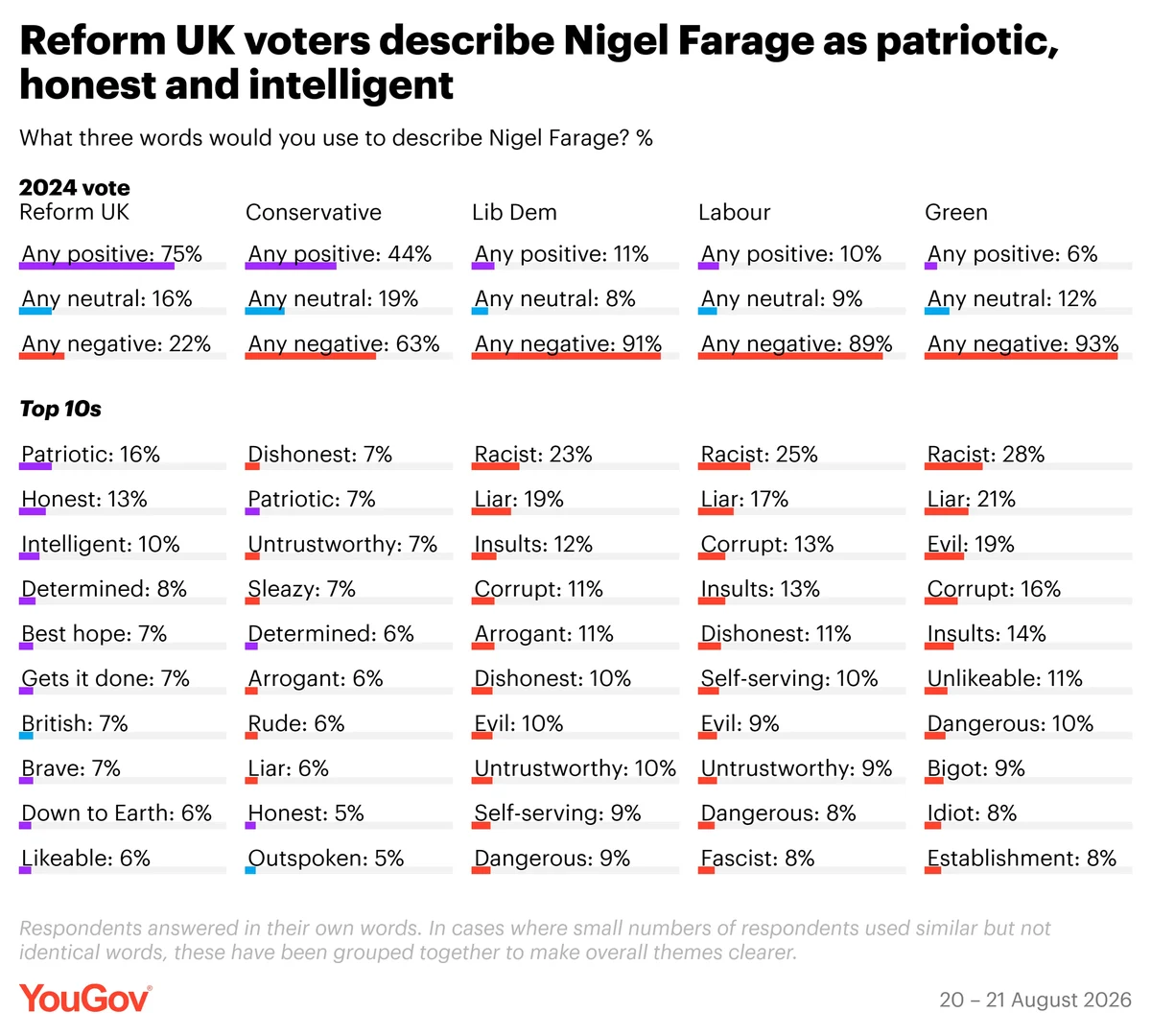
Among Reform UK voters, the descriptions are more positive, with 75% of those who backed the party in 2024 using at least one positive term in a three-word description of Farage, with the most common being patriotic (used by 16%), honest (13%) and intelligent (10%).
Farage’s determined nature is brought up by 8%, while descriptions used by 7% include references to him being the best option available, his ability to get things done, and his bravery. His “man of the people” image features in descriptions used by 6% of Reform voters, as does his likeable or affable personality.
Nonetheless, 22% of Reform voters use at least one barbed term to describe Farage. Although no single critical adjective is used by more than 3%, various references to his perceived untrustworthiness or dodginess make up the bulk of this negativity.
Conservative voters are the most mixed in their attitudes to Farage, with 63% using at least one negative term and 44% using at least one positive term in their descriptions of the Reform leader. Labour, Lib Dem and Green voters are almost entirely negative in their descriptions (89-92%), with “racist” and “liar” among the most common terms for all three groups.
What do Britons think about Reform UK?
Negativity is not just limited to Farage. Around six in ten Britons (59-62%) think Reform as a party is untrustworthy, serving their own interests, prejudiced and extreme, relative to as few as 15-16% instead describing the party as tolerant or trustworthy.
Clear majorities of Britons (56%) also see the party as incompetent and caring only about a select few rather than caring about ordinary people, with the public also tending to believe Reform are out of touch by a margin of 46% to 28%.
Britons are a little more likely to describe the party as weak (35%) than strong (29%), though are more likely to think that Reform have a clear sense of purpose (44%) than are unclear what they stand for (37%).
As with Farage himself, it is Conservative voters who are most conflicted in their attitudes to Reform, tending to see the party as having a clear purpose (by 55% to 30%), as in touch (44% vs 27%) and strong (38% vs 22%) on the one hand, but tending to view them as prejudiced (by 48% to 22%), extreme (49% vs 27%), untrustworthy (46% vs 24%) and incompetent (39% vs 28%) on the other.
See the full results here, here and here
Interested in taking YouGov surveys? What do you think about Nigel Farage, Reform UK, and everything else? Have your say, join the YouGov panel, and get paid to share your thoughts. Sign up here.
Interested in commissioning YouGov research? We connect in real-time with real people around the world to gather their thoughts, behaviours, and opinions, to ensure that our research data is powered by reality. Explore our survey services here.
Photo: Getty