

There has been an increase in pro-Labour tactical voting across the board since February, while Reform UK have fallen behind in key contests
Key takeaways
- Reform UK increasingly loses out in tactical voting scenarios, with Labour and the Tories pulling further ahead when they are the only viable competitors to Nigel Farage’s party in a constituency
- In a constituency contest between Labour and Reform UK, voters would back Andy Burnham's party by 41% to 26%
- If only the Conservatives or Reform UK stood a chance of winning in their seat, voters would favour the Tories by 35% to 20%
- 63-68% of Lib Dem and Green voters would tactically vote for Labour to stop Reform UK winning in their seat, as would 18% of Tories
- 43-49% of Labour and Lib Dem voters would tactically vote for the Conservatives to stop Reform UK winning in their seat, with 26% of Greens saying the same
- Voters now favour Labour over the Conservatives by 34% to 27% in a contest where only these two parties could realistically win – in February this scenario had resulted in a dead heat
- Half (52-55%) of Lib Dem and Green voters would back Labour to stop the Conservatives
- 60-74% of Labour voters would tactically vote Lib Dem or Green to prevent the Conservatives or Reform UK winning in their seat
- 41-46% of current Reform UK voters would vote Tory if their seat was between the Conservatives versus Labour, the Lib Dems or Greens
Since YouGov's last look at tactical voting in February of this year, Labour has replaced Keir Starmer with Andy Burnham, Nigel Farage and Reform UK have been struck by a succession of scandals, and the rising Green tide led by Zack Polanski has receded.
So how, if at all, has tactical voting behaviour shifted in the last seven months?
Our latest study shows that willingness to back Reform against Labour, the Tories or Lib Dems has declined markedly, from a high watermark in October 2025.
How has tactical voting behaviour shifted since February?
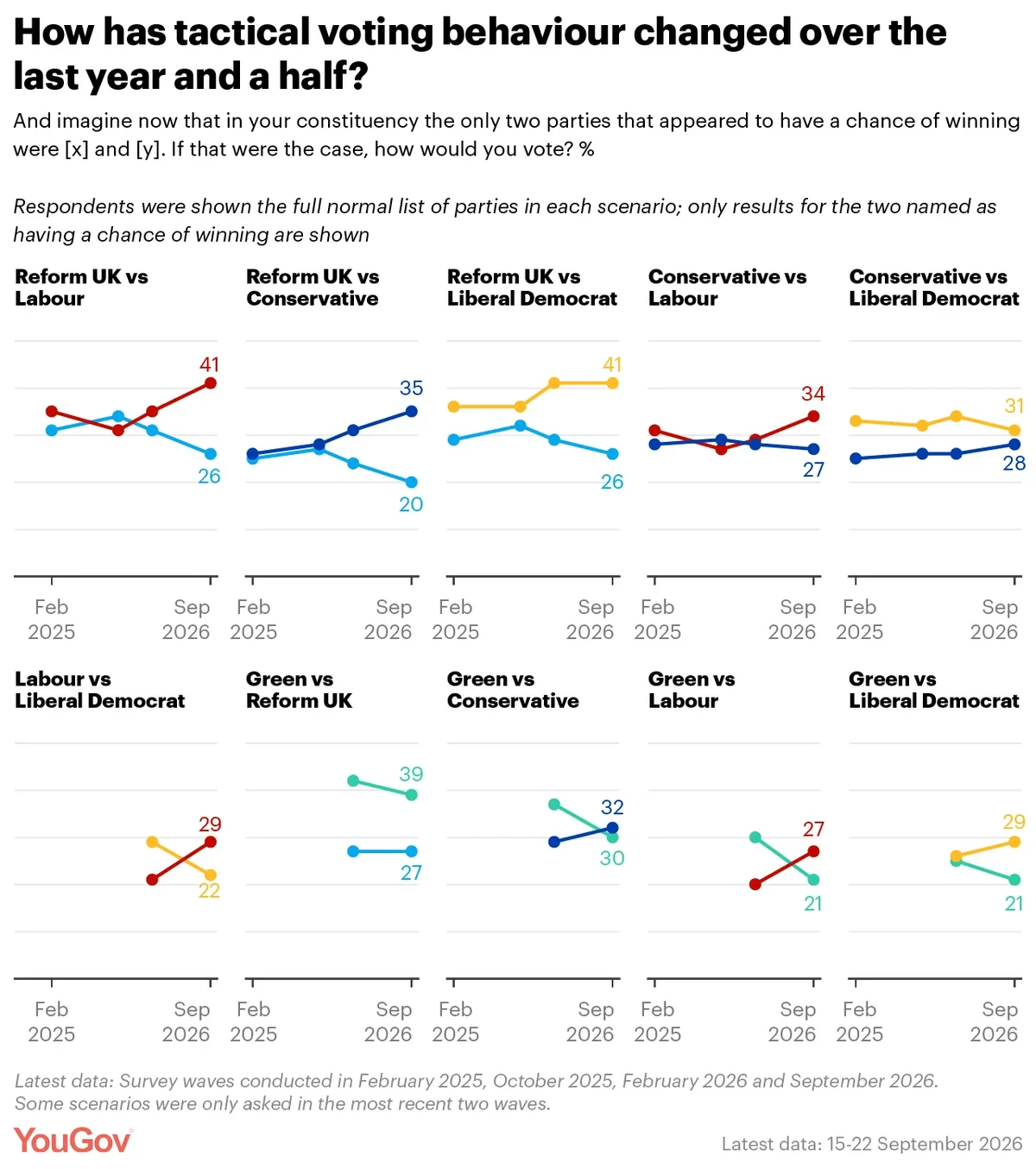
In a constituency contest where only Reform UK and Labour were likely to win, only 26% of voters would now choose Nigel Farage’s party against Andy Burnham’s, compared to 41% who would back Labour. This represents a 5pt reduction for Reform UK since February, and a 6pt increase for Labour.
Likewise, when facing off against the Conservatives, only 20% of voters would now choose Reform UK (down 4pts since February), compared to 35% who favour Kemi Badenoch’s party (up 4pts).
Labour are also performing more positively in all other constituency head to heads, having moved out in front of the Tories (with whom they were tied in February) at 34% vs 27%, as well as pulling ahead of the Lib Dems and Greens (who they trailed earlier in the year).
The other notable trend across the contests is the decline in Green support, with Zack Polanski’s party experiencing vote share reductions of between three and nine points. The Greens have now fallen behind Labour (who they led in our previous survey), and the Lib Dems (with whom they were tied in February), while now being tied with the Tories.
Looking within voting groups, the change in prime minister appears to have heralded a greater willingness to vote for Labour in tactical voting scenarios among Green, Lib Dem and Conservative voters. Willingness among Tories to vote Labour against the other three parties has increased by 7-9pts, while for the Lib Dems it has increased by 9-12pts and among Greens by 6-12pts.
Separately, there has also been an increase in the number of 2024 Labour voters who are willing to vote tactically for the Conservatives against Reform UK. At 35% now willing to side with Badenoch over Farage, this is a six point increase from 29% in February, and a 15pt rise from the 20% recorded in our first poll in the series in February 2025.
The rest of this article takes a broader look at some of the key head to head constituency contests, as well as a detailed look at how each of the five main voting groups would cast their ballot in tactical voting scenarios.
Who would voters back in a contest between Reform UK and Labour?
Among all voters, faced with a Labour versus Reform battle, Labour leads Reform UK by a substantial 15 point margin of 41% to 26% – a far wider gap than the 35% to 31% recorded in February.
As in February, voting behaviour in this scenario still indicates ‘bloc voting’ is taking place, with Labour gaining little support from voters currently backing right wing parties and vice versa for Reform UK.
The 41% tactical share for Labour breaks down as roughly 18 points from current Labour voters, six points each from Green and Lib Dem voters and a further six points from those who were unsure or unlikely to vote. Just two points come from Conservative voters and essentially nothing comes from current Reform voters.
Reform UK's 26% is built almost entirely from its own side: around 16 points from current Reform voters, five points from Conservatives, and three points from the unsure/unlikely-to-vote group – with just one point in total crossing over from Labour, Lib Dem or Green voters combined.
Who would voters back in a contest between Reform UK and the Conservatives?
The Conservatives’ advantage over Reform UK is notably better than in February. Where they are the only two parties who can realistically win in a seat, the Tories now lead by 15 points (35% vs 20%), more than double February's seven-point lead (31% vs 24%), and compared to a near tie of 26% vs 25% in February of 2025.
Who would voters back in a contest between the Conservatives and Labour?
In this traditional matchup, Labour has moved from a dead heat with the Conservatives in February (29% vs 28%) to a seven point lead (34% vs 27%).
A majority of both Lib Dem (52%) and Green (55%) voters also now say they would back Labour here, up from 43-44% in our previous study.
Who would voters back in a contest between the Conservatives and the Lib Dems?
Relatively little has changed when it comes to the matchup between Conservatives and Lib Dems, with all voting groups behaving similarly to our prior poll. Nevertheless, the relatively minor shifts favour the Conservatives, with the two parties now within touching distance at 31% for the Lib Dems and 28% for the Tories – having stood at 34% vs 26% in February.
Who would voters back in a contest between Labour and the Greens?
For scenarios where Labour and the Greens are the only two parties that could win in a constituency, Labour now leads by six points (27% vs 21%) – a striking reversal of February's 10pt Green lead (30% vs 20%).
As in February, not all the switching may be purely tactical: 13% of current Labour voters say they would back the Greens even here (a figure effectively unchanged from last time).
Who would voters back in other tactical voting scenarios?
- Lib Dems vs Reform UK: while the Lib Dems’ lead over Reform UK has grown, this is solely a result of the latter’s vote share declining from 29% to 26%, with the former remaining steady on 41% of the vote.
- Greens vs Reform UK: while the Greens maintain a substantial 12pt lead over Reform UK, this represents a 3pt drop since February, with the Green vote share declining from 42% to 39%, while Reform are unchanged on 27%.
- Greens vs Conservatives: the Conservatives have drawn level with the Greens, on 32% of the vote to their 30%, after having trailed 29%-37% in February.
- Labour vs Lib Dems: Labour has overtaken the Lib Dems, with their 29%-22% lead a reversal from the 21%-29% result in February.
- Lib Dems vs Greens: Ed Davey’s party has now opened a clear lead against Zack Polanski’s (29% vs 21%), having been effectively tied in February (26% vs 25%).
Who would Labour voters back in tactical voting scenarios?
Labour voters remain some of the most enthusiastic tactical voters. In scenarios that see another progressive party (i.e. the Lib Dems or Greens) in contest with a right wing party (i.e. the Tories or Reform UK), just 16-20% of those currently backing Labour say they would stick with the party.
Instead, between 68% and 74% would switch to either the Lib Dems or Greens to try to stop Reform UK winning their seat, while 60-63% would tactically vote Lib Dem or Green in two-way contests between them and the Conservatives.
In the event that it was the Conservatives and Reform UK coming to blows in a respondent’s constituency, fully 43% of Labour voters opt to back Kemi Badenoch’s party in order to keep out Nigel Farage’s candidate, while a mere 2% say the reverse. This represents considerably greater willingness to back the Tories than in February, when only 30% of those intending to vote Labour were willing to do so. Nevertheless, 35% of current Labour voters would stick with their party, while 11% would refuse to vote.
Who would Green voters back in tactical voting scenarios?
Green voters are generally less willing to vote tactically, with 27-36% of current supporters sticking with the party across the bulk of our scenarios.
A Labour versus Reform contest is the scenario where current Green voters are most inclined to vote tactically, with 63% saying they would back Andy Burnham's party against Nigel Farage’s. Labour are also beneficiaries of strong Green tactical support in contests against the Conservatives, with 55% willing to back the governing party in a constituency fought largely between Labour and the Tories.
The Greens are similarly likely to back the Lib Dems against right wing rivals, with 60% saying they would tactically back the party against Reform UK and 54% against the Conservatives.
When it is the Tories and Reform UK that are likely to win in their constituency, Green voters are primarily unwilling to opt for either, with 49% choosing to continue to back the Greens, and 13% pledging not to vote. However, a full quarter (26%) would back the Conservatives in order to keep Reform UK from winning – this is against just 2% who would prefer Nigel Farage’s party to win the seat over Kemi Badenoch’s candidate.
Who would Lib Dem voters back in tactical voting scenarios?
Current Lib Dem voters are likewise very willing to vote tactically in order to keep out parties of the right. Two-thirds (68%) would back Labour in a contest between them and Reform UK, as well as 52% in a seat fought between Labour and the Tories (although 14% would instead back Kemi Badenoch's party).
While 71% of current Lib Dem voters would switch to the Greens if they were the only realistic challenger to Reform UK in their constituency – a figure largely the same as in February – they are far less likely to do so against the Conservatives. Currently only 46% of Lib Dem voters would back Zack Polanski’s party against Kemi Badenoch’s – this compares to 60% in our previous study in February. Instead, 22% of Lib Dems would now back the Tories, up from 13% earlier in the year.
Where Reform UK and the Conservatives are the only parties seemingly in with a chance of winning, close to half of Lib Dems (49%) say they would vote Conservative to keep Nigel Farage's party at bay.
Who would Reform UK voters back in tactical voting scenarios?
Voters for right wing parties are also willing to vote tactically in order to keep their left wing rivals at bay, although Reform UK voters are slightly more willing to do so than their Conservative counterparts.
In contests between the Conservatives and either Labour, the Lib Dems or the Greens, current Reform UK supporters are roughly divided between the 40-43% who would remain with Reform and the 41-46% who would instead switch to the Tories.
Reform UK supporters also have a higher degree of willingness to opt out if their favoured party is not on the ballot, particularly in contests between two left wing parties. Between one in four and one in five (21-26%) say they just wouldn’t vote if the only parties in contention in their constituency are some combination of Labour, the Lib Dems or the Greens.
Who would Conservative voters back in tactical voting scenarios?
When it comes to current Conservative supporters, 36% are prepared to vote tactically for Reform in order to keep the Lib Dems out, 37% against Labour, and 40% against the Greens. While the first two figures are largely the same as in February, the anti-Green vote has increased more noticeably, up from 32% earlier in the year.
However, there is also a considerable section of the Tory electorate that would back the Lib Dems in order to keep Reform UK out, at 30%. This compares to a lower 16% who would rather go Green than Reform, and 18% who would prefer Andy Burnham’s party to Nigel Farage’s.
The Lib Dems are likewise favoured over other left wing parties by tactical Tory voters, with 30% of current Conservatives willing to back them over Labour in their constituency, and 40% preferring them to the Greens.
Interested in taking YouGov surveys? Would you vote tactically in your first-choice party couldn’t win in your constituency? What do you think about voting in general, and everyone else? Have your say, join the YouGov panel, and get paid to share your thoughts. Sign up here.
Interested in commissioning YouGov research? We connect in real-time with real people around the world to gather their thoughts, behaviours, and opinions, to ensure that our research data is powered by reality. Explore our survey services here.
Photo: Getty