Opinion towards the Greens has become more unfavourable in the last year
Key takeaways
- Having peaked in March, support for the Greens has fallen since the spring, with the number of Britons willing to consider voting for the party now lower than before Polanski became leader
- When Britons are asked to describe Zack Polanski in three words, 47% use at least one negative term, while only 18% use a positive term
- Just 48% of 2024 Green voters use a positive term in a three-word description of Polanski, with 30% using at least one negative term
- Over the course of Polanski’s leadership, the Greens’ net favourability rating has fallen from +5 to -19
- Britons tend to see the Greens as weak, out of touch, incompetent and serving their own interests
On Friday, party conference season will turn to the Greens, who will be looking back on something of a mixed year for the party. They started 2026 well, solidifying their advances in voting intention polls during Zack Polanski’s first few months as leader by making their first ever Westminster by-election gain in Gorton and Denton and achieving record results in this year’s local elections.
However, in recent months, the party has fallen backwards. Across September, an average of just 10% of Britons have given the party as their main voting intention in our polls, down five points from their peak in March. This is, though, still two points above the average figure in August last year, prior to Polanski becoming party leader.
The proportion of Britons willing to consider voting for the party, though, is down from its pre-Polanski baseline. From 25% in August 2025, this figure peaked under Polanski at 28% in March of this year, in the aftermath of the Gorton and Denton by-election, but has since fallen gradually to just 23% today.
What do Britons think of Zack Polanski?
At the centre of both this rise and fall has been Zack Polanski. In his first few months as leader, the proportion of Britons with favourable and unfavourable opinions of him rose at roughly the same rate. This growth in awareness – to a level much higher than that of his predecessors Carla Denyer and Adrian Ramsay, who 77-82% of Britons had no opinion of at about the time he was elected to succeed them – coincided with the Greens rising in voting intention polls.
Since the start of this year, however, the proportion of Britons with a positive view of Polanski has remained largely stagnant, with our favourability tracker consistently recording figures between 19-26%, with no continuous trend.
On the other hand, the proportion with a negative opinion of Polanski continued to trend upwards into 2026, before increasing massively at the start of May, peaking at 50%, after he shared a tweet criticising the police handling of the Golders Green attack. In our latest figures, Polanski has a net favourability rating of -29, with Nigel Farage the only major party leader with a lower net score.
Alongside this, there has been a shift since the spring in perceptions of how successful Polanski is as a party leader. In April, Britons were divided 34% to 35% over whether he was doing well or badly as Green Party leader; now, just 21% believe he’s doing a good job, while 48% think he’s doing poorly in the role.
How would Britons describe Zack Polanski?
This predominant negativity can be seen when asking Britons to describe Zack Polanski, with nearly half of Britons (47%) using at least one negative term in a three-word description of the Green Party leader, relative to just one in six (18%) opting for one or more positive terms.
Among the negative words used, there are some repeating themes. One of these is a feeling of duplicitousness, with 4% of Britons calling Polanski untrustworthy in their description, while references to him being a chancer, a charlatan, dishonest, dodgy or a liar are each made by 2%.
For some critics, rather than fooling others, it is Polanski who is foolish, with 5% labelling him an idiot, 4% viewing him as stupid and another 4% seeing him as deluded. Other criticisms of Polanski each featuring in 4% of three-word descriptions include dangerous, mad and useless, with the same proportion including a swearword or other insult in their summary of the self-proclaimed eco-populist.
Positive descriptions are more diffuse, with no individual term being used by more than 2% of Britons in their rough sketches of Polanski, though with the relatively more frequent themes including that he is ambitious, caring, decent, honest, gives hope, or is passionate.
There is, though, still a lack of awareness of Polanski, with a third of Britons (34%) unable to provide a three-word description of him, giving variations of either don’t know (25%) or more bluntly “who?” (9%). Additionally, among the neutral terms featuring in the descriptions of a further 18% of Britons, many are vague, with 6% featuring allusions to him being the Green’s leader.
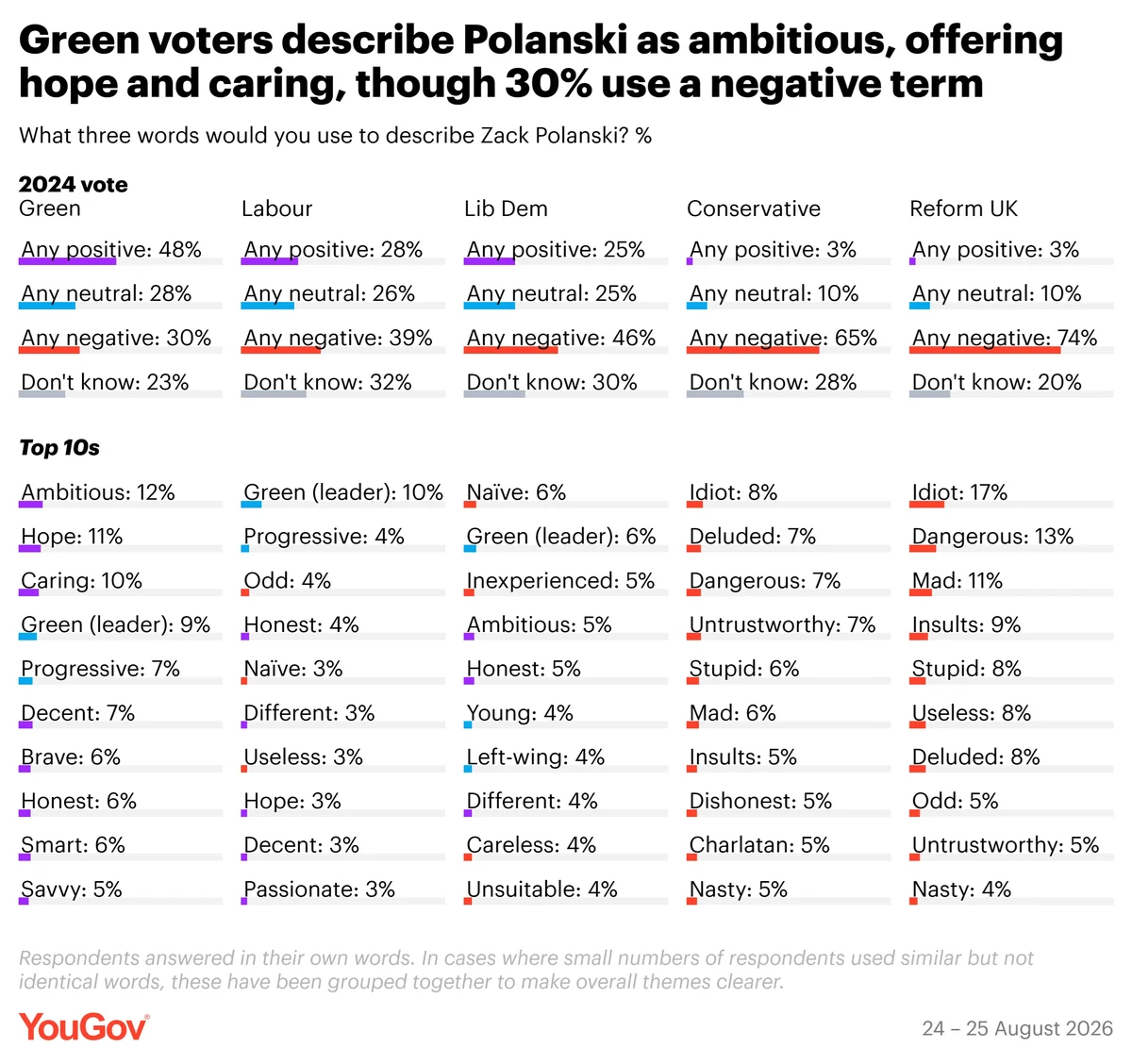
Even among Green voters, the descriptions are far from overwhelmingly positive. Only around half of those who backed the party in 2024 (48%) use at least one outright positive term when describing Polanski, while as many as 30% use at least one negative term. Additionally, 28% use a neutral term, including 9% describing him as little more than the Green Party’s leader.
Ambitious, ‘hope’ and caring are the most common positive terms Green voters use to describe Polanski, with them featuring in 10-12% of three-word descriptions, with decent, brave, honest and smart cropping up 6-7%. It is also likely that the 7% who used the word progressive in their descriptions mean so in a positive way. The negative terms used by Green voters are varied, with none being used by more than 4% (unrealistic).
Other voters tend to be more negative, with even more aligned Labour and Lib Dem voters being more likely to use critical (39-46%) than complimentary adjectives (25-28%) in their three word outlines of Polanski. But the themes of the criticism do vary. Among Reform and Conservative voters, 65-74% of whom use negative terms, the top barbs include idiot, dangerous, deluded, mad and stupid, while words like naïve, careless and inexperienced tend to be more common among Labour and Lib Dem voters.
What do Britons think about the Greens?
A decline in popularity is not just isolated to Zack Polanski, with the Green Party as a whole viewed much more unfavourably by the public than before he took over as leader. In August 2025, the Greens held a positive net favourability rating of +5. Even if it was only marginally positive, they were then the most favourably viewed party in Britain.
In our latest figures, however, this score stands at -19, with a majority of Britons (53%) now seeing the environmentalist party unfavourably, a 14 point increase over Polanski’s leadership. This rating also places the Greens on a par with Labour (-17), who have recovered substantially from a nadir of -49 last December.
Indeed, this negativity now extends to most parts of the Greens’ image. Half of Britons (50%) see the party as weak, relative to a mere 10% feeling they are strong, with the public also tending to view the Greens as out of touch (by 46% to 21%), incompetent (45% to 20%), serving their own interests (44% to 32%), untrustworthy (40% to 24%) and caring only about a select few (40% vs 29%).
Nearly four in ten Britons (36-37%) also see the Greens as extreme or prejudiced, relative to just 26% viewing them as moderate or tolerant.
The only exception, among the party image questions we typically ask, is whether the Greens have a clear sense of purpose, which divides Britons, with 36% finding the party to have a clear direction and an equal 36% instead finding it unclear what they stand for.
Perhaps unsurprisingly, the Greens’ image holds up reasonably well among those who backed the party in 2024, but among those who voted for Labour, who the Greens’ gains earlier in the year primarily came from, the picture is mixed.
While 2024 Labour voters tend to, for instance, think the Greens have a clear sense of purpose (by 48% to 29%) and are generally tolerant (40% vs 25%), they are divided over whether they are competent (32% vs 34%) or in touch (32% vs 35%), and see the Greens as weak by a margin of 43% to 16%.
See the full results here, here and here
Methodology
- Sample size: An online survey of 2,070 adults aged 18+ in Great Britain
- Fieldwork: 24 to 25 August 2026
- Commissioned by: YouGov
Click here for more information about how we carry out research
Interested in taking YouGov surveys? What do you think about Zack Polanski, the Green Party, and everything else? Have your say, join the YouGov panel, and get paid to share your thoughts. Sign up here.
Interested in commissioning YouGov research? We connect in real-time with real people around the world to gather their thoughts, behaviours, and opinions, to ensure that our research data is powered by reality. Explore our survey services here.
Photo: Getty