
Key takeaways
- 77% of Britons have heard the term ‘picky bits’, including 38% who use it themselves
- 73% of Britons have heard the term ‘holibobs’, with 17% using it
- Survey also examined awareness of and attitudes to other terms like cozzy livs, menty b, and platty joobs
- 43% of Britons like the term picky bits, only 25% dislike it – with dislike primarily coming from those who had never heard the term before
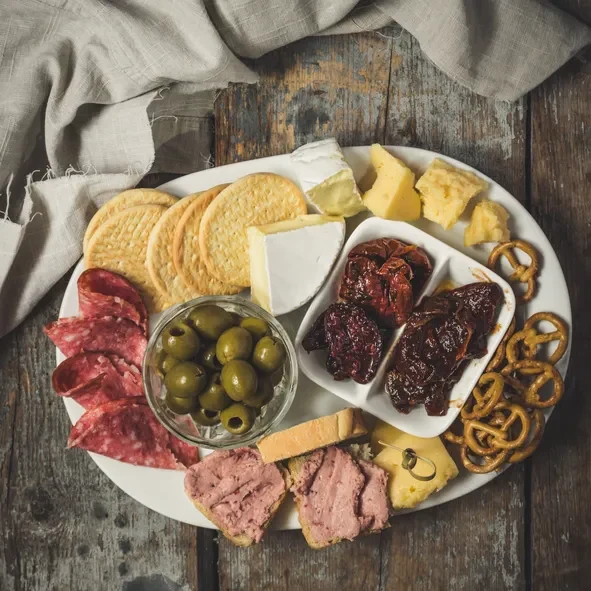
The term ‘picky bits’ is having something of a moment, with Marks & Spencer adopting the term – which refers to a meal made up of small, snackable finger foods – to promote its offerings.
Data from Google Ngrams shows that usage of the term (in books) has been rising since the year 2000, while Google Trends shows search traffic for the term dramatically increasing over the past two years.
This is not a welcome development for some, with The Telegraph’s Camilla Tominey suggesting it might be the most revolting phrase in the English language, while The Guardian’s Laura Snapes saying that no self-respecting adult should use the term.
Unfortunately for Snapes, this applies to more than a third of the British public, with 38% saying that they use ‘picky bits’ themselves. On top of that, another 39% of people say they have heard the term; it has only passed 23% of the public by.
Relatively few find the terms as offensive as Snapes – only a quarter (25%) have a negative view, with just 12% saying they “hate” it, the most negative option we offered.
Set against this are 43% of the public who love or like the expression, and a further 31% who don’t mind it either way.
Much of the disdain comes from those who only discovered the term when YouGov introduced them to it. While 57% of this group say they dislike or hate the term, this falls to 28% among those who have heard it and don’t use it – and just 1% of those who use it themselves (presumably ironically).
Other terms are less popular.
For instance, the term “holibobs” – used to refer to holidays – is almost as widely known as ‘picky bits’, with 73% of the public aware of the term. However, almost half of the public (48%) dislike or hate the word, compared to only 25% who like it or love it.
Other terms, such as “menty b”, “platty joobs”, “cozzy livs”, “statey funes” are particularly unpopular, with 71-82% of the public having a negative view.
However, these words are substantively different, insofar as relatively few Britons have heard of them, at 8-26%. This matters because there are dramatically different attitudes to each of the words we surveyed depending on whether or not the public were already familiar with them. In all cases, where a respondent was introduced to the term by YouGov for the first time, they were far more likely to feel negatively towards it than those who had already heard it being used before.
So if instead we look at only those who were already familiar with the term ‘picky bits’, we can see that 52% are positive about the term, 32% are neutral, and only 15% are negative. By contrast, only 8% of those who had not heard it before are positive upon discovering it, while 27% are neutral and 57% are negative.
Older people are less familiar with these terms
Our results show differing levels of awareness across the generations, with older people generally less likely to have heard of each of the terms.
Nevertheless, picky bits has cut through, with a majority of all age groups aware of the term, ranging from 87% of 18-24 year olds to 64% of the over-65s.
Holibobs is likewise understood by most people whatever their generation, with 25-49 year olds the most likely to have heard of it (81%) and the over-65s again the least likely (58%).
Methodology
- Sample size: An online survey of 2,082 adults aged 18+ living in Great Britain
- Fieldwork: 29-30 September 2026
- Commissioned by: YouGov
Click here for more information about how we carry out research
Interested in taking YouGov surveys? What do you think about picky bits, cozzy livs and all these other terms? Have your say, join the YouGov panel, and get paid to share your thoughts. Sign up here.
Interested in commissioning YouGov research? We connect in real-time with real people around the world to gather their thoughts, behaviours, and opinions, to ensure that our research data is powered by reality. Explore our survey services here.
Photo: Getty