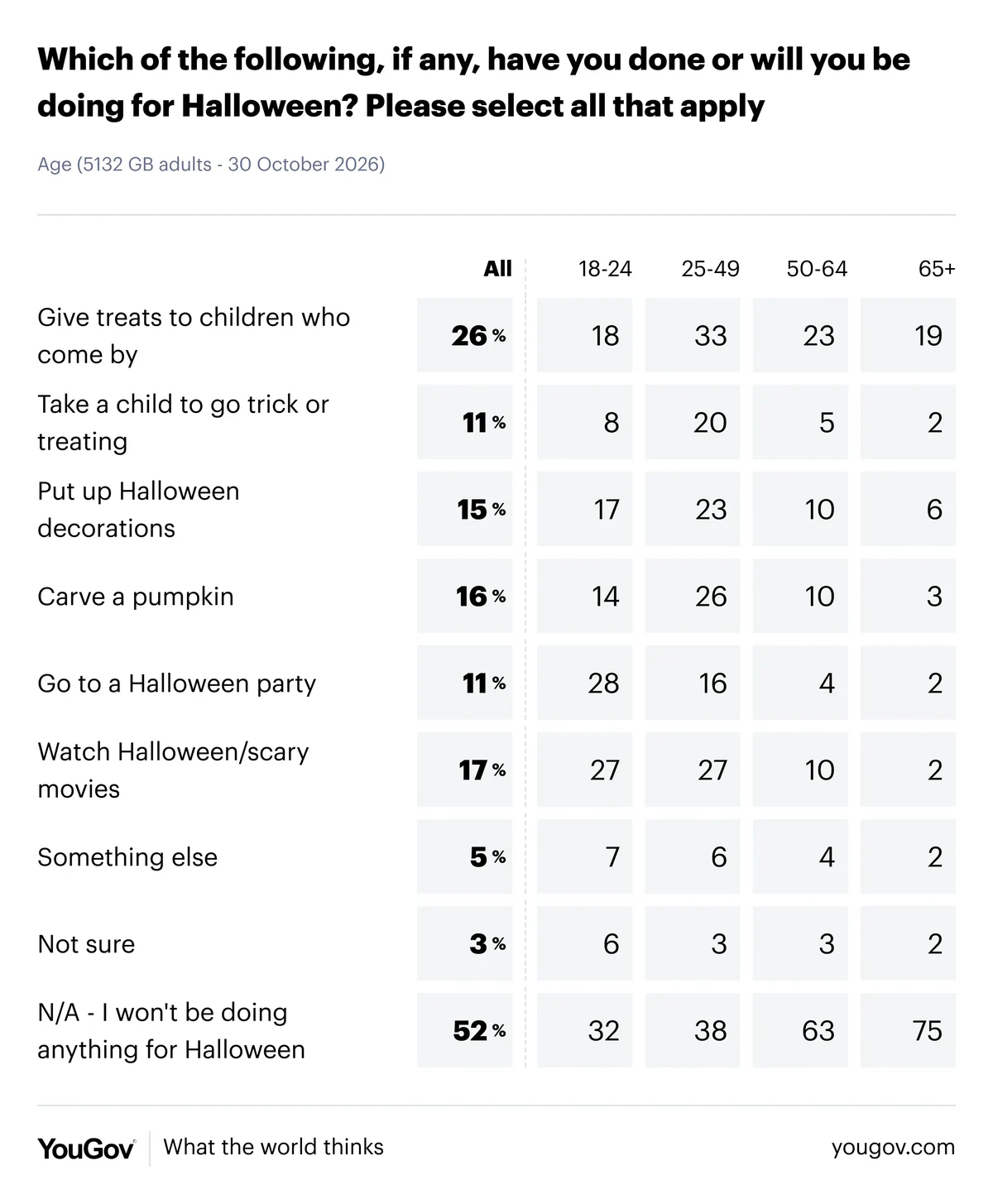
YouGov recently asked Britons what, if anything, they are doing for Halloween.
One in nine (11%) will be taking a child trick or treating, and 26% will be giving treats to children who come by.
One in six (16%) will be carving a pumpkin, while 15% will be putting up Halloween decorations.
One in nine (11%) will be attending a Halloween party, and 17% will be watching Halloween or scary movies.
However, most Britons won’t be getting into the festivities, with 52% saying they won’t be doing anything.
The younger Britons are, the more likely they are to be doing something spooky on Saturday, ranging from 68% of 18-24 year olds to only 25% of the over-65s.
But what do Britons make of Halloween? To find out, we used our new YouGov AI Interviewer tool to ask respondents: “What do you think about Halloween in general?”
The AI agent then conducted interviews with each respondent, following up on their responses, in order to provide ‘the why’ behind what Britons think. Our qualitative analysis of attitudes, including quotes, can be found below, along with examples of respondent interviews in their entirety.
It has become too commercial
Many respondents see Halloween as a money-making exercise for shops and businesses. They point to aisles of plastic tat, the pressure on parents to spend on costumes, decorations and treats, and the waste that follows.
- “Well it's now a massive shopping event with people buying loads of tat they don't need and enriching big corporations as a result. That seems like an American import.” – Man, 18-24
- “It’s so over hyped. Ridiculous amounts of money wasted on it. Can’t stand it.” – Woman, 55+
- “I think it’s another chance to be sold items I don’t want to buy, and I don’t want to participate in the event. But my kids love it and I want to make them happy.” – Man, 45-54
- “Every child expects what their friends get so Boo baskets, Halloween days out,etc and some parents can't afford these in the run up to Christmas” – Woman, 35-44
A fun, spooky time of year
Some simply enjoy Halloween. They talk about dressing up, horror films, decorations and parties with friends, and about having something to look forward to as the evenings get darker.
- “I didn't answer that earlier...but I enjoy Halloween, and wish the spooky season was longer! It's a few days a year where it's 'normal' to dress a little more odd, listen to creepy music, etc.” – Woman, 18-24
- “I have put up Halloween decorations, bought some treats for home, and will watch some spooky movies. I quite enjoy it as a nice little treat-break during the chillier, darker months.” – Man, 45-54
- “Every year for Halloween I get together with friends and watch horror movies. We usually make cocktails and get a chippy.” – Woman, 35-44
- “Creative, dark, fun, decorations, horror movies, macabre story lines on tv shows - I call it Goth Christmas” – Woman, 45-54
It is for the children
Some see Halloween as an event for children. For some this is a reason to join in with their own children or grandchildren; for others it is a reason why adults should not take part.
- “I think it is a fun event for children but it is immature to take part in as you get older.” – Man, 18-24
- “I think it's fun. I enjoyed taking my children Trick or Treating when they were young, and I enjoy having children coming to the door now.” – Woman, 55+
- “Don’t enjoy it but do stuff because the kids love it” – Woman, 35-44
- “I like seeing the effort they and their parents make in dressing up to look scary. I like seeing how proud they are of how they look.” – Man, 55+
An American import
Some regard Halloween as an American custom that has been imported into Britain. Some of them feel it has pushed aside British traditions such as Bonfire Night, guising, turnip lanterns and apple bobbing.
- “It's very American by now” – Man, 18-24
- “It used to be OK... "Penny for the Guy" etc but we have allowed American "Trick or Treat" to take over. Why do we always have to be swayed/influenced by America. We ought to stay more true to "British" values and ways of doing things.” – Man, 55+
- “I think it matters to follow the traditions for it’s own sake as well as resisting Americanisation of our culture” – Man, 55+
- “I hate how it’s eclipsed the traditional Bonfire Night.” – Woman, 55+
Not interested
Some are indifferent to Halloween. It plays no part in their lives, they have grown out of it, or it was never something they celebrated.
- “I dont really think much of it, I only really celebrate it when friends or family want me to join them.” – Woman, 18-24
- “Not something I’m interested in but don’t feel negatively about it” – Woman, 25-34
- “People can have fun if they want to or need this as an excuse to do so. I don’t feel any special affinity towards it as a special day.” – Woman, 35-44
- “I'm a 53 year old man so it's not aimed at me” – Man, 45-54
Trick or treating can feel intrusive or intimidating
Some object to trick or treating itself. They describe unwanted knocks at the door, antisocial behaviour by older children, eggs thrown at homes and the effect on older people, and question telling children to avoid strangers and then sending them to strangers’ doors.
- “Scaring young children, being anti social, setting off fireworks and flares dangerously, using it as an excuse to get really drunk for a weekend straight and then behaving antisocially” – Woman, 18-24
- “A few years ago my elderly neighbour (she was 92) had people knocking on her door at 22.30 at night and she could see there were 3 people. She did not want to open the door. They threw eggs at the door and then set her wheelie bin alight” – Woman, 45-54
- “I will be sitting at home with the lights off as I so not like trick or treaters” – Woman, 35-44
- “You encourage kids to talk to strangers and elicit candy from them with the threat of a trick if they don't comply.” – Man, 45-54
Religious objections and lost meaning
Some Christians object to Halloween as a celebration of darkness or evil. Others regret that its roots, whether in All Hallows’ Eve and All Saints’ Day or in the Celtic festival of Samhain, have been forgotten.
- “We are Christian’s so dont like the dark negativity around it- we prefer the smaller family things that are fun e.g pumpkin carving” – Woman, 18-24
- “The religious link. I am a roman catholic so it was all about the night before all Hallows day and remembering the dead who have gone before us. Also the old celtic links. We always got the 1st of November of school as it was a holy day of obligation. Now its all pumpkins and ghosts with no link to our shared past.” – Woman, 55+
- “I prefer to think of it as Samhain or Calan Gaeaf in Welsh as this expressed the origins of a key point in the cycle of the seasons.I will go out at dark and will meditate” – Woman, 55+
- “It's an American import, and a re-paganisation of what used to be a Christian feast day” – Man, 25-34
Other themes
A smaller number of respondents raised other points. Some dislike the horror and gore that now surrounds Halloween, while others focus on the environmental cost, from single-use plastic to discarded pumpkins. Some value the chance that dressing up gives them to express themselves.
- “I don’t like being scared and think the real world is scary enough!” – Woman, 45-54
- “Too many Halloween related items for sale which are single use. Also people generally don't use the scooped out pumpkin for food and they leave pumpkins on the ground where they are toxic for hedgehogs” – Woman, 55+
- “You can explore gender in a non judgmental way. Or just explore your interests” – Woman, 18-24