
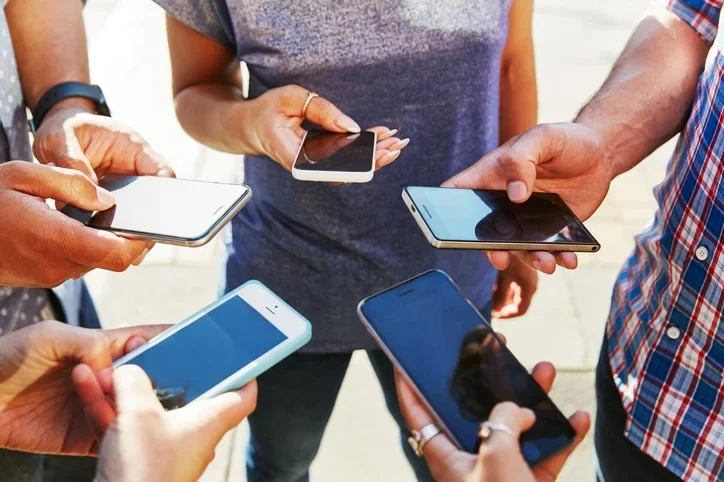
A new YouGov survey explores how much screen time Americans are getting on an average day, how they feel about the frequency with which they’re checking their phones, and their phone usage while driving, watching TV, or eating with other people.
Three-quarters (76%) of Americans say they use their cellphone or another device at least sometimes when they’re watching a movie or TV show at home. 12% say they always do this, while 33% often do it and 31% sometimes do. 51% of Americans who are between 45 and 64 years old always or often use their cellphone or another device when watching TV at home, a greater share than among older adults (39%) and younger ones (43%).
Nearly two-thirds (64%) of Americans estimate they spend at least five hours a day looking at screens, including 10% who say they spend more than 12 hours per day looking at screens. Adults under 65 are more likely than older Americans to spend at least five hours per day looking at screens (67% vs. 52%).
Americans 65 and older are more likely now than they were in July 2025 to say they spend at least five hours daily looking at screens (52% vs. 43%)
Which type of screens are occupying those hours? 28% of Americans say they spend at least five hours each day looking at a computer screen; similar shares spend at least five hours daily looking at their cellphone (25%) and television (22%).
Adults under 45 are more likely than older Americans to spend at least five hours per day looking at cellphone screens (32% vs. 19%) and computer screens (31% vs. 24%), but the reverse is true for TV screens (13% vs. 29%).
45% of Americans say they check their cellphone more often than they’d like to, including 26% who do so much more often than they’d like to. Adults under 45 are more likely than older Americans to say they check their cellphone much more often than they’d like to (34% vs. 20%).
Americans are slightly more likely to say they check their phone much more often than they’d like to now than they were in May 2025 (26% vs. 20%).
Majorities of Americans say they check their phone at least once when they’re watching a movie or TV show at home (76%) and when they’re eating a meal alone (71%). Many check their phone at least once when they’re eating with others (48%), driving somewhere (31%), or in a meeting at work (23%).
About one-third (36%) of Americans say they wish they could take a break from their cellphone to focus on other activities, and say they often do so. Slightly fewer (27%) say they wish they could do so, but rarely or never do. Adults under 30 are more likely than older Americans to say they wish they could but generally don't (34% vs. 25%).
The most common methods people use for taking a break from their cellphone, from among seven options provided in the survey, are deleting distracting apps (37% sometimes do this), turning off notifications (32%), using Do Not Disturb mode (31%), putting their phone in another room (25%), and powering off the phone (22%).
How long do Americans say they could comfortably go without their phone for personal use? 8% say they could go only an hour or less, 26% a few hours, 17% a full day, and 16% a few days. Fewer say they could go a week (8%), one month (4%), more than one month (4%), or more than a year (6%).
Americans 30 and older are more likely than younger adults to say they could comfortably go without their phone for a full day or longer (58% vs. 47%).
There are noticeable differences between age groups in use of cellphone ringers. Among Americans 65 and older, 45% say they almost always have the ringer on. Fewer 45- to 64-year-olds (33%), 30- to 44-year-olds (22%), and adults under 30 (16%) almost always have the ringer on.
Only 9% of Americans 65 and older say they almost always have their phone on vibrate or silent. 21% of 45- to 64-year-olds, 33% of 30- to 44-year-olds, and 36% of adults under 30 almost always have their phone on vibrate or silent.
Related:
- For many Americans, their smartphone is the last thing they see at night and the first thing they see in the morning
- The enduring appeal of classic technology: A poll of Americans’ past and present usage
- How do Americans feel about 16 emerging technologies, including AI, VR, crypto, and NFTs?
See the results for this YouGov survey
— Carl Bialik contributed to this article
Methodology: This article includes results from an online survey conducted on February 11 - 17, 2026 among 2,012 U.S. adult citizens. Respondents were selected from YouGov’s opt-in panel to be representative of adult U.S. citizens. The sample was weighted according to gender, age, race, education, 2024 presidential vote, 2020 election turnout and presidential vote, baseline party identification, and current voter registration status. 2024 presidential vote, at time of weighting, was estimated to be 48% Harris and 50% Trump. Demographic weighting targets come from the 2019 American Community Survey. Baseline party identification is the respondent’s most recent answer given around November 8, 2024, and is weighted to the estimated distribution at that time (31% Democratic, 33% Republican). The margin of error for the overall sample is approximately 3 percentage points.
Image: Getty