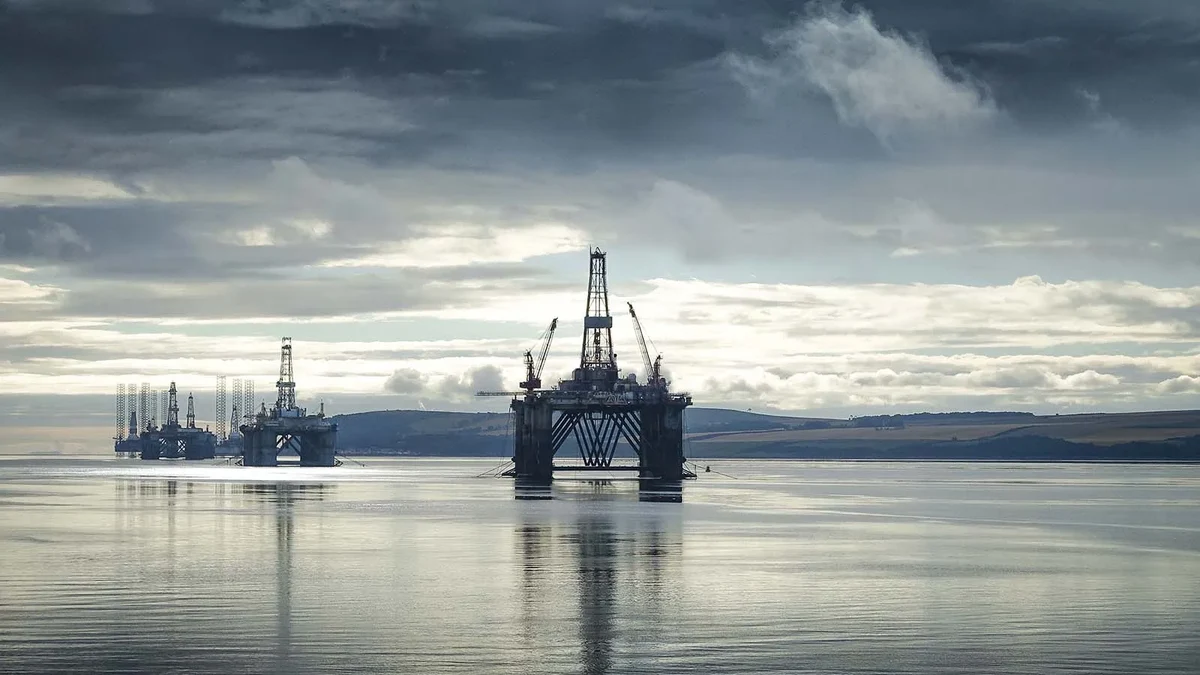
Scots tend to oppose the existing ban on new developments
Key takeaways
- Scots tend to oppose the current ban on new North Sea oil and gas developments by 45% to 37%
- By comparison, those in England and Wales are near-split on allowing new oil and gas fields
- 51% of Scots believe it’s more important to ensure oil and gas extraction in the North Sea can continue as long as possible than for Scotland to reach its net zero targets
- By 60% to 29%, Scots think public funds generated from North Sea oil should be spent exclusively in Scotland
The future of oil and gas drilling in the North Sea has been back on the political agenda in recent weeks, with debate reignited by the increase in oil prices caused by the conflict between the US and Iran.
Having stood on a manifesto promising not to approve new oil and gas developments, some in Labour have now said they would be happy to see the greenlight given to two new North Sea drilling projects, despite reported reluctance from energy secretary Ed Miliband.
This is a path vocally supported by the Conservatives and Reform UK, while the Scottish government are also seen to have softened their stance on future developments, with first minister John Swinney saying energy security should be prioritised.
The Scottish public tend to agree with this stance, with nearly half of Scots (45%) opposed to the current ban on new oil and gas developments in the North Sea, relative to 37% supporting it.
Among those intending to vote for the SNP, Labour or Lib Dems in May, roughly half (47-52%) oppose the ban and 36-41% support it, with Conservative and Reform UK supporters being around twice as likely to be against the ban (59%) than in favour (29-32%).
It’s only those intending to vote for the Greens in the Holyrood election who tend to support the ban, though even then, just 54% who support preventing new developments, with 30% opposed.
In the rest of Britain, the public are more evenly divided, with 38% of people in England and Wales in favour of the ban and 39% against it. This does, nonetheless, represent a small growth in opposition to the ban since last February, when 40% of those in England and Wales backed it and 33% were opposed.
The gap between Scotland and the rest of the country is particularly evident among those who backed Labour and the Lib Dems at the last general election. Just 31-32% of their English and Welsh voters oppose the ban, relative to nearly half of their Scottish supporters (48%).
Do Scots think North Sea oil extraction should be prioritised over reducing carbon emissions?
While SNP policy is that they “are committed to capitalising on [Scotland’s] natural resources and pursuing a green reindustrialisation of Scotland”, at the core of the debate on North Sea oil is that only one can be the priority.
And in terms of which one should come first, half of Scots (51%) believe it’s more important to ensure that oil and gas extraction in the North Sea can continue as long as possible, compared to 36% who feel the Scottish government should prioritise its target of meeting net zero carbon emissions by 2045.
Eight in ten Scots intending to vote Reform UK in May (79%) believe the Scottish government should prioritise the oil and gas industry over net zero, as do 74% of Conservative supporters and 61% of those planning to back the Lib Dems.
Scots intending to cast their regional vote for the SNP or Labour in May are both divided on the question, with 43-45% believing oil and gas extraction should the priority and 40-43% favouring pursuing net zero by 2045.
Green backers again, unsurprisingly, stand apart in believing the Scottish government should prioritise net zero targets by a margin of 75% to 15%.
On this trade-off, the public in England and Wales are similarly divided to the public in Scotland, believing it’s more important for oil and gas extraction in the North Sea to continue as long as possible than for Britain to meet its net zero targets by 50% to 34%.
The distinct difference between the views of Scottish Labour voters and those elsewhere in Britain are still apparent, however, with Scots who backed Labour in 2024 believing it’s more important to prioritise extraction by 52% to 34%, while the party’s English and Welsh voters think it’s more important to reach net zero by a near-identical margin of 52% to 33%.
Do Scots think it should just be Scotland’s oil?
Given Britain’s North Sea oil and gas developments are primarily located off the coast of Scotland, there has been a long-standing demand from some Scots for all the revenues generated to be spent on Scotland, with the SNP in the 1970s famously using the slogan “It’s Scotland’s Oil”.
Indeed, six in ten Scots (60%) believe that public North Sea oil money should be exclusively spent on Scotland, roughly twice the 29% who feel it should be able to be spent across the whole UK.
The question’s link to the idea of Scottish independence can somewhat be seen in who supports the idea, with 85% of those intending to vote SNP and 74% of supporters of the also pro-independence Greens doing so, but falling to 49-52% of those planning to back Labour or the Lib Dems, as well as just 38% of Reform UK supporters and only 26% of Conservatives.
The issue is more one-sided in England and Wales, with 79% of the public believing funds generated by North Sea oil and gas should be open to the whole country, with only 4% feeling they should be allocated solely to Scotland.
See the full results here (Scotland) and (England and Wales)
Interested in taking YouGov surveys? Do you support new oil and gas developments in the North Sea? What do you think about energy security in general, and everything else? Have your say, join the YouGov panel, and get paid to share your thoughts. Sign up here.
Interested in commissioning YouGov research? We connect in real-time with real people around the world to gather their thoughts, behaviours, and opinions, to ensure that our research data is powered by reality. Explore our survey services here.
Photo: Getty