
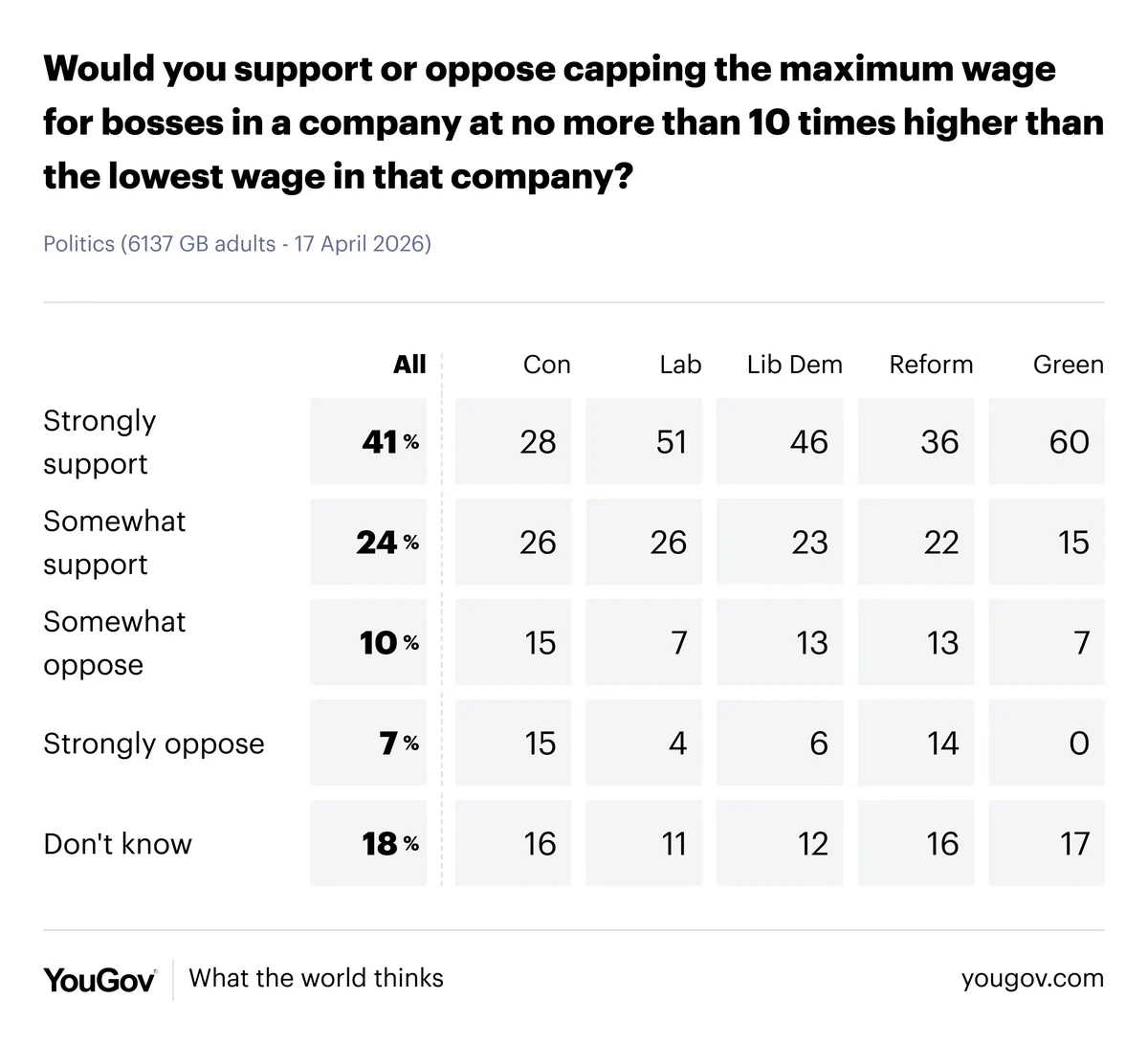
Following the Green Party’s announcement that they would look to cap the maximum wage for bosses at a company at no more than ten times higher than the lowest wage in that company, a YouGov survey found that almost two thirds of Britons (65%) back the proposal.
There is majority support across the political spectrum for such a move, ranging from 54% of Tories and 58% of Reform voters to 75% of Green and 77% of Labour voters.
Clearly the public do not believe that CEOs deserve the high levels of pay they receive – but why?
To dig deeper into public perceptions in this area, we used our new YouGov AI Interviewer tool to ask respondents: “do you think CEOs in big businesses generally do or do not deserve the high levels of pay they receive?”
The AI agent then conducted interviews with each respondent, following up on their responses, in order to provide ‘the why’ behind what Britons think. Our qualitative analysis of attitudes, including quotes, can be found below, along with examples of respondent interviews in their entirety.
Performance and CEO pay
Respondents criticising levels of CEO pay called into question the high sums involved, and their relation to company performance

- They are completely disproportionate to the work they do, they sustain consumptive and extractive models and mean money is being drained from worker pay and wider societal need – Female, 45-54
- Often their pay doesn't relate to company performance – Male, 25-34
- CEO pay is so astronomically more than the average worker, even when they mess up and are booted out (or leave) they still get handsome pay offs – Female, 55+
- They have rigged the system so they get a grossly higher pay than the majority of staff. Getting salaries and bonuses based on the share price of a company leads to share buy backs and pumping stock. Should entirely be related to performance. Look at tesla pumped up to extraordinarily share price and completey unrelated to the performance of the company – Male, 55+
- because those at the top over value themselves and under value their employees. they have lost touch with reality. – Female, 55+
- I think the figures are too High, especially in respect of stock options and the like, when compared to the actual value they add to a given company – Male, 18-24
- Because very often the high pay is supposedly linked to their level of accountability and responsibility, and in reality the level of consequences these people receive (mostly none) when something goes wrong rarely reflects the reasoning why they were supposed to be receiving the high pay. – Female, 35-44
- CEOs should be well paid if they do a good job. There are too many being paid and receiving large bonuses when they fail – Male, 55+
- Many CEOs earn huge bonuses even when companies perform poorly or lay off staff. Pay is sometimes linked to short-term share price rather than long-term health of the business – Male, 45-54
Worker pay gaps and fairness
Many respondents contrast the high level of CEO pay with that of lower paid workers at their companies.
- Limit their pay to a specific multiple of a median workers salary. I think that’s a fairer way to do it as it recognises every person’s contribution to the success of an organisation – Female, 35-44
- CEOs are more in the public view, with some additional stress overseeing the whole company, but their effort is not worth hundreds of times more than a regular employee working hard full time to barely make a living – Male, 18-24
- It seems to have grown beyond wages for staff in general. If a company does well, it's because everyone in the workforce is contributing. CEOs and executives should be paid more because they have more responsibility. However, if the exec is getting a 20% pay rise so should the workforce. – Male, 45-54
CEO responsibility and merit
Those who defended high levels of pay for CEOs cited the responsibilities they hold, and the level of business experience.
- If I make million pound decisions on a daily basis - then compensation in that range is appropriate. Your management of funds personally at that level has an impact on your decision making. Its like taking a person who has only ever earnt 10K a year and entrusting them to make decisions worth 10 million every day . – Male, 25-34
- A CEO needs great awareness of the market in which they are operating and must be able to future proof a business by making shrewd decisions- these things are hard-won over time - and a CEO must be able to prove that they have these qualities. Experience abd business acumen is worth rewarding! – Female, 55+
- They work long hours and have high levels of responsibility, and are usually highly qualified/have been background information on their industry – Female, 25-34
- It's shocking on how little some people need to survive - but on the other hand if someone has extensive experience, knowledge, and potentially various degrees - and the leadership skills to match, then I do think that with a highly stressful role that is not a 9-5 job 5 days a week but rather a round the clock affair the higher compensation is absolutely justified. Again - it depends very much. – Female, 55+
- I think they deserve to be paid well as they have a lot of responsibility in their role however some ceos get paid exorbetant amounts – Male, 18-24
Market forces and pay setting
Some suggest that ultimately the amount that CEOs are paid is up to their shareholders, and that the government should keep out of the issue.
- Most of them probably do not, but the decision is for the owners/shareholders of the "big businesses" and not the government. – Male, 55+
- It really depends - private sector companies should pay what they want - it’s public sector that needs to be looked at – Male, 45-54
- The only high CEO pay I have an issue with is those who work for charities. What private businesses pay is none of anyone else’s business, but charities spend far too much on wages… leaving a lot less to cover the reason they were formed in the first place. – Female, 45-54
- If the business is ethically making money, paying appropriate taxes and contributing positively to the economy then I don’t think it’s anything to do with the state as to what the CEOs are paid. If they aren’t paying taxes, consistently making things harder for consumers and then lining their pockets from profiteering, then it’s less okay – Female, 35-44