SNP on course for fifth term in office, amid historic losses for the Tories and Labour and a breakthrough for Reform UK
Key takeaways
- The SNP win 62 seats in our model’s central estimate, just short of a majority, though they get over the line in 11% of our simulations
- Reform UK are on course to make a significant breakthrough in Scotland, winning 19 MSPs in our central projection
- Labour and the Conservatives are set for their worst Holyrood elections to date, falling to 17 and seven seats respectively
- The Greens are projected to double their seat total to 16, including potentially gaining two constituency seats, with the Lib Dems also doubling their tally, to eight seats
YouGov’s final MRP model of the 2026 Holyrood election suggests the SNP are on track for a fifth term in office, though with our central projection of 62 seats for the party falling just short of the 65 needed for a majority in the 129-member Scottish Parliament.
An SNP majority cannot be completely ruled out. Our model overall projects a range of outcomes, with an upper bound of 66 seats for the SNP, who win a majority in 11% of our simulations. Nonetheless, even a result close to our lower estimate of 56 seats for the nationalist party is likely to be enough to ensure John Swinney will be returned as first minister. In 99% of our simulations, the SNP and their fellow pro-independence Greens combined have more than enough seats to govern.
But while the SNP are projected to near-replicate their 2021 result of 64 seats, our model, which uses data from more than 6,500 Scottish adults in total in fieldwork from 25 April to 5 May, shows a seismic shift in the rest of the Scottish political landscape.
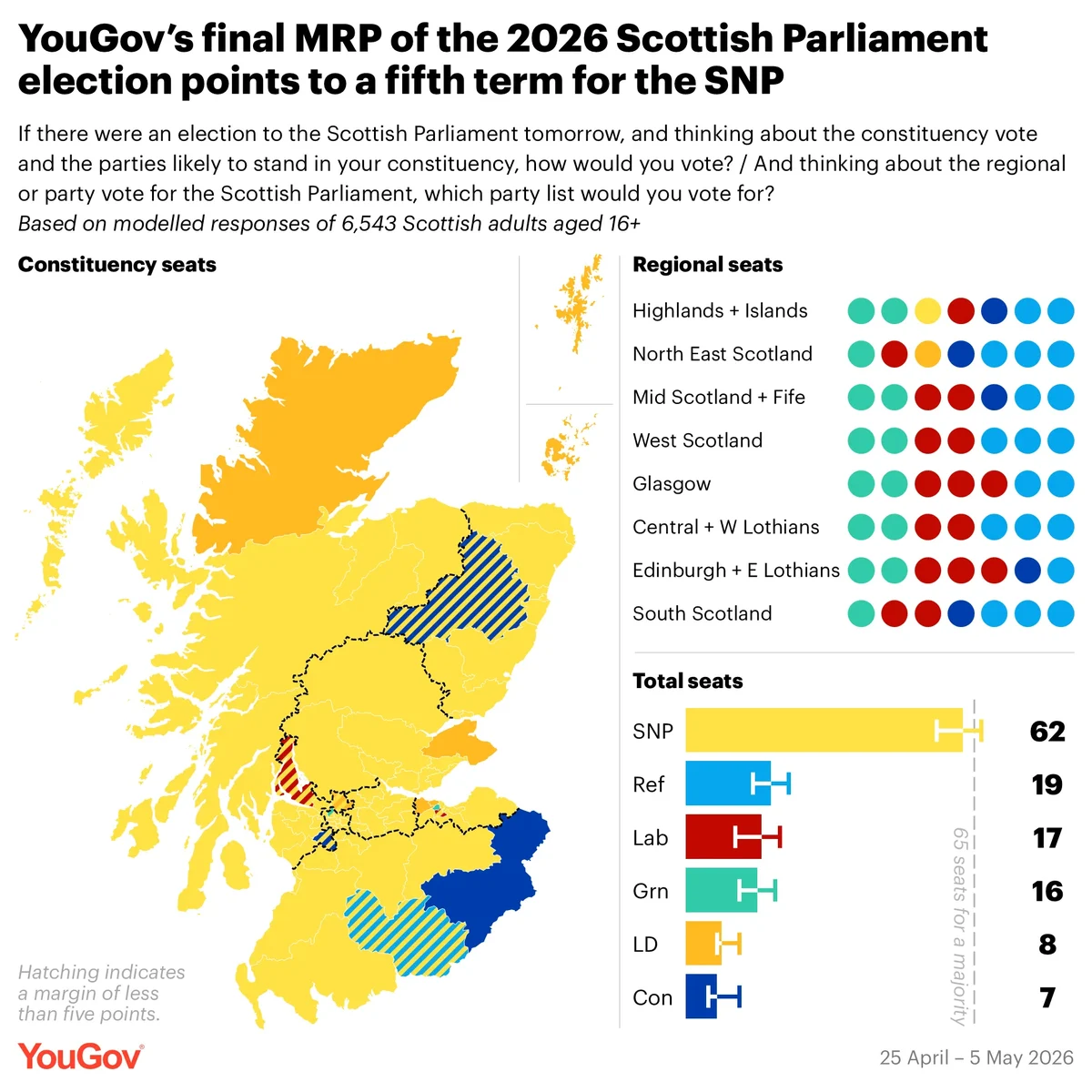
This is perhaps most apparent in terms of the near three-way tie for second place. Reform UK, who won a mere 0.2% of the vote five years ago, are on course to become the first party to the right of the Conservatives to win seats in the Scottish Parliament, taking 19 MSPs on our median estimates.
At the other end of the political spectrum, the Scottish Greens are likewise set for a record result, winning 16 seats in our central projection, double the eight they won in 2021. Labour are also on course for a similar level of representation, returning 17 MSPs in our model, though this is down five since the last election.
The range of results estimated by our model for these three parties all overlap so much that it is plausible any of them could emerge as the second-largest party in the Scottish Parliament.
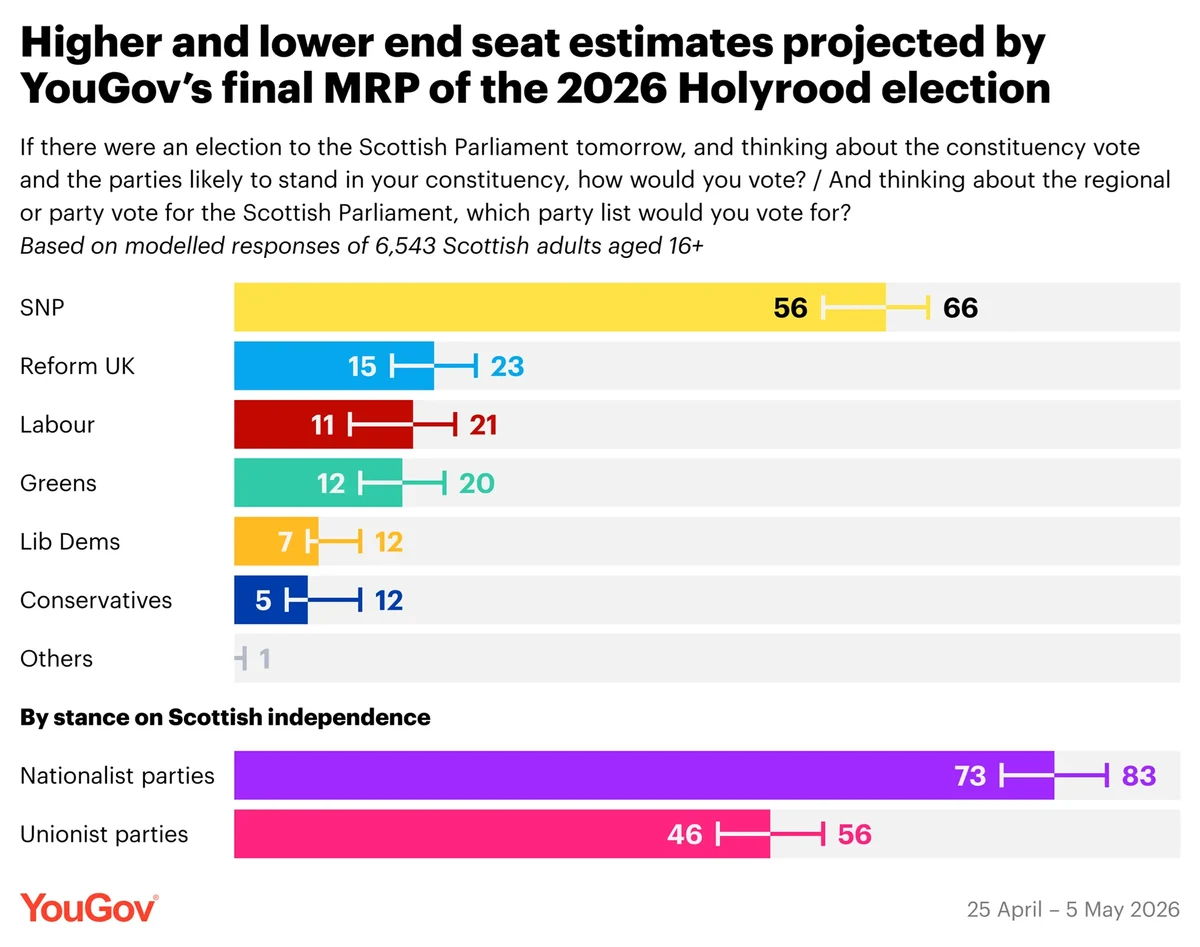
This cannot be said of the Conservatives, who have been the second-largest party – and largest unionist party – at Holyrood for the past decade. They are reduced to just seven seats in our central estimate, a loss of 24, putting them on a similar level to the Lib Dems, who are forecast to double their seats to eight.
For both the Tories and Labour, a result mirroring our MRP would be the fewest MSPs either party has yet returned to Holyrood, and is a marked decline from the 74 seats the two parties collectively won in the first devolved election in 1999. It would also continue a trend of Labour making a net loss at every election.
With the SNP experiencing little change in their seat total and the Greens on course for a record seat total, the 2026 election is set to result in the most pro-independence Scottish Parliament to date, with nationalist parties collectively winning between 73 and 83 seats in our model, relative to a combined range for unionist parties of 46 to 56.
The constituency contests
Scotland’s voting system has two components. First, there are 73 ‘constituency’ seats, elected by the same first past the post system used for Westminster elections. These constituencies are grouped into eight regions, each of which elect seven ‘regional’ seats by a form of proportional representation (giving 56 regional seats in total). These additional regional seats aim to balance the inherent disproportionality of the constituency results, and make the Scottish Parliament more closely reflect overall national support for each party, while still retaining elected representatives with constituency links.
Since 2011, the SNP have dominated the constituency results at Holyrood, a trend that shows no sign of letting up. On our central estimates, John Swinney’s party are projected to win 61 of these seats, relative to 62 in 2021.
The second most successful party in the constituency contests is set to be the Lib Dems, who are forecast to win in seven, up from four at the last election, while the Greens, who have never won a constituency seat at Holyrood, take two such seats in our central figures.
The Conservatives and Labour are on course to be reduced to just their safest seats, with the Tories winning in only two constituencies in our median projections, down from five in 2021, while Labour only hold a knife-edge lead in Dumbarton.
Nonetheless, this is overall a slightly better showing for ‘unionist’ parties in the constituencies than in our first MRP, to the extent of being sufficient to deny the SNP an outright majority at Holyrood. The changes in the data suggest that in a number of constituencies this is down to the ‘pro-unionist’ vote consolidating behind a single candidate, particularly for the Lib Dems’ gains in both Strathkelvin and Bearsden, and Edinburgh Northern.
Of course, in some constituencies, the lead projected by our model is wafer-thin. Seven constituencies are effectively tossups in our results, with the winning party’s estimated lead being five points or less.
Alongside the close race between Labour and the SNP in Dumbarton, the nationalists are well within reach of winning instead of the Conservatives in Eastwood, instead of the Lib Dems in Strathkelvin and Bearsden, and instead of the Greens in Glasgow Kelvin and Maryhill.
This is balanced, though, by the vulnerability of the SNP’s narrow margins over the Conservatives in Aberdeenshire West, Labour in Edinburgh Southern, and Reform UK in Dumfriesshire, where the Conservatives are also only slightly further behind.
Beyond these particularly tough to call races, there are a clutch of slightly less marginal constituencies where parties could pose a threat to the projected winner on a respectively good and bad night. This includes Galloway and West Dumfries, where both the Conservatives and Reform UK are no more than seven points behind the SNP, and Edinburgh Central, a three-horse race, with Labour and the Greens both lagging by a mere six points in our central model.
Regional results
The SNP’s domination of the constituency seats means that, on our model’s central figures, they are entitled to just one of the regional “top-up” seats, despite being set to win the most votes in all eight regions.
Instead, 19 of the regional seats are projected to be allocated to Reform UK, with 16 going to Labour, 14 to the Greens, five to the Conservatives and just one to the Lib Dems. Though, as with the constituency seats, some of these allocations are down to wafer-thin margins. For instance, if the Tory vote share is just a fraction of a percentage point higher in the Central Scotland region, the final seat goes to them rather than the Greens.
Support for the Greens is particularly strong in the Glasgow and Edinburgh and Lothians East regions, where 20-23% of voters intend to cast their regional vote for the party, relative to 12-14% in other regions. Reform UK’s vote is almost a mirror image of this, standing at just 11% in the capital’s region, half that seen in the Central, North East, South and West Scotland regions (22%).
Despite the decline in their support, Labour’s historic areas of strength in Scotland can still be seen, with the party continuing to do better in the so-called ‘central belt’, where the party is currently on 18-20% of the regional vote, compared to 11% in the North East and just 8% in the Highlands and Islands.
Likewise, the Conservatives are still set to do better in North East Scotland and South Scotland (both 14%), while Lib Dem support is disproportionately found in the Highlands and Islands, where they are projected to win 20% of the regional vote.
Latest Holyrood voting intention figures
Although the SNP are projected to largely hold their ground in seat terms, this is in spite of a significant decline in support since 2021, with our model’s median estimates showing the party taking a 39% constituency vote share, down nine points, and a regional vote share of just 28%, down a full 12 points. This latter figure is also down four points from our first MRP.
But while the SNP are less popular than at recent Holyrood elections, their opposition is more fragmented, with this enabling the party to retain so many first past the post constituencies in spite of their lower vote share.
As the first major electoral test in Scotland of Keir Starmer’s government, comparisons will also be drawn against the 2024 Westminster election result, where the SNP won 30% of the Scottish vote to Labour’s 35%.
Here, Labour are undoubtedly down, with a projected constituency vote of 18% and a regional share of 16%, both figures largely unchanged from our first MRP. But this is additionally a decline of four and two points respectively on Labour’s shares at the 2021 Holyrood election, putting Labour on course for their worst result at any election in Scotland since 1910, excluding only the 2019 European election result.
The Conservatives’ support is also set to sink to an historic low. Having never won less than a 12% vote share at any election in Scotland, the Tories are currently set to win a 10% constituency share and a 11% regional share on our model’s central estimates.
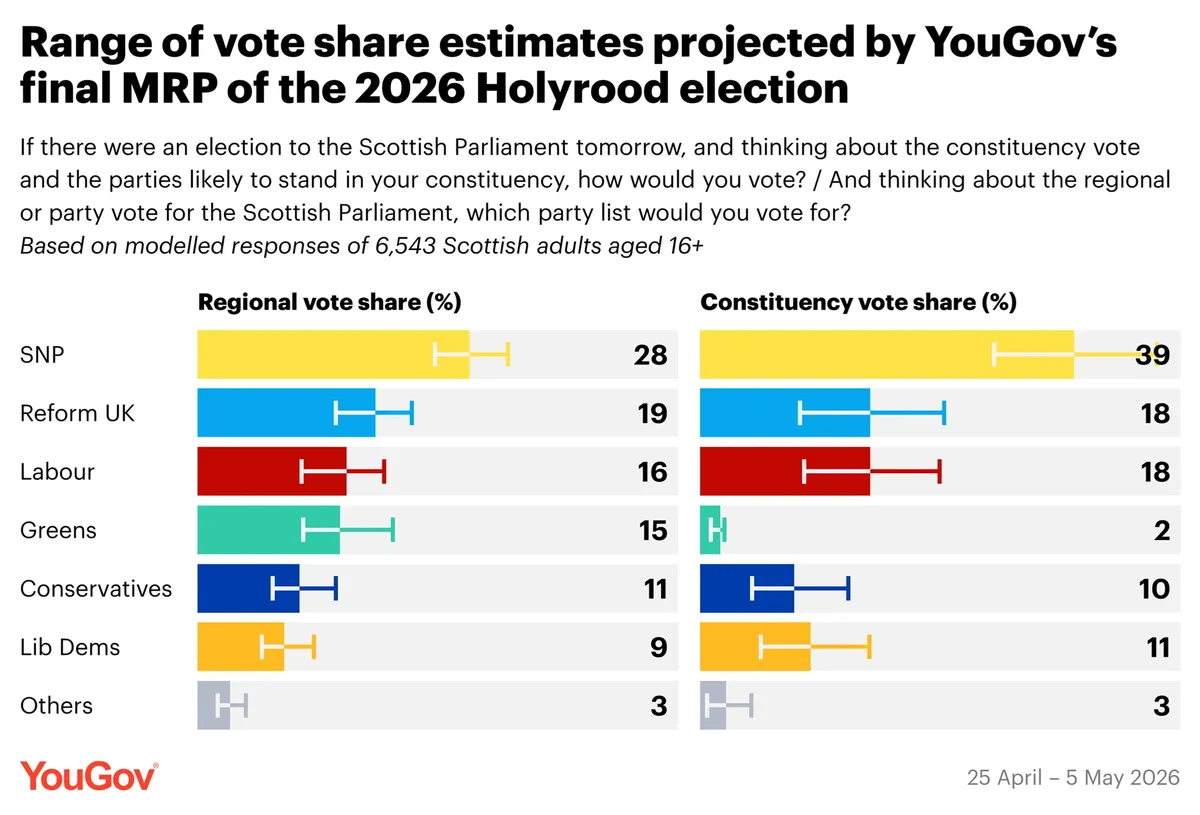
Reform UK are forecast to win 18% on the constituency vote, and 19% on the regional list. While this is from a baseline of next to 0% at the previous Holyrood election, it still marks a substantial gain on the 7% they won in Scotland at the 2024 general election, as well as exceeding the 15% they took as the Brexit Party in the 2019 European elections in Scotland.
Also set to make significant gains are the Greens, who in addition to a 2% constituency share (they are only fielding candidates in six constituencies), hold a median projected share of 15%, a gain of seven points from their joint-best result in 2021.
Our model projects four point increases on both votes for the Lib Dems, taking them to 11% of the constituency vote and 9% of the regional vote.
See the full results here and here
Interested in taking YouGov surveys? What do you think about the SNP, the 2026 Scottish Parliament election in general, and everything else? Have your say, join the YouGov panel, and get paid to share your thoughts. Sign up here.
Interested in commissioning YouGov research? We connect in real-time with real people around the world to gather their thoughts, behaviours, and opinions, to ensure that our research data is powered by reality. Explore our survey services here.
Photo: Getty