
Many current Labour voters would actually feel more positively if a Labour MP defected to the Greens
Key takeaways
- An MP defecting from the Tories to Reform would cause 40% of Britons to see them more negatively
- 39% say the same of Labour to Conservative defectors
- If a Labour MP went to the Greens the public are more divided: 23% would be more positive about them, and 20% more negative
- 19% of current Labour voters would feel more positively about a Labour MP if they defected to the Greens
In January of this year, five former Conservative MPs defected to Reform UK, most notably shadow justice secretary Robert Jenrick and former home secretary Suella Braverman.
More recently, Zack Polanski, leader of the Green Party in England and Wales, has also said publicly that many Labour MPs are in discussions about defecting to the Greens.
So what does the public think of such defections, and how, if at all, do opinions differ depending on the parties involved?
We asked Britons whether they would have a more positive or negative view of a hypothetical MP leaving a certain party and joining another, or whether this would make no difference.
Hypothetical Tory defections to Reform UK are the most negatively received by the British public, with 40% saying they would have a more negative view of the MP as a result and only 11% having a more positive view.
Labour to Conservative defections are viewed similarly poorly, with 39% having a more negative opinion of the hypothetical defector and only 12% a more positive view.
While Green to Labour MP defections follow on 30% and 8%, respectively.
Those who currently intend to vote Conservative would be more enraged by a Tory MP quitting the party for Labour than Reform UK. While relatively similar numbers would view the former scenario more negatively than the latter (69% vs 61%), the number who would feel “much more negative” about a Con to Lab defector is much higher (53%) than for a Con to Ref equivalent (33%).
For their part, 75% of current Labour voters would feel negatively towards one of their MPs defecting to the Tories, but are much less likely to be negative about a Labour MP jumping ship for the Greens – indeed 19% say they would feel more positively about the defector!
In terms of attitudes towards inbound defectors, current Green voters are the most likely to feel more positively about a Labour MP crossing the floor to their party, at 78%. Likewise, 51% of Reform voters would feel more warmly about a Tory MP who defected to their side.
By contrast, fewer current Labour voters would feel more well-disposed towards a Tory MP that joined their ranks (43%), and Tory voters are even less likely to be welcoming of a Labour MP who crossed over to their side (36%).
When it comes to a Green MP defecting to the Labour party, only 29% of Labour voters would feel more positively about them, although this is markedly different to other scenarios in that a much larger number of Labour voters say they would already have felt positively towards them, and the defection would not have changed this (30%, vs 6-15% in the other scenarios).
What is a good reason for defecting?
In explaining her defection, Suella Braverman said she had felt "politically homeless for the best part of two years”, while Robert Jenrick said it was because Reform UK represented the best chance of getting Labour out of Downing Street. But what do Britons see as good and bad reasons for an MP to change party?
Separate survey results from January find that three in four Britons think a good reason to defect is if the party has changed their views significantly, resulting in many core policies shifting to a different position (74%), or if the MP is dissatisfied with the party as a whole (72%).
However, a similar proportion say bad reasons to defect are if the party that the MP defects from is expected to do poorly in an election (73%), actually does poorly in an election (70%) or if the MP has a better chance of winning their position/seat with another party (70%).
Currently MPs are allowed to ‘cross the floor’ at any time, since individual MPs, rather than parties, are elected to the House of Commons, meaning that even if the MP changes their party, they remain the chosen representative of their constituency.
Seven in ten Britons (68%) nevertheless feel there should be a by-election in these circumstances – a majority of all voters share this view, ranging from 62% of Reform UK voters to 78% of Labour voters.
See full results here and here
Interested in taking YouGov surveys? What do you think about MPs who defect, whether they should have to fight a by-election, and everything else? Have your say, join the YouGov panel, and get paid to share your thoughts. Sign up here.
Interested in commissioning YouGov research? We connect in real-time with real people around the world to gather their thoughts, behaviours, and opinions, to ensure that our research data is powered by reality. Explore our survey services here.
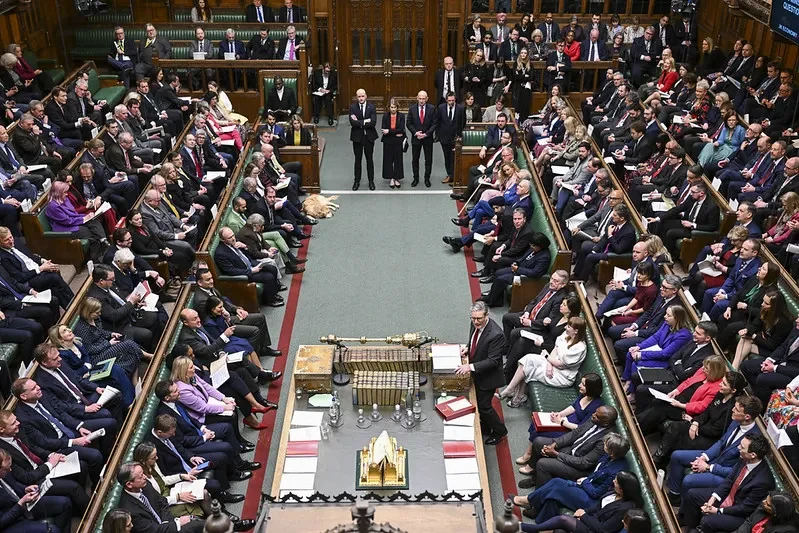
Photo: House of Commons via Flickr