Greens and Reform UK are set to make major gains in the capital, including potentially being the largest party on multiple councils
Key takeaways
- Labour look set for big losses across the capital, as the Greens in particular eat into their once solid London vote
- Reform UK are also expected to perform well, picking up significant levels of previous Conservative support in the outer boroughs, and driving into Labour heartlands in Barking and Dagenham
- The Conservatives and the Liberal Democrats are expected to hold most of what they have, while Independents and other parties look set to make gains particularly in London’s East.
YouGov’s new MRP model published today – our first ever in London for borough elections – projects a seismic shift for local government in the capital, with major gains for the Greens and Reform UK, as well as historic losses for Labour, who are on course to lose councils they’ve held for decades. In many boroughs, though, the margins are small, with multiple parties plausibly being victorious on 7 May.
The model, which uses data from more than 4,500 adults in London in fieldwork from 27 March to 21 April, projects vote shares for each of the parties in all 32 London boroughs. With so many close races, we are not projecting seat wins and losses, as per previous YouGov council election models, but are instead focussing on support for the parties. Owing to the first past the post voting system, this does not guarantee a party will win outright control of a borough, or even the most seats, as happened in Bexley at the 2002 elections and Havering in 2022.
Across the central vote share projections, there are no fewer than 10 boroughs where the second-placed party is within two percentage points of the largest party, an additional six where the margin is less than five percentage points, and a further nine where the margin is less than 10. This reflects wider patterns of fragmentation and increasing multi-party politics across the country.
In our model’s median projections, Labour win the highest vote share on 15 councils, down from 21 at the 2022 local elections, while there are breakthroughs for the Greens and Reform UK, who lead (even if marginally so, in some cases) on four and three councils respectively, having never previously topped the poll on any council in London.
The Conservatives remain ahead on five councils, relative to six at the last election, while the Lib Dems are set to win the most votes on four councils in our model’s central estimates.
Lutfur Rahman’s Aspire party is forecast to, once again, come first in Tower Hamlets, having become the first party other than the Conservatives, Labour or Lib Dems to win a London borough outright at the 2022 elections. We also expect the Havering Residents Association to again do well in their patch, but to come under a strong challenge from Reform UK.
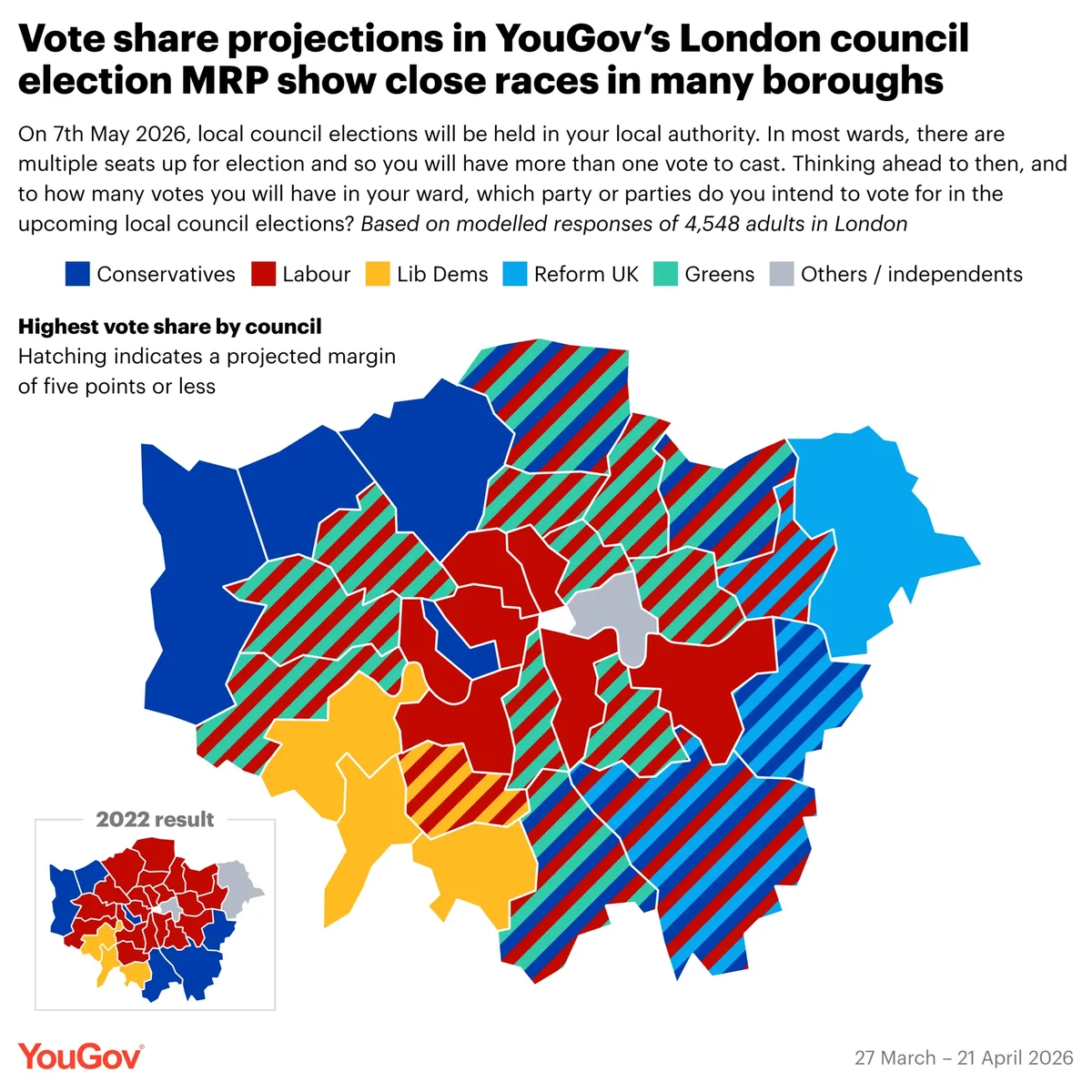
But as highlighted already, in many councils the margins projected by our model’s median projection are slim, with half (16 of 32) seeing five points or less between first and second place, and in some cases third.
The largest group here is councils where Labour and the Greens are both within five points of each other – Brent, Ealing, Hackney, Haringey, Hounslow, Lambeth, Lewisham, Newham and Waltham Forest – with the Conservatives providing the third participant for three-way contests in Croydon, Enfield and Redbridge.
In Merton, it’s the Lib Dems who are neck-and-neck with Labour, with just a point between the two parties on our central projection, while the Tories are projected to ‘flip’ largest party status in Barnet by a margin of just over five points.
While London has not typically been the happiest hunting ground for Reform UK or its predecessors, our model’s median estimates put them more than five points ahead in Havering, with smaller leads in both Bromley, and Barking and Dagenham. The party is also within five points of beating the Tories in Bexley.
Winning in Barking and Dagenham would be a particular bag for Nigel Farage’s party, as it is the only London borough to have remained under Labour majority control since it was created in the 1960s. Newham, where it’s the Greens and the Newham Independents Party who threaten Labour, has also been run by Keir Starmer’s party since its creation, though not always with a majority.
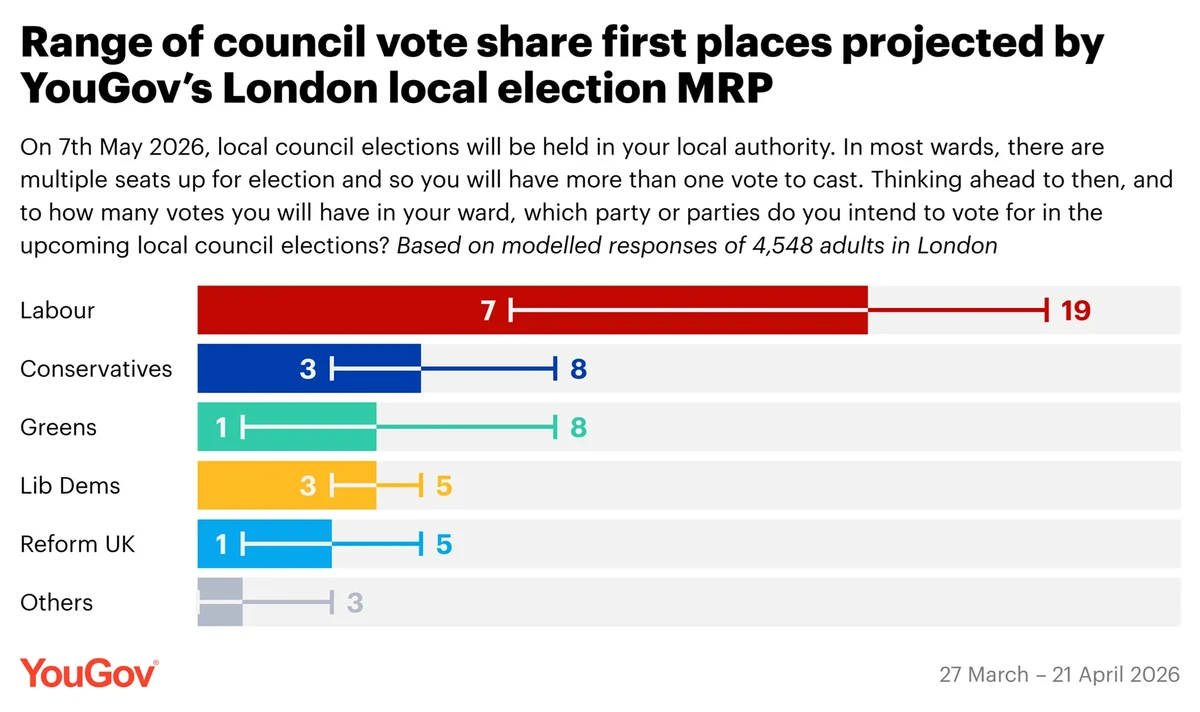
Overall, across all our simulations, the Greens could come first in as many as eight councils, with Reform UK winning the most votes in five councils on our model’s upper-most bounds, though both parties could fall as low as one each if our model’s respective lower bounds were borne out.
For Labour, our model puts the party in first place on seven councils in its lower-most estimate, while the higher-most estimate shows them topping the poll in 19 boroughs.
Not all our model’s projections are so close run, with the Lib Dems projected to retain their vote lead in their three south west London councils by double-digit margins, while the Conservatives are forecast to win more than twice as many votes as any other party in Harrow.
Labour’s safest councils on our model’s median projects are Camden, and Hammersmith and Fulham, where the party has estimated leads of 10-11 points.
London vote share
Across the whole of London, our model paints a highly fragmented picture, with all five of England’s largest parties registering double digit vote shares in our central projections.
While Labour are expected to top the London ballot once more, this will be off only around a quarter of the city-wide vote (26%), down a full sixteen points since the 2022 London elections, with the Conservatives dropping nine points to 17%.
Mirroring the national picture, the biggest beneficiaries of this decline will be the Greens and Reform UK, though in the capital it is the Greens of the two who are ahead, on 22% of the vote, up ten points since 2022. Reform UK, who won close to 0% of the vote last time, are now forecast to win a 14% share in our model’s central estimates.
The Lib Dems, who won 14% themselves in 2022, are near-unchanged, on a 15% vote share.
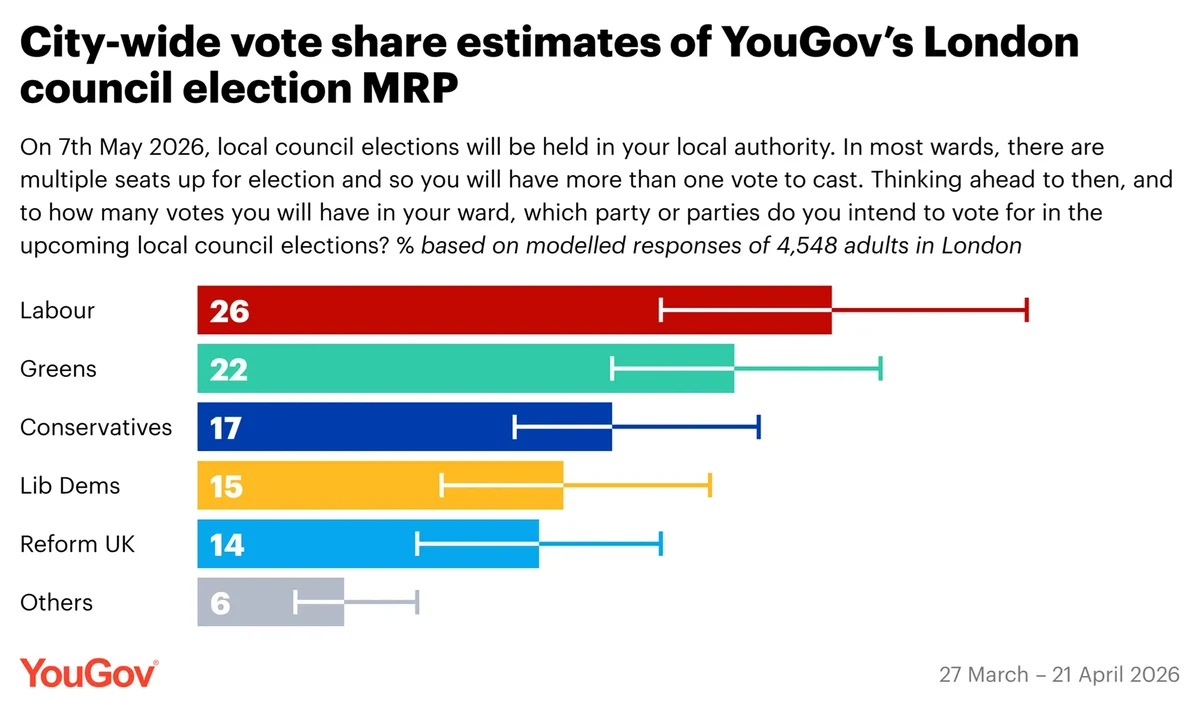
As with all projections of this nature, our London-wide vote share estimates also come with possible ranges. Labour could be anywhere from as low as 19 to as high as 34. The Conservatives have a ten-point probable range from 13% to 23%, while the Lib Dems could be between 10% and 21%, Reform between 9% and 19%, and the Greens between 15% and 28%.
On the part of other small parties and independents collectively, we expect them to remain as a bloc largely static on their 2022 performance with a central estimate of 6%, ranging between 4% and 9%. We do, however, expect to make a significant number of gains across boroughs in the east of the city in particular, including Newham and Redbridge.
Methodology
Our MRP model for the London Borough elections in 2026 projects central, high, and low vote share estimates for each of Labour, the Conservatives, Reform UK, the Liberal Democrats, the Greens, and other parties and independents (combined) across the capital. With so many close races, we are not projecting seat wins and losses, as previous YouGov council election models have done, and are instead focussing solely on vote share. Please bear in mind that due to the first past the post system, a party winning the highest vote share in a borough will not necessarily win outright control of a borough, or even the most seats.
YouGov interviewed 4,548 Londoners from 27 March to 21 April to build this model, with a final sample of 1,520 being passed to the model itself. Respondents were asked to indicate which candidate, if any, they would vote for using each of their (up to) three allocated votes. Our model is able to account for this full set of preference data using a unique design. The model also accounts for patterns of candidature across the boroughs – in particular, whether there are independent/smaller party candidates standing in the borough (and what percentage of wards they are contesting).
Interested in taking YouGov surveys? What do you think about London politics, the 2026 local elections in general, and everything else? Have your say, join the YouGov panel, and get paid to share your thoughts. Sign up here.
Interested in commissioning YouGov research? We connect in real-time with real people around the world to gather their thoughts, behaviours, and opinions, to ensure that our research data is powered by reality. Explore our survey services here.
Photo: Getty