
A YouGov experiment examines public willingness to amend the triple lock
Key takeaways
- 66% of Britons support keeping triple lock in place, while 14% are opposed
- 18-34 year olds support triple lock by 44% to 22%
- Public are split on reducing triple lock to a double lock, and against making it a single lock
- The older Britons are, the higher net opposition is for changing the triple lock
The ‘triple lock’ on pensions was introduced by the 2010-15 coalition government, and ensures that the state pension increases annually by whichever is highest out of inflation, average earnings for working people, or 2.5%. This policy has been the subject of much debate in Westminster due to the high cost of maintaining the policy, with think tanks and MPs proposing alternatives.
Polling has consistently shown that a large majority of Britons support retaining the triple lock. In a new YouGov study, 66% say they support keeping it in place, while 14% are opposed to doing so. A plurality of all voting and social groups back the policy, including the youngest Britons, with 18-34 year olds supporting it by a margin of 44% to 21%.
But with the government looking to grapple with rising pension costs, would the public be open to adjustments to the triple lock?
Our polling experiment puts this to the test by examining public support for one of seven potential changes to the system.
What do the public think of changing the triple lock?
In a control variable for this test, we asked one bloc of respondents simply if they would support or oppose changing the triple lock. Only one in four (26%) say they would be in favour, fewer than the 37% opposed to making changes, while 36% answered “don’t know”.
Other conditions tested public willingness to reduce the number of ‘locks’, i.e. switching to a double lock (where pensions would increase by two of the three existing measures), or a single lock (where pensions would increase by just one of the measures). We additionally tested a further – more generous – option, which would see pensions increase by at least 5% yearly, rather than the current 2.5%.
The public are split on reducing the triple lock to a double lock. A pension policy tied to earnings or inflation is supported by 33% but opposed by 30%; one connected to earnings or 2.5% is backed by 29% and rejected by 34%; and the version linked to inflation or 2.5% is endorsed by 35% but disapproved of by 30%.
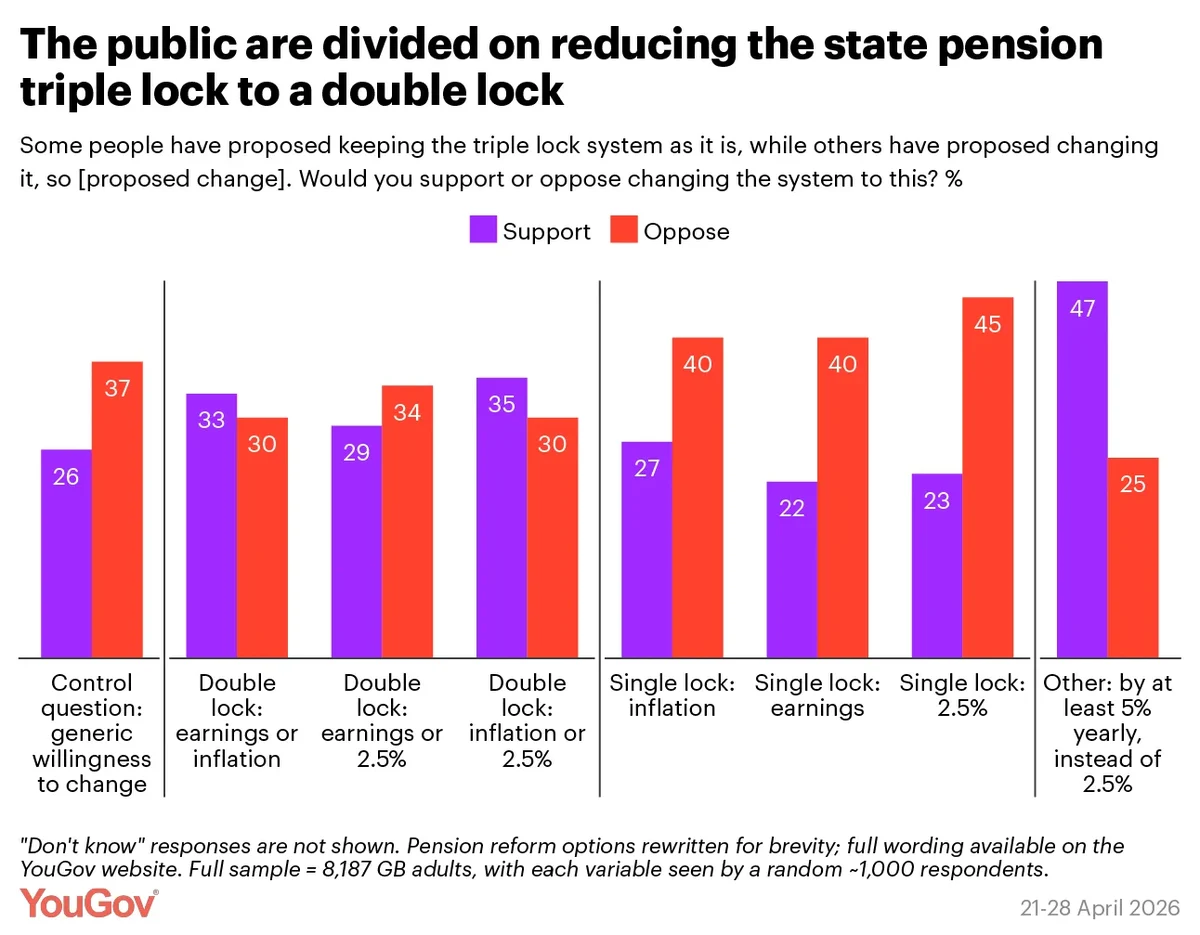
The single locks are less popular still, with the public opposed to pegging the state pension to earnings only by 40% to 22%; to inflation alone by 40% to 27%; and solely to a rate of 2.5% a year by 45% to 23%.
By contrast, the option that saw a more generous arrangement, with the 2.5% element boosted to 5%, is substantially more supported (47%), than opposed (25%).
Across almost all variations, the older Britons are, the higher net opposition is for changing the triple lock. The exception is for the more generous version, for which the oldest Britons are the biggest advocates (67% of the over-65s would support increasing the 2.5% component to 5%).
Do the public support triple locks for other areas of welfare spending?
A separate YouGov survey also tested whether the public are open to introducing a triple lock in further areas of welfare spending.
The public are split over whether there should be a triple lock on working-age benefits, with 40% supporting the idea and 35% opposing it, or a triple lock on benefits for children, which 36% support while 38% are opposed.
Opposition in both cases is notably higher among the older age groups – with 55% of the over-65s opposed to a triple lock on child benefits – although this is in part because younger Britons are more likely to have answered “don’t know”.
See full results for...
The state pension triple lock here
Triple locks on working age / child benefits here
Interested in taking YouGov surveys? What do you think about the state pension triple lock, the affordability of welfare spending in general, and everything else? Have your say, join the YouGov panel, and get paid to share your thoughts. Sign up here.
Interested in commissioning YouGov research? We connect in real-time with real people around the world to gather their thoughts, behaviours, and opinions, to ensure that our research data is powered by reality. Explore our survey services here.
Photo: Getty