
Reform UK also set for substantial gains, with our final projection pointing to an end of Labour’s century of dominance in Wales
Key takeaways
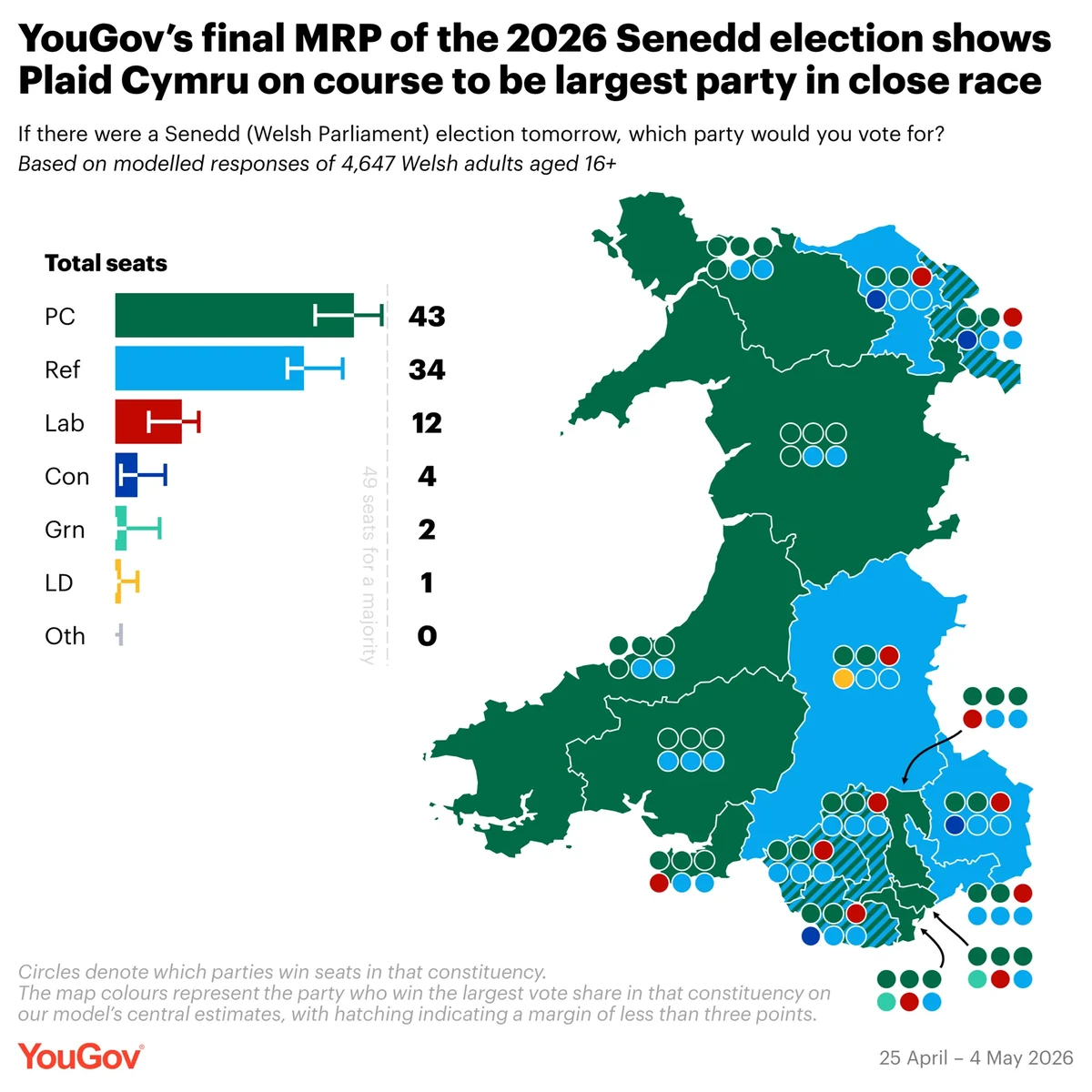
- Plaid Cymru are set to win 43 seats in our model’s central estimate, ahead of Reform UK on 34 seats
- Labour’s vote share is projected to fall to just 12%, down 24 points on the 2021 election and their worst major election result in Wales in more than a century
- The Conservatives are reduced to just four seats in our central projection, with the Lib Dems returning a single member
- The Greens are on course for a record Welsh vote share, including being likely to win seats at Cardiff Bay for the first time
- Plaid Cymru will likely require Labour for a majority, with the two parties together crossing the threshold of 49 seats in 89% of our model’s simulations
YouGov’s final MRP model of the 2026 Senedd election for ITV Cymru Wales places Rhun ap Iorwerth in pole position to be the next first minister, with a central projection of 43 seats for Plaid Cymru. This would be just six shy of the 49 needed for a majority in the now 96-member Welsh parliament, and puts them ahead of Reform UK, who are in a strong second place on 34 seats in our median estimate.
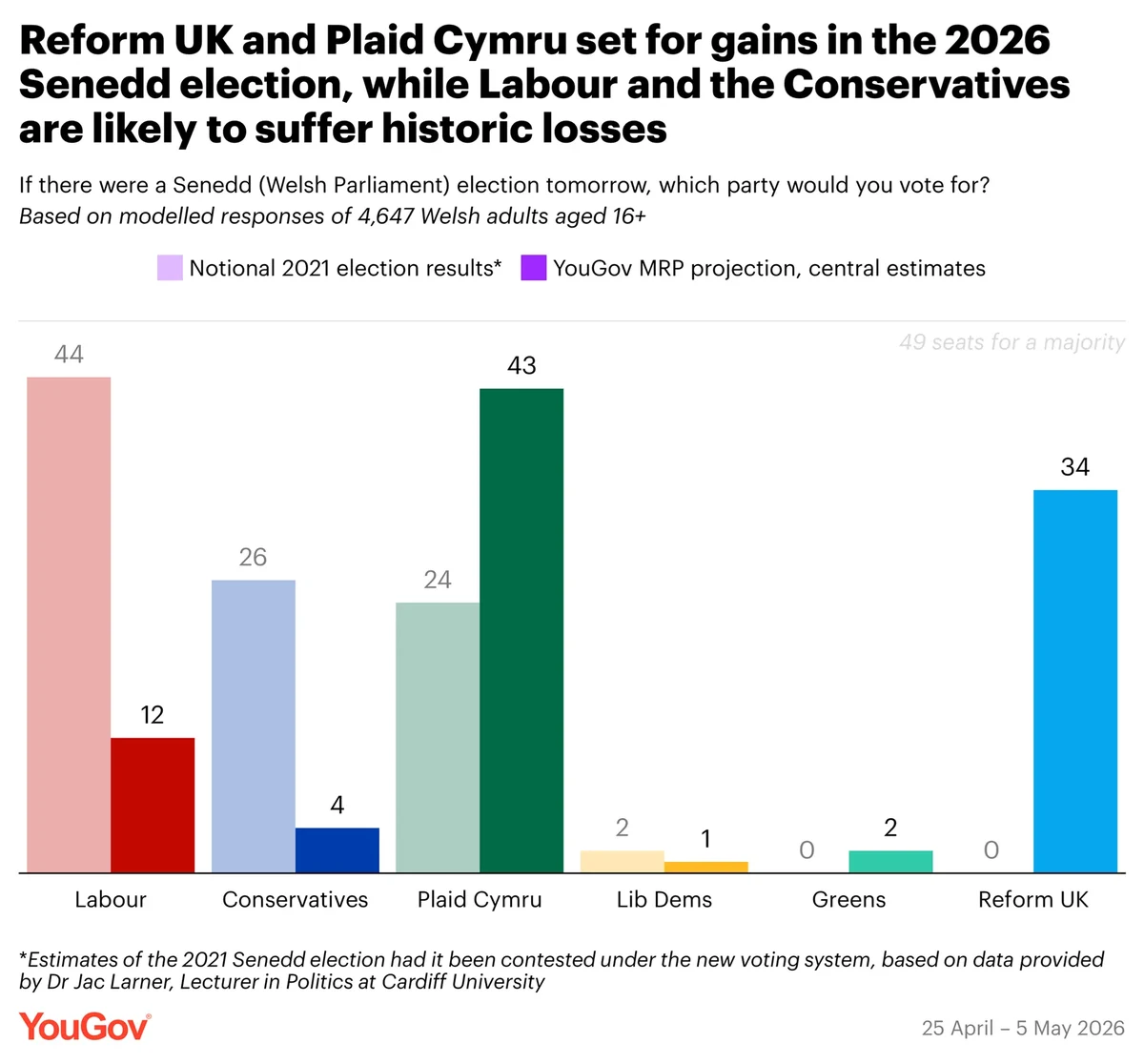
For both parties, such a result would represent substantial gains on the 2021 election, which would have resulted in 24 seats for Plaid Cymru had it been conducted under the newly introduced electoral system, and zero seats for Reform UK, who won a mere 1% of the vote five years ago.
Our latest model, which uses data from more than 4,600 adults in Wales in fieldwork from 25 April to 4 May, suggests Plaid Cymru have made small gains in the latter stages of the campaign, largely at the expense of the Greens, with our mid-April MRP having shown a neck-and-neck contest between them and Reform UK.
Nonetheless, the model overall projects a range of outcomes, with the allocation of some seats by the new D’Hondt voting system on a knife-edge. Plaid Cymru hold a lower-end estimate of 36 seats and a higher-end result of 48 seats, while Reform UK has an overall projected range of 31 to 41 seats, including emerging as the largest party in 13% of our simulations. Such is the sensitivity of allocations under D’Hondt to minor changes in vote shares that the predicted seat range for each party is relatively wide as a result, reflecting the narrow races in some constituencies.
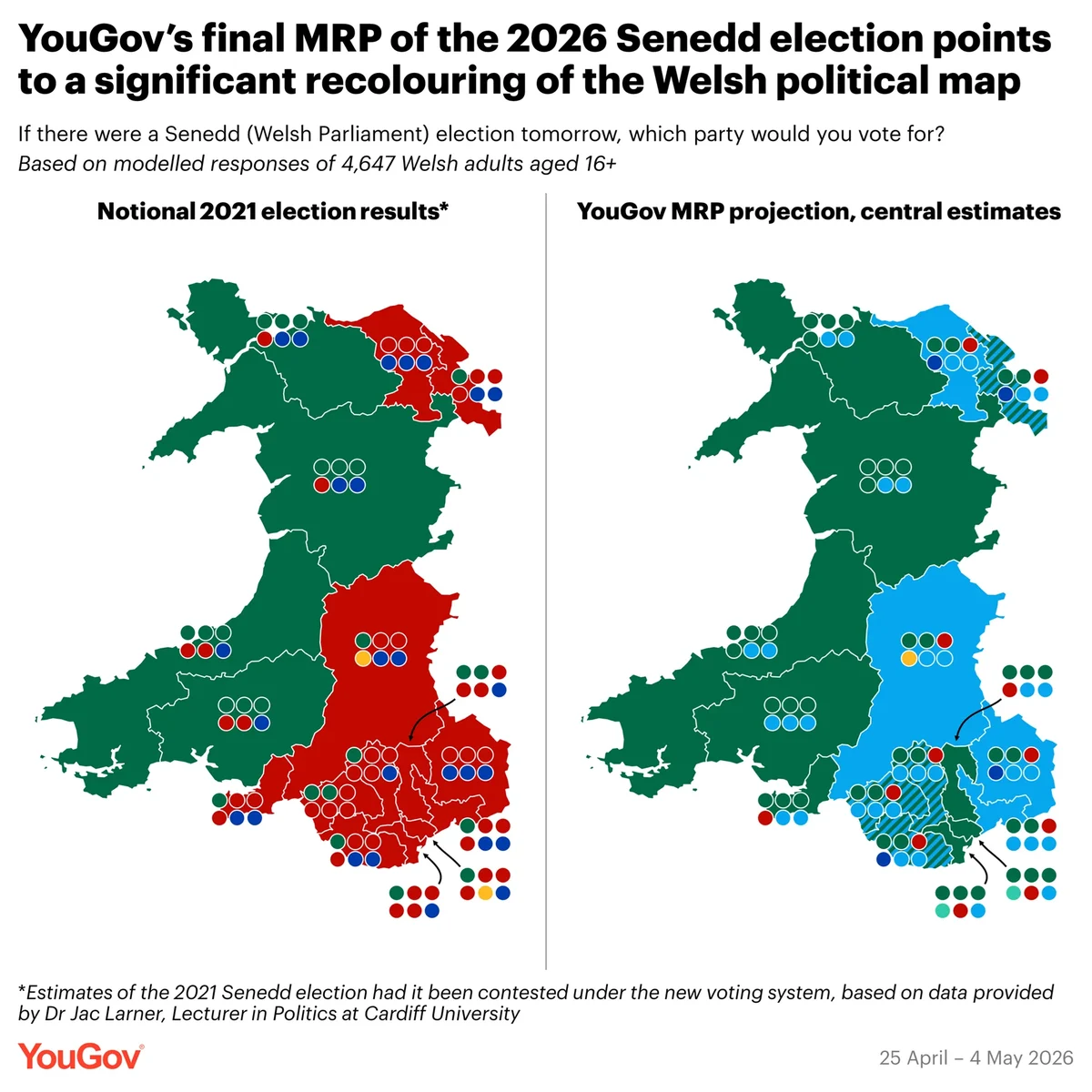
This recolouring of the political map is set to come primarily at the expense of Labour, who are set to fall to just 12 members of the Senedd (MSs), a notional loss of 32.
Such is the scale of the defeat for Labour, who have won every devolved election so far and topped the poll in Wales at every Westminster election since 1922, that they do not finish first in any of the Senedd’s 16 constituencies in our forecast, and are set to win zero out of six seats in four of them.
One such constituency is Ceredigion Penfro, in the west of the country, and where Eluned Morgan is top of Labour’s list of candidates, making it a realistic possibility that the first minister will lose her seat.
It’s not just Labour who are being knocked back. While Wales has not been such an area of strength for the Conservatives, our model projects the party will be reduced to just four seats, down from a notional result of 26 in 2021 and their worst result in a devolved election to date. This would additionally leave the party short of the five seats needed to form a political group in the Senedd, barring them from chairing committees and limiting their ability to question ministers.
The Liberal Democrats are also likely to fall short of this threshold, winning only a single seat on our median projection (in the mountainous Brycheiniog Tawe Nedd constituency), meaning Jane Dodds would remain the party’s sole representative in the Senedd.
Rounding out the chamber, but also likely to be unable to form a group by themselves, are the Greens, who are projected to win their first representation in the Senedd according to our model, with a seat in each of the two Cardiff constituencies.
This does represent the biggest change from our pre-campaign MRP, which showed the Greens winning ten seats, suggesting the environmentalist party’s vote has been squeezed somewhat over the course of the last month-and-a-half.
A result in their earlier territory is not wholly out of reach, though, with our model’s upper bound suggesting the party could feasibly reach as high as eight seats. Because the four smaller parties are on such similar shares of the vote, hovering around the 12% typically needed in a constituency to win a seat, a few hundred votes here or there could significantly change the allocation of many seats.
Of course, worse results than our central estimates are also plausible, with the Conservatives facing the possibility of being reduced to just a single seat on a bad night, while the Greens and Lib Dems could win none.
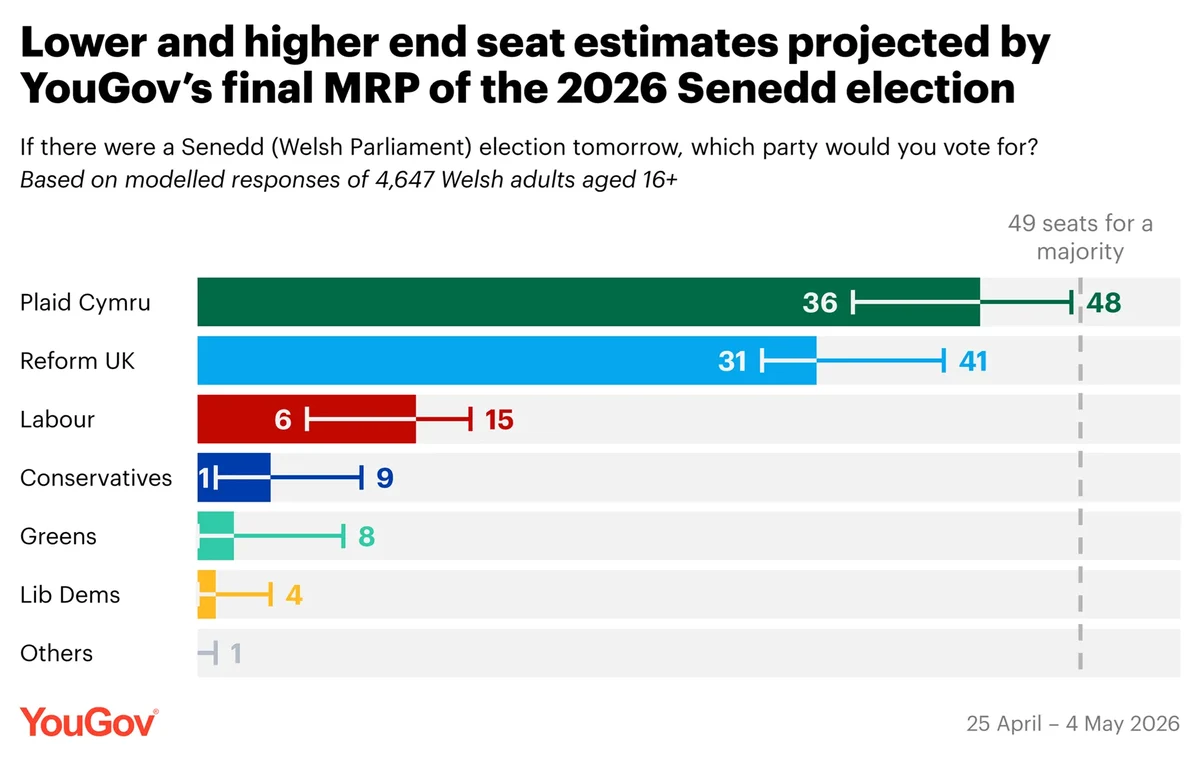
Who will form the next Welsh government?
With no party projected to win a majority of seats in the Senedd, some form of co-operation between the parties will be required in order for a first minister to be elected, even if parties do not form a full coalition government.
Here, there is little doubt that the balance tips decisively towards the likelihood of a Plaid Cymru-led government, as Reform UK and the Conservatives win a collective right-of-centre majority in a mere 1% of our model’s simulations, suggesting Dan Thomas’s route to being first minister is limited.
While Rhun ap Iorwerth has expressed a preference for forming a minority government of only Plaid Cymru ministers, our model suggests he is likely to require Labour’s assistance for a majority in the Senedd, with the two parties holding a 14-seat majority between them in our median estimates.
Although some in Plaid Cymru might have seen the Greens as more natural partners, these two hold a majority between them in only 9% of our model’s simulations, relative to Plaid Cymru and Labour doing so in 89%.
Constituency results
Although our model forecasts Plaid Cymru will make gains across Wales, it shows the party’s support remaining strongest in the more Welsh-speaking west of the country, including reaching as high as 46% in the Bangor Conwy Môn constituency that includes the island of Anglesey. It is in these areas that Labour are projected to do worst, falling to single digit vote shares (6-8%) in the four western constituencies in our central estimates.
Plaid Cymru are expected to still be weaker in areas of the country closer to the border with England, including a relatively low share of 25% in the Sir Fynwy Torfaen constituency that includes Monmouthshire.
Reform UK’s support is largely more evenly distributed across Wales, though falls to lows of 20% in the two Cardiff constituencies, in contrast to stronger performances in the industrial valleys of south Wales.
The Pontypridd Cynon Merthyr constituency holds particular symbolic value for Labour, covering the Merthyr Tydfil area that elected Keir Hardie as Wales’s first Labour MP in 1900. Our model’s central estimates show a near-tie there today between Reform UK (34%) and Plaid Cymru (33%), with Labour trailing on just 14% of the vote.
This is one of four constituencies where there is a margin of less than three points between the first-placed and second-placed parties in our median projection, reflecting the close nature of some of the constituency contests.
In these constituencies, whether the final seat is allocated by the D’Hondt system to Reform UK or Plaid Cymru is sometimes by decided by fractions of a percentage point of support, with similarly fine margins determining whether other parties even win one seat in some constituencies.
Latest Senedd voting intention figures
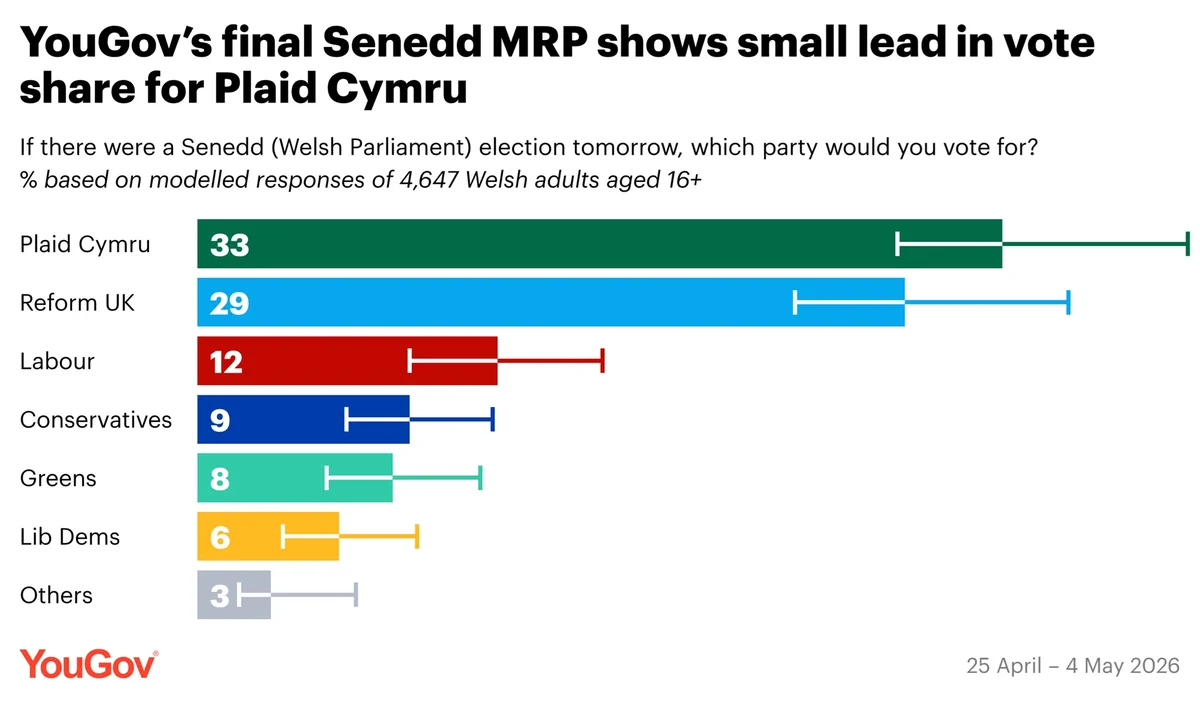
Across the whole of Wales, Plaid Cymru hold a four point vote share lead in our model’s central estimates, being forecast to win 33% of the vote to Reform UK’s 29%. These are gains of 12 and 28 points on their respective 2021 election results, and are relative to the two parties being tied on 29% each in our mid-April figures.
Labour are on course to lose two thirds of their vote share from 2021, being on 12% of the vote in our latest figures, down a full 24 points. This would be their worst Welsh vote share since the 1906 general election, when the party fielded just two candidates across the country.
The Conservatives have also lost a substantial amount of support over the last five years, recording a vote share of 9% in our latest figures, down 16 points from their regional vote in the previous Senedd election and compared to a previous low of 16% at a Westminster or devolved election.
By contrast, the Greens are on track to win their highest-ever Welsh vote share, taking an 8% share in our central projection, up four points since 2021. The Lib Dems are on 6%, having likewise won 4% of the regional vote at the last election.
YouGov would like to thank Dr Jac Larner of Cardiff University for providing us with the notional results of the 2021 election.
Interested in taking YouGov surveys? What do you think about Plaid Cymru, the 2026 Senedd election in general, and everything else? Have your say, join the YouGov panel, and get paid to share your thoughts. Sign up here.
Interested in commissioning YouGov research? We connect in real-time with real people around the world to gather their thoughts, behaviours, and opinions, to ensure that our research data is powered by reality. Explore our survey services here.
Photo: Getty