
Our latest projection continues to point to historic losses for Labour and the Conservatives
Key takeaways
- Reform UK and Plaid Cymru are neck-and-neck in our model’s central estimate, winning 37 and 36 seats respectively
- Labour’s vote share is projected to fall to 13%, down 23 points on the 2021 election and ending a century of dominance in Welsh politics
- The Greens are projected to win seven seats in our central projection, with the Conservatives reduced to three and the Lib Dems winning a single seat
- Plaid Cymru, Labour and the Greens hold a majority in 96% of our model’s simulations, while Plaid Cymru and Labour alone doing so in 47%
YouGov’s second MRP model of the 2026 Senedd election for ITV Cymru Wales shows the race to be the largest party in the next Welsh parliament is on a knife-edge, with a central projection of 37 seats for Reform UK and 36 seats for Plaid Cymru.
Our latest model, which uses data from over 3,000 adults in Wales in fieldwork from 6-15 April, represents a tightening of the contest, with Plaid Cymru down by seven seats relative to our first MRP last month, while Reform UK are up by a corresponding amount.
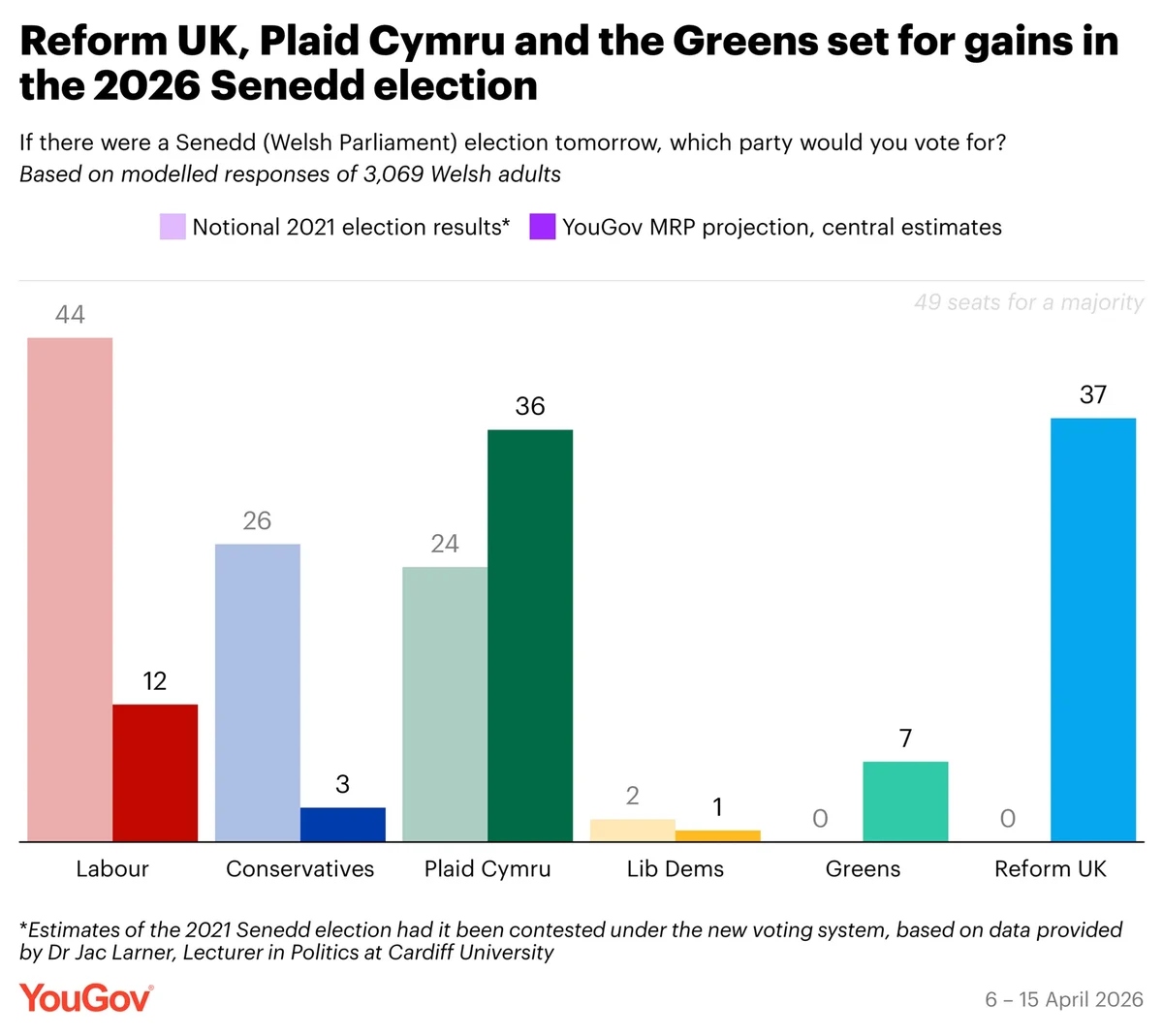
Nonetheless, both parties are still on course to make substantial gains relative to the 2021 election: had the election five years ago been conducted under the newly introduced electoral system, Plaid Cymru would have won 24 seats, while Reform UK would have won none.
The Greens are also forecast to make a breakthrough at Cardiff Bay, being on course to elect seven members of the Senedd (MSs), having never previously won any.
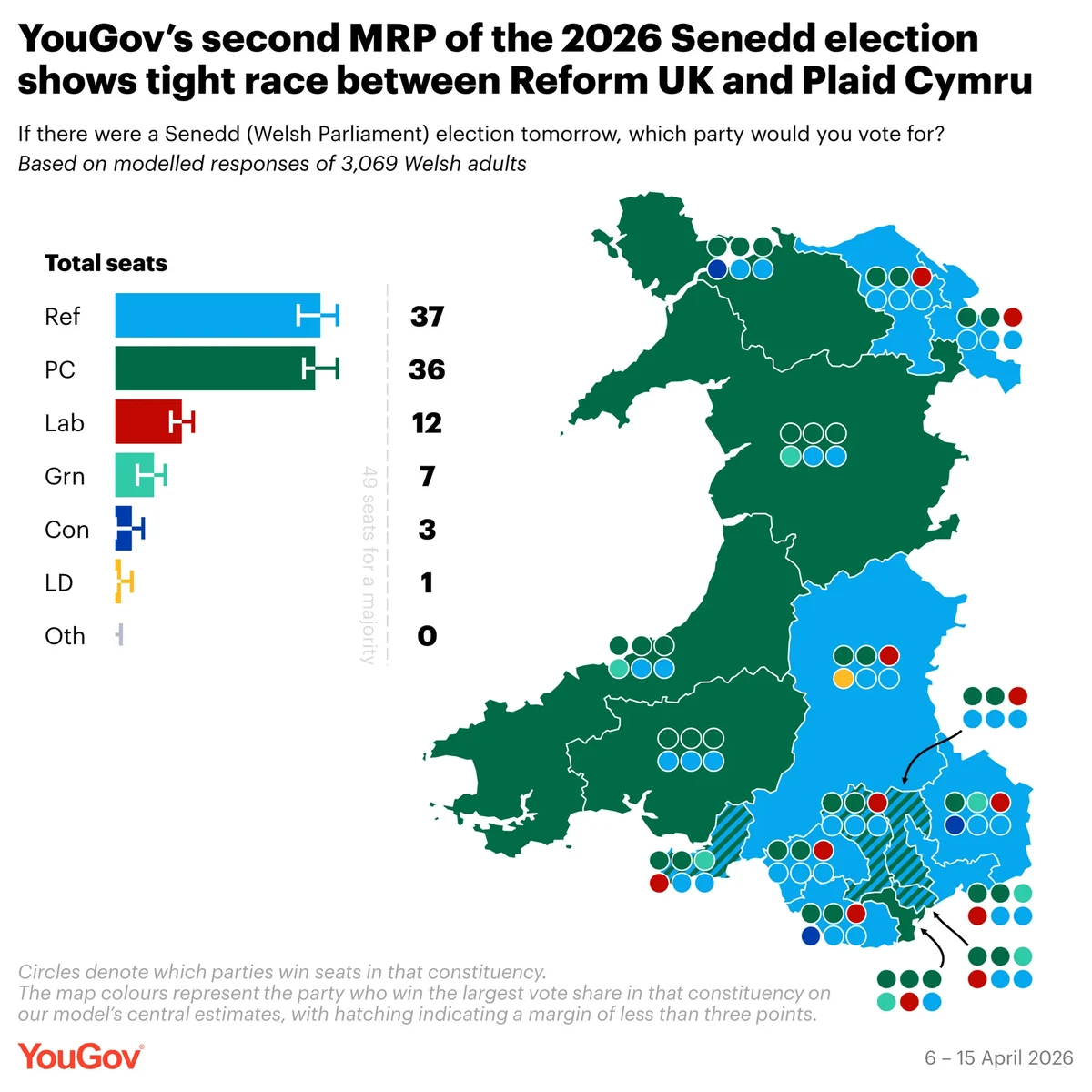
Such gains primarily come at the expense of Labour, who are set to fall to just 12 seats in the Senedd, a notional loss of 32, ending their century of dominance of Welsh politics and leaving them with no representation in a huge swathe of the country stretching from Llanelli to Llandudno.
The Conservatives are likewise set for major losses, with our central estimates showing them on just three seats, down from a notional result of 26 in 2021. This would leave the party short of the five seats needed to form a political group in the Senedd, barring them from chairing committees and limiting their ability to question ministers.
Also likely to be falling short of this threshold are the Lib Dems, who win only a single seat on our median projection (in the mountainous Brycheiniog Tawe Nedd constituency), meaning Jane Dodds would remain the party’s sole representative in the Senedd.
Who will form the next Welsh government?
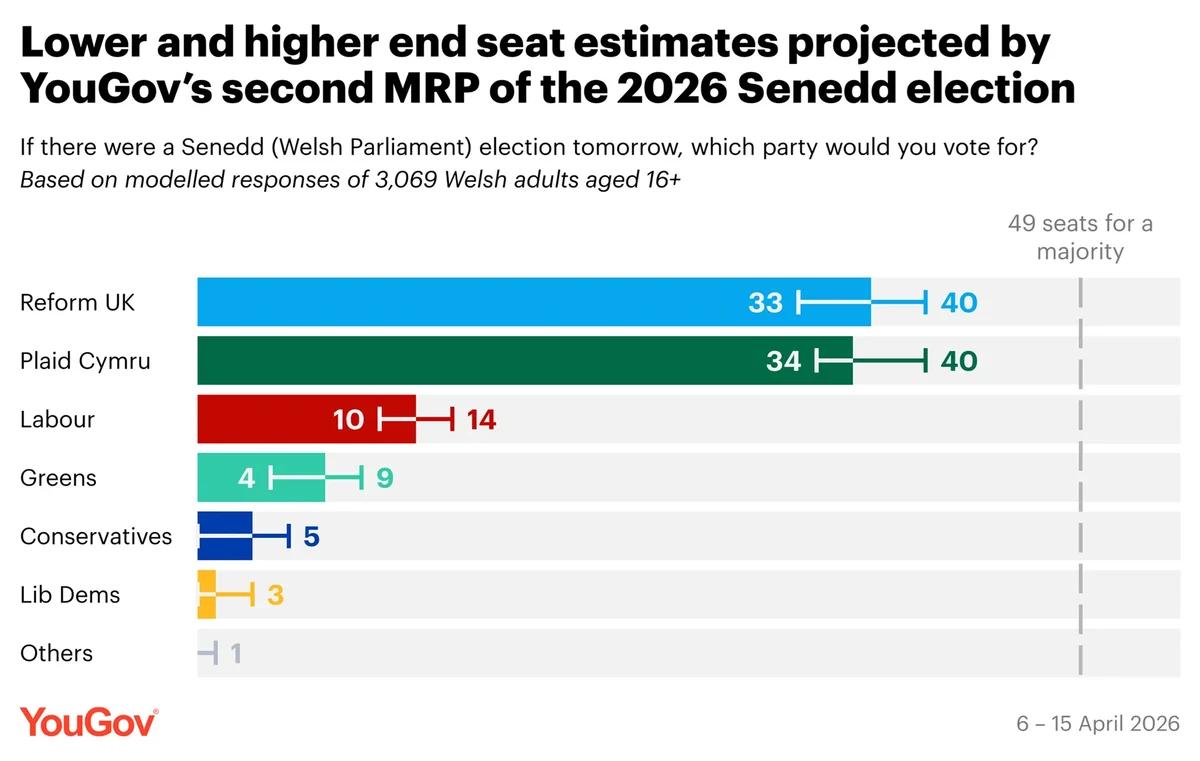
Overall, our model projects a range of outcomes, though even at the higher end of predictions for Reform UK or Plaid Cymru, which is 40 seats for both parties, they are short of the 49 needed for a majority in the now 96-member Senedd.
Such a result would require some form of co-operation between parties, if not a full coalition government, in order for a first minister to be elected and for the day-to-day business of government to function.
Here, the balance tips decisively towards the likelihood of a Plaid Cymru-led government, as Reform UK and the Conservatives win a collective right-of-centre majority in a mere 3% of our model’s simulations, suggesting Dan Thomas’s route to being first minister is limited.
While Rhun ap Iorwerth has expressed a preference for forming a minority government of only Plaid Cymru ministers, he would still need the assistance of Labour and either the Greens or the Lib Dems for a majority in the Senedd, according to our model’s median projections.
Although they fall just short in our headline estimates, Plaid Cymru and Labour hold a majority between them in 47% of our simulations, while Plaid Cymru and the Greens do so in 5%. The three parties hold a combined majority in 96% of our mid-campaign model’s simulations.
Any plans for a government involving the Conservatives or Lib Dems should come with a word of warning, as there’s no guarantee either makes it into the next Senedd. The lower bounds of our model for both parties show them winning zero seats.
Latest Senedd voting intention figures
When it comes to vote shares, Reform UK and Plaid Cymru are likewise tied, each being forecast to win 29% of the vote on our model’s central estimates, representing respective gains of 28 and 8 points on their 2021 results and relative to Plaid Cymru leading Reform UK by 33% to 27% in our March figures.
Labour’s 13% vote share is unchanged from March, still being down a full 23 points on their 2021 regional vote and on course to be their worst Welsh vote share since the 1906 general election, when the party only fielded two candidates in the country.
The Conservatives have also lost a substantial amount of support over the last five years, recording a vote share of 8% in our latest figures, down 17 points since the previous Senedd election and half their current lowest share in a Westminster or devolved election.
While the Greens and Lib Dems both won 4% of the regional vote in 2021, our model shows some divergence today, with the Greens now on 10% and the Lib Dems on 6%.
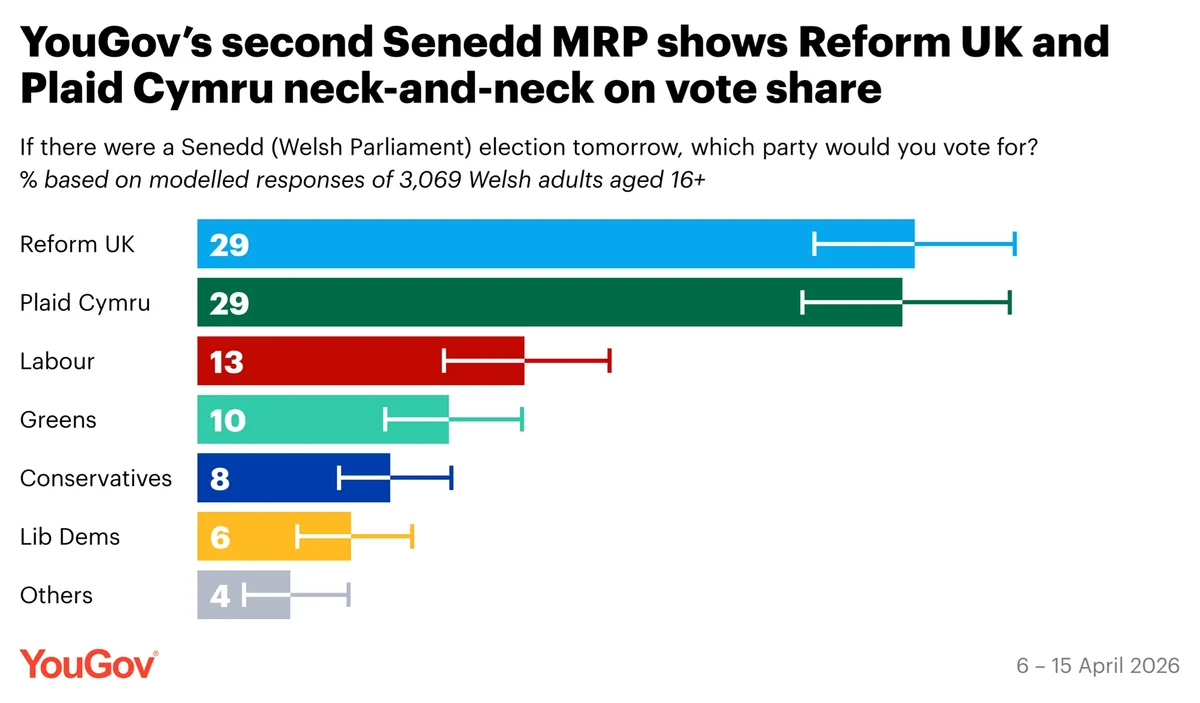
Nonetheless, a result come 7 May that falls anywhere within our model’s ranges would undoubtedly be a landmark moment in Welsh politics.
YouGov would like to thank Dr Jac Larner of Cardiff University for providing us with the notional results of the 2021 election.
Interested in taking YouGov surveys? What do you think about Plaid Cymru, the 2026 Senedd election in general, and everything else? Have your say, join the YouGov panel, and get paid to share your thoughts. Sign up here.
Interested in commissioning YouGov research? We connect in real-time with real people around the world to gather their thoughts, behaviours, and opinions, to ensure that our research data is powered by reality. Explore our survey services here.
Photo: Getty