
Reform UK and Greens also set for breakthrough seat gains, while new projection points to historic losses for Labour and the Conservatives
Key takeaways
- Plaid Cymru are set to win 43 seats in our model’s central estimate, just six seats short of a majority
- Labour are projected to fall 23 points to 13% of the vote, ending a century of dominance in Welsh politics
- Reform UK and the Greens are on course to make significant breakthroughs, winning 30 and 10 seats respectively in our central projection
- Our MRP points to potential wipeouts for the Conservatives and Lib Dems, with the former projected to hold on to just a single seat, and the latter not to win any
YouGov’s first full MRP model of the 2026 Senedd election for ITV Cymru Wales puts Rhun ap Iorwerth in pole position to be the next first minister of Wales, with a central projection of 43 seats for Plaid Cymru, just six short of the 49 needed for a majority in the now 96-member Welsh parliament.
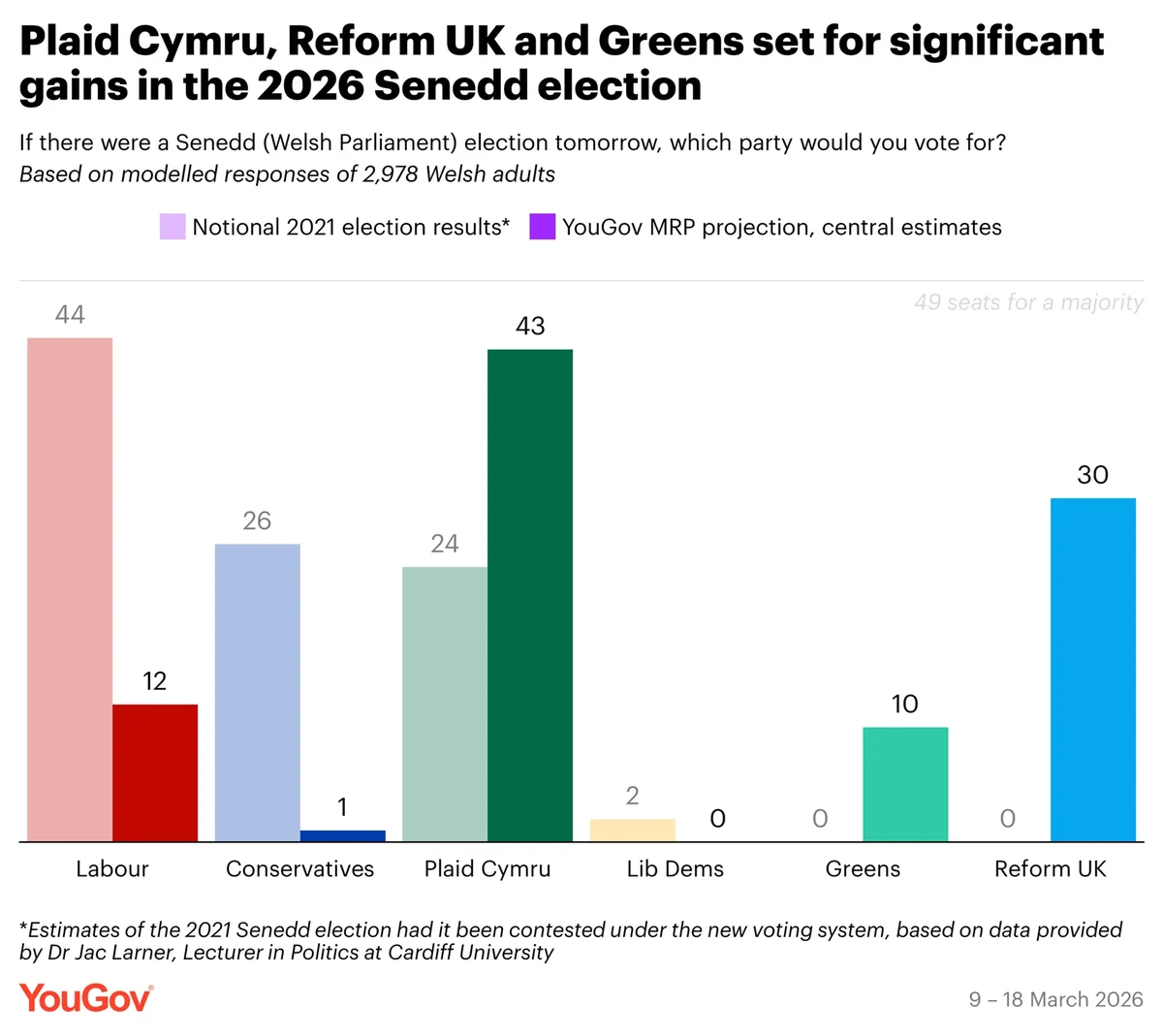
Although the party has been a junior member of Welsh governments in the past, this would be the first time the nationalist party has come first across Wales in a major election, and marks a substantial gain on the 24 seats the party are estimated to have won in 2021 had it been conducted using the new electoral system.
But Plaid are not the only party set for a significant breakthrough in Wales according to our model, which uses data from nearly 3,000 Welsh adults in fieldwork from 9-18 March.
Reform UK, who won a mere 1% of the vote at the previous Senedd election, are set for a clear second place on 30 seats according to our model’s central estimates, while the Greens, who have also never won a seat at Cardiff Bay, are currently on course to elect 10 members of the Senedd (MSs).
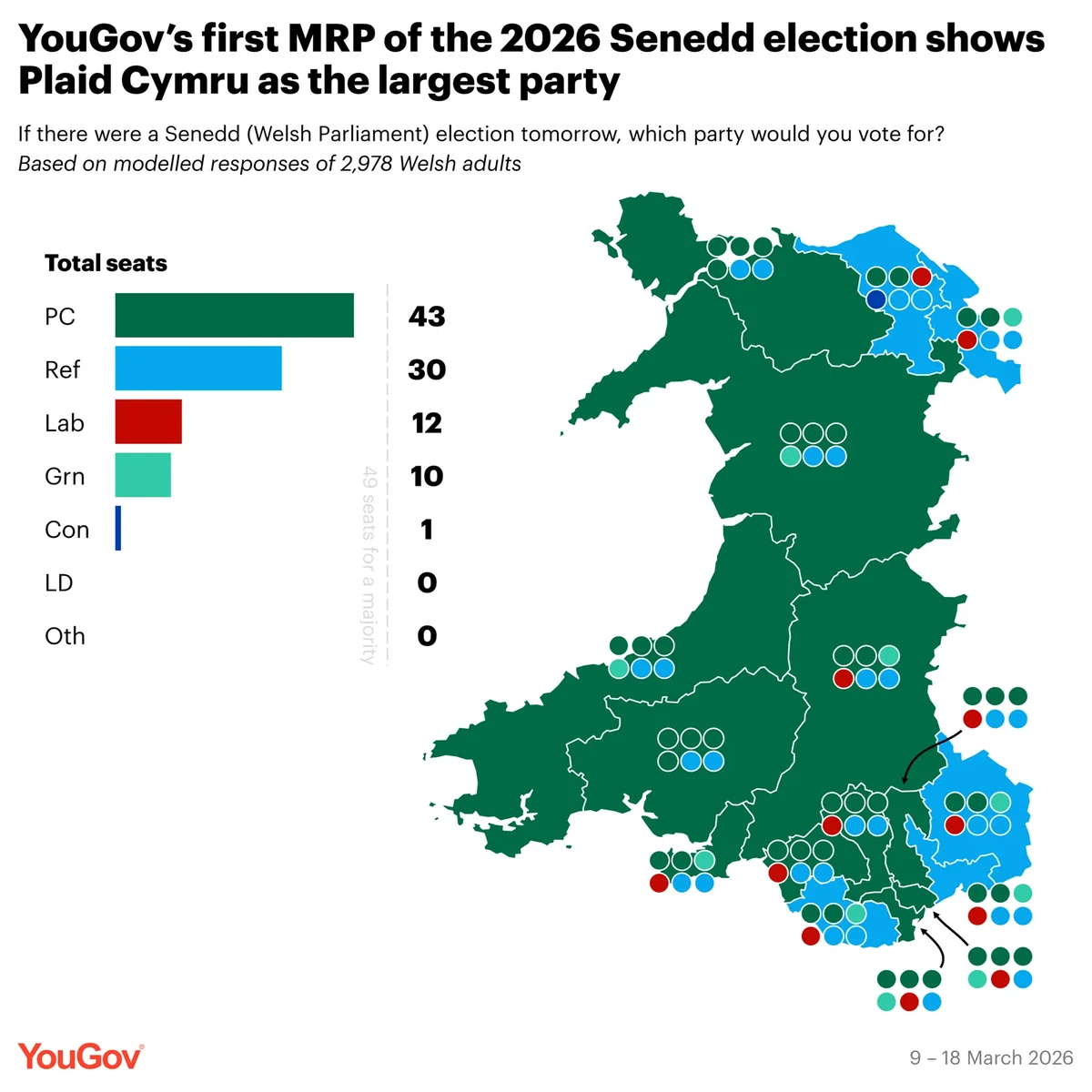
These gains come most notably at the expense of Labour, who are set to win just 12 seats, a notional loss of 32, leaving them near-tied for third place and without representation in a huge swathe of the country stretching from Llanelli to Llandudno.
For the party that has dominated Welsh politics for generations, winning every devolved election so far and topping the poll in Wales at every Westminster election since 1922, such a result would undoubtedly be a significant blow.
While Wales has not been such an area of strength for the Conservatives, the result projected by our MRP is nearing existential for the Welsh Tories, with our central estimate projecting just a single seat for the party (in the north eastern Clwyd constituency), down from a notional result of 26 in 2021.
The Liberal Democrats fare even worse, being left with no seats according to our median projection, a notional loss of two.
Overall, according to our model’s median projections, a Plaid Cymru-led government is by far the most plausible outcome of the election, with Reform UK requiring the votes of every other party to form an alternative government.
By contrast, Plaid Cymru are set to have the option of forming coalitions with either Labour (giving 55 seats, a 14-seat majority) or the Greens (53 seats, a 10-seat majority), though the party have expressed a preference for a minority government made-up solely of Plaid Cymru members.
The new Senedd will be elected using a form of proportional representation (PR), meaning that the number of seats a party wins broadly reflects its share of the vote. But because the allocations under Wales’s new version of PR take place in each constituency, each of which elects six MSs, the system does have a small advantage towards parties that win a greater share of the vote.
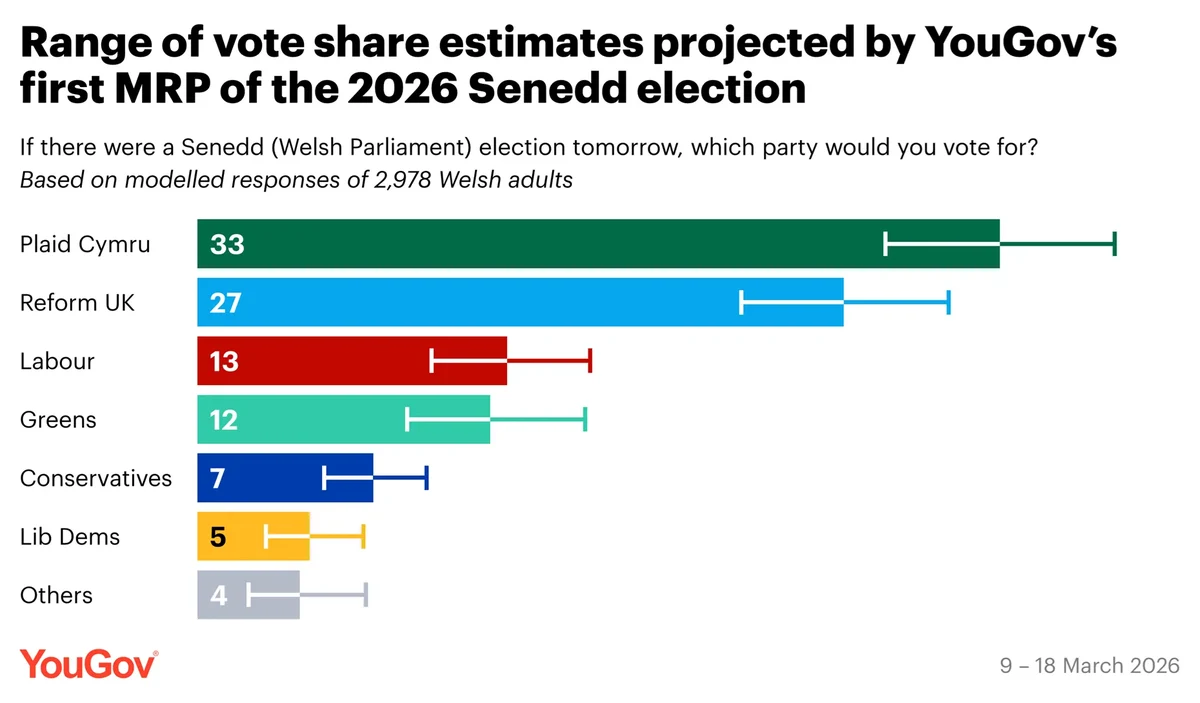
This can be particularly seen with Plaid, whose central projection of 45% of the seats stems from a median vote share estimate in our model of 33%, which is nonetheless a gain of twelve points on their regional vote in 2021.
Reform UK are projected to win 27% of the vote, up from only 1% in 2021, while the 13% share projected for Labour is down a full 23 points on their previous vote, with the fall in the Conservative vote to only 7% a similarly seismic loss of 18 points.
While the Greens and Lib Dems both won 4% of the regional vote in 2021, our model shows clear divergence today, with the Greens now on 12%, up eight points, in contrast to the Lib Dems’ near-unchanged 5% in our central estimate.
Of course, the model in full projects a range of outcomes, and it is not definite that Plaid Cymru will win the most votes: their lower-most estimate (28%) is below the upper-most bound for Reform UK (31%), meaning that it remains a possibility that the latter wins the most votes, even if this is only the case in a small minority of our MRP’s simulations.
Nonetheless, a result come 7 May that falls anywhere within our model’s ranges would undoubtedly be a landmark moment in Welsh politics.
YouGov would like to thank Dr Jac Larner of Cardiff University for providing us with the notional results of the 2021 election.
Interested in taking YouGov surveys? What do you think about Plaid Cymru, the 2026 Senedd election in general, and everyone else? Have your say, join the YouGov panel, and get paid to share your thoughts. Sign up here.
Interested in commissioning YouGov research? We connect in real-time with real people around the world to gather their thoughts, behaviours, and opinions, to ensure that our research data is powered by reality. Explore our survey services here.
Photo: Getty