
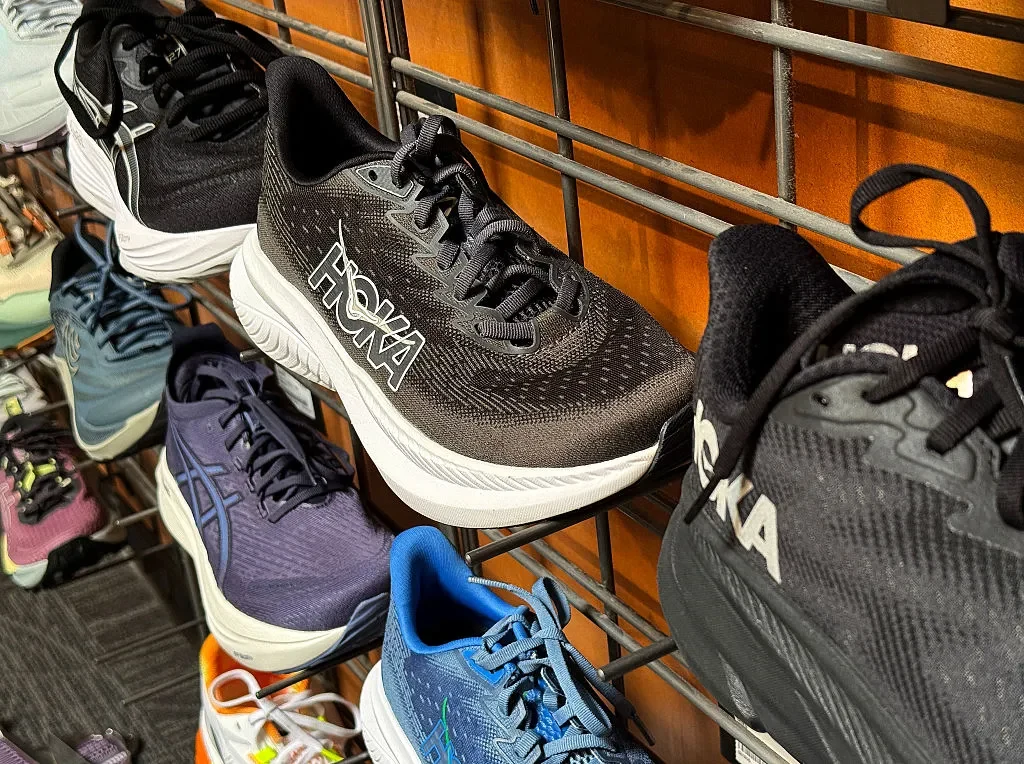
Sneaker culture in the U.S. remains as competitive as ever – and while industry stalwarts such as adidas and Nike still carry significant sway among Americans, newer brands are still breaking through and seeing significant momentum.
Hoka, the French brand which entered the U.S. market in the early 2010s, has steadily built momentum. Using YouGov BrandIndex data, we can track how the brand is performing among U.S. sneaker buyers – defined here as consumers who have purchased sneakers in the past three months.
For context, the competitive set referenced throughout this analysis reflects a group of 11 sneaker-forward brands selected for their relevance to both performance footwear and broader sneaker culture. The list features names ranging from Nike to Vans to Asics.
Hoka brand awareness growth: Gaining ground in a competitive sneaker market
Looking at Hoka’s growth in the U.S. market, the sneaker brand shows a strong trajectory – with potential to grow even further. Awareness among sneaker buyers has increased from around 42% a year ago to 52.5% as of mid-April.
While impressive, this is below the category average (close to 75%) which underlines the scale of the opportunity ahead.
Strong Satisfaction is powering steady Index gains
Hoka’s Index score – a composite measure of brand health – among brand aware sneaker buyers over the past year shows a brand that is steadily closing the gap with the wider sector. From April 2025 through to April 2026, Hoka’s Index rises from the high 30s to the mid-to-high 40s, at points overtaking the sector average and largely moving in parallel with it thereafter.
Looking at the individual metrics that contribute to a brand’s Index score helps explain Hoka’s upward trajectory. Hoka outperforms the sector average on Quality and Reputation, reinforcing its positioning as a serious performance player. Most striking, however, is its advantage on Satisfaction, where it significantly exceeds the category average.
The data suggests that once consumers engage with Hoka, they are more likely than average to come away satisfied. In contrast, lower scores on Value and slightly softer Recommend metrics indicate that while the product experience is strong, perceptions around price and advocacy still have room to improve.
Demographic profile: Who’s considering Hoka sneakers?
Hoka’s consideration base also offers insight into its positioning. YouGov Profiles data shows that the brand skews more female than the category overall, with women accounting for 55% of considerers versus a 49% sector average. This is a notable point of differentiation in a space often dominated by male audiences.
Generationally, Hoka is broadly balanced, with slight over-indexing among Gen Z and Gen X, and a marginal under-index among Millennials. This suggests cross-generational appeal rather than reliance on a single cohort.
Income segmentation further reinforces the brand’s premium positioning. Hoka considerers are less likely to fall into lower-income brackets and more likely to sit within middle- and higher-income groups, with a particularly strong over-index among higher earners compared to the sector.
When it comes to purchase motivations, Hoka considerers are more likely to cite quality, promotions, and price competitiveness than the category average. This combination points to a consumer who is discerning – willing to invest in performance, but still attentive to value signals.
Closing the gap in a crowded field
Hoka’s trajectory in the U.S. sneaker market is clear: Awareness is improving but still trails the category, while experience metrics, especially Satisfaction, are strong. The Index trendline reflects this, showing steady gains. Based on the data, it appears that Hoka’s greatest challenge is reach, not product perception.
Methodology: YouGov BrandIndex collects data on thousands of brands every day. Index score for airlines is a composite measure of overall brand health, calculated as the average of key metrics including Impression, Quality, Value, Satisfaction, Recommend, and Reputation. Scores are based on daily surveys of U.S. adults and are reported on a scale from -100 to +100. Data is weighted using a propensity scoring methodology with targets from the American Community Survey (ACS) to ensure representation by age, gender, race, education, and region. Unless otherwise stated, scores are shown as a 12-week moving average. The observation period for this analysis is from Apr 17, 2021 to Apr 16, 2026.
YouGov Profiles is based on continuously collected data through rolling surveys, rather than a single limited questionnaire. Figures are drawn from responses collected between April 2025 and April 2026, using a 52-week dataset updated weekly. Data is nationally representative of adults (18+) in the US and weighted by age, gender, education, region, and race.