Social Democrats on course to be the largest party, with Danish People’s Party and Green Left making the biggest gains
Key takeaways
- Centre-left Social Democrats lead on 21% of the vote, though this is down seven points from 2022
- Parties of the left-of-centre ‘red bloc’ and right-of-centre ‘blue bloc’ are near tied in our model’s central estimate, with a slight edge for the red bloc
- Danish People’s Party, the Liberal Alliance and Venstre are all vying to be the largest party in the blue bloc
- Current governing ‘SVM’ coalition between Social Democrats, Venstre and Moderates extremely unlikely to win enough seats to be able to remain in office
The first YouGov projection of the 2026 Danish general election shows a close race between the two main blocs of parties, with the centre-left Social Democrats of prime minister Mette Frederiksen set to remain the largest party in the Folketing.
The new YouGov model is the first of its kind – a Looped Stratified Simulation (LSS) election model. This method leverages one of YouGov’s strongest assets, our world leading panel, to simulate elections under thousands of different assumptions about individual-level vote choice and likely electorates, before pooling these estimates into probability distributions. From these, we can draw central, lower, and upper bounds for party support and expected seat wins, as well as a range of other electoral statistics. In total, we spoke to 4,966 Danes from 1-18 March.
Our model’s central estimate projects that the Social Democrats will win 38 of the Danish parliament’s 179 seats from approximately 21% of the vote, though this is much reduced from the 50 seats and 28% vote share they won in 2022, and would be the party’s worst result in more than a century. All vote and seat shares, including the above, are subject to a probabilistic range of outcomes drawn from the simulations.
The other parties in the current government – the centre-right Venstre and centrist Moderates – are also expected to suffer losses, being projected to win 16 and 10 seats respectively, down from 23 and 16 last time. This would leave the incumbent coalition with just over a third of seats (64) in parliament, making it very likely that new governing arrangements will be required. It would also be Venstre’s worst result in their 156-year history.
Prior to the last election, governments in Denmark were typically formed from some combination of parties from one of two blocs – a right-of-centre ‘blue bloc’ and left-of-centre ‘red bloc’. With expectations of a return to bloc-based politics, our model projects overall gains for the ‘blue bloc’ parties, on 80 seats in Denmark itself, up 8, resulting in a near-tie with the ‘red bloc’ parties, who are on 85 seats in the median estimate, down 2.
Driving gains for the blue bloc are the populist Danish People’s Party, projected to win 18 seats, having fallen to just 5 at the last election. The Liberal Alliance are on course for a record haul of 17 seats, up 3, with the Conservatives projected to win 14 seats, up 4.
The populist Denmark Democrats party are on 11 seats in our central projection, relative to 14 seats won last time, with the new pro-referendum Citizens’ Party estimated to win 4 seats.
The Green Left are expected to be the only party making significant advances in the red bloc, with our model putting them on 24 seats, a gain of 9. Minimal changes in seats, if any, are projected for the more left-wing Red-Green Alliance (+2 seats), more centrist Social Liberals (+1 seat) and the environmentalist party The Alternative (-2 seats).
Denmark’s version of proportional representation includes a 2% vote share threshold that parties need to pass in order to win seats (with some exceptions). Although our model gives a central vote share projection of 2.3% to both the Citizens’ Party and The Alternative, it shows lower bounds for both parties of less than 2%, making it within the range of possibilities for them to win zero seats.
A feature of our LSS election model is that it allows us to attribute expected probabilities of the Citizens’ Party and The Alternative making it into parliament. As of today, these probabilities stand at 84% and 82% respectively.
Who could form the next Danish government?
With no party expected to win much more than a fifth of seats in the Folketing, some arrangement involving multiple parties will likely be required to form Denmark’s next government.
According to our model’s central estimates for each party, neither the red nor blue blocs would hold a majority by themselves, with each requiring the Moderates’ estimated 9 to 12 seats to get over the line.
Again, our LSS model allows us to estimate the probability of each coalition arrangement getting a majority of seats. According to our model today, adding the Moderates to the red bloc results in a majority more than 99% of the time. Adding them to the blue bloc results in a majority around 10% of the time.
A continuation of the SVM government falls short of an overall majority, even if it was expanded to include the adjacent Conservative and Social Liberal parties (sometimes known as SVM+). These potential coalitions would secure majorities in less than 1% of our model simulations.
Nonetheless, Denmark has a long history of minority governments. The combinations below show the groups of parties, based on our median projections, that could support the various potential coalitions, even if they do not directly take part themselves.
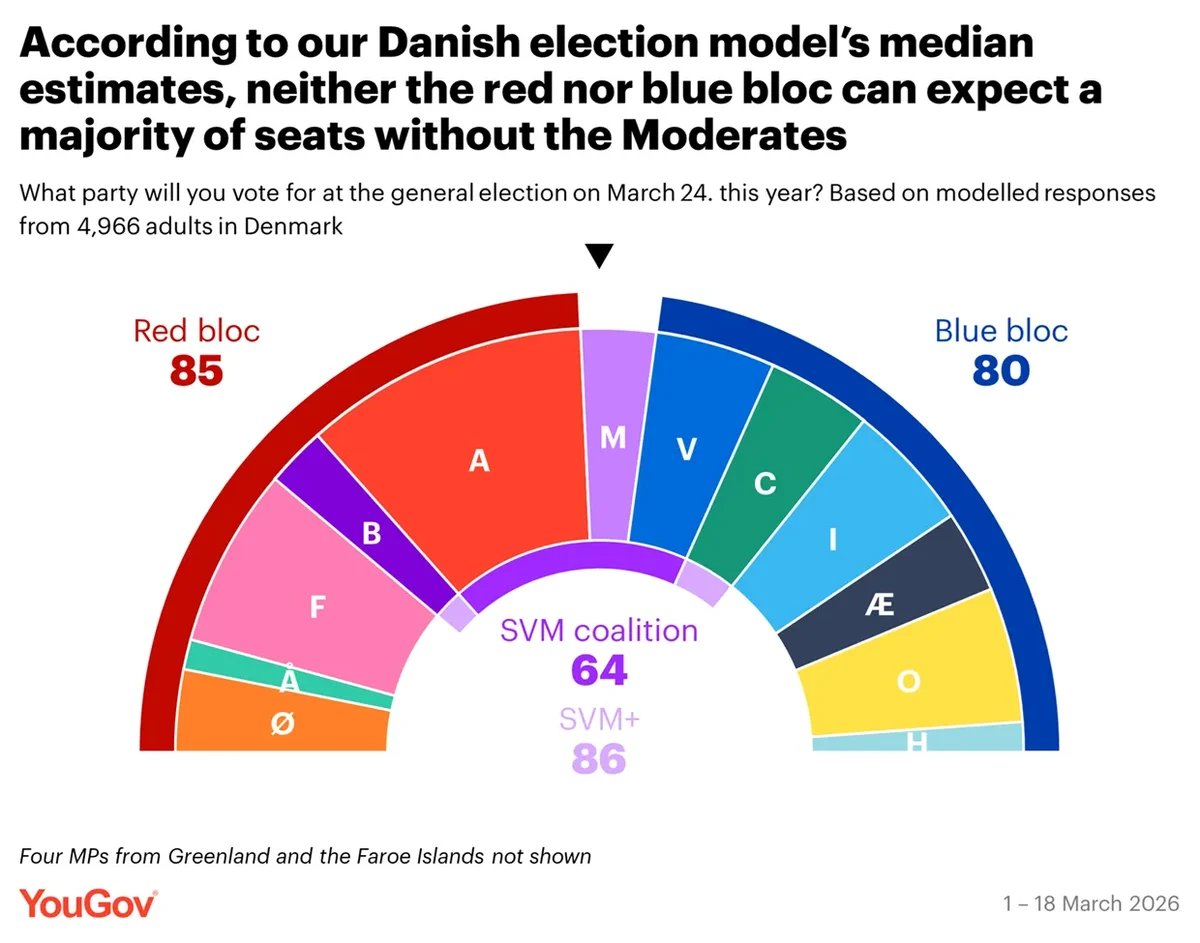
In addition to these seats, Greenland and the Faroe Islands elect two MPs each, though with both territories having their own party systems. At the last election, this added three MPs to the red bloc and one to the blue bloc, though all four have supported the SVM coalition. Regardless of whether such a result is repeated next week, these seats are unlikely to be sufficient to give either bloc an overall majority.
How have Danish voters moved since the 2022 election?
We now move to look at some of the stories behind the headline numbers by analysing in depth a stratified and weighted sub-sample of 3,480 Danes from everyone we spoke to over the past two weeks.
The largest movement of voters since the last election has been from the Social Democrats to the Green Left, who have won 16% of those who backed the centre-left party in 2022 and intend to vote next week. With 70% of 2022 Social Democrat voters still backing the party, this single shift represents half of all their losses and compares to no more than 3% of 2022 Social Democrats going to any other individual party.
Venstre have held on to just half of their 2022 voters (49%), with 9-13% now intending to vote for each of the Conservatives, Liberal Alliance and Danish People’s Party.
The Danish People’s Party’s new voter coalition also includes 29% of those who backed the Denmark Democrats in 2022 and 35% of those who backed the more radical New Right, who are ineligible to run in this year’s election.
The Green Left have won over 23% of those who previously backed their more left-wing competitor the Red-Green Alliance, while the Liberal Alliance’s gains include 13% of those who voted Conservative in 2022.
How are different social groups voting?
Compared to Britain, Danish voting patterns do not have as strong a left versus right age divide, though collective support for blue bloc parties is higher among the 50-66 age group (52%) than among other age groups (39-45%).
This is particularly driven by a peak in support for right-wing populist parties, with 25% of 50-66 year old Danes intending to vote for the Danish People’s Party, Denmark Democrats or Citizens’ Party, compared to 20% of over 67s, 19% of 35-49 year olds and just 10% of 18-34 year olds.
Support for the Social Democrats skews particularly heavily towards older Danes, with 31% of those aged 67 and over intending to back Mette Frederiksen’s party, roughly double the 16-17% of those in the under 50 age groups.
Younger Danes are instead more likely to favour parties to the Social Democrats’ left, with 29-30% of under 50s intending to back the Green Left, Red-Green Alliance or The Alternative, compared to 15-18% of over 50s. Support for the Social Liberals is also stronger among younger Danes, standing at 11% of 18-34 year olds and only 2% over 50s.
Nonetheless, the right-wing Liberal Alliance also do best among younger voters, backed by 13% of under 50s, relative to just 5% of over 67s.
Among younger Danes, though, there is a significant divide between men and women, with 18-34 year old women backing red bloc parties by a margin of 62% to 34%, while men the same age are more split between the 54% favouring red bloc parties and 43% preferring blue bloc parties.
In terms of individual parties, the Green Left do particularly well among 18-34 year old women, with around a quarter (24%) supporting the party, while 18-34 year old men are notably more likely to be backing the Liberal Alliance (15%) when compared to both women the same age and the wider Danish public.
But a stark gender gap isn’t just seen among younger Danes. In all age groups, women are at least eight points more likely than men to intend to vote for the red bloc, who enjoy a 12 point advantage among all Danish women (53% to 41%), while trailing the blue bloc by six points among Danish men (44% to 50%).
As is the case in much of western Europe, the divide between those with and without a degree is apparent in how Danes cast their votes. Around a quarter of those without a degree (23%) intend to back one of the three right-wing populist parties next week, compared to just 7% of those with the highest educational levels (a degree programme of five years or more and/or a post-graduate degree).
Support for the Social Democrats follows a similar though less severe pattern, with the party picking up 24% of the vote among those without a degree, relative to 15% among those in the higher educational category.
Degree-laden Danes are particularly more likely than those without a university education to vote for the Liberal Alliance (12-13% vs 8%) and the Moderates (8% vs 4%), while the Social Liberals more exclusively outperform among those in the uppermost educational bracket (10% vs 3-4%).
Interested in taking YouGov surveys? What’s your view on Danish politics, and everything else? Have your say, join the YouGov panel, and get paid to share your thoughts. Sign up here.
Interested in commissioning YouGov research? We connect in real-time with real people around the world to gather their thoughts, behaviours, and opinions, to ensure that our research data is powered by reality. Explore our survey services here.
Photo: Getty