
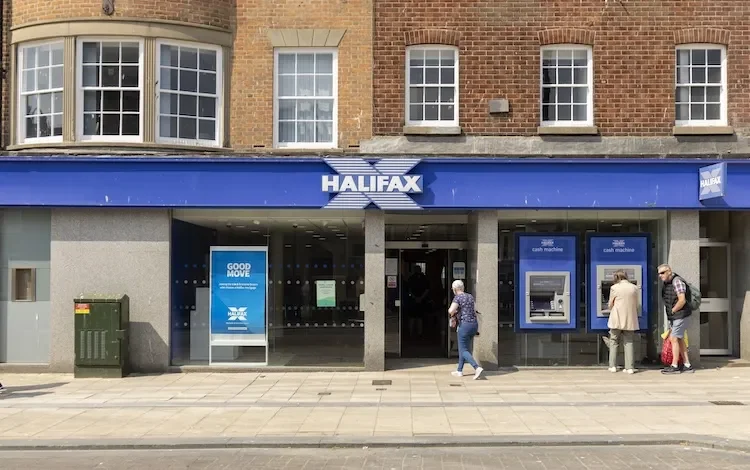
Lloyds Banking Group, the parent company of Halifax, recently announced that it would be retiring the Halifax brand, along with its blue-and-white logo. It will no longer allow new Halifax accounts to open, and existing accounts will move over to Lloyds. The disappearance of high street stalwarts can often provoke a disappointed response in some consumers, and residents of Halifax’s namesake town have been particularly upset.
So: does the decision make commercial sense? Industry commentators have suggested that the overlap between the brands in the group may partially explain the decision to consolidate. YouGov BrandIndex data suggests they are similarly perceived. We can see that Index scores (a measure of overall brand health that averages several metrics) more than twice the industry average, but there is less than a point between them (Lloyds 13.5; Halifax 12.3; Banks & building societies 5.8).
When we look at general likeability, as measured by our Impression scores, Lloyds and Halifax are again very close (15.0 vs. 14.9). Lloyds has an edge when it comes to certain metrics Quality scores are one such example (17.8 vs. 14.8). Reputation scores (20.0 vs. 16.9), which measure whether consumers would be proud or embarrassed to work for a particular company, are another.
In other cases, the gap is again more narrow: Consideration scores, which measure which brand the public would choose from a list, are at 20.9 for Lloyds and 19.0 for Halifax; and Recommend scores, which track consumer advocacy, are at 10.0 compared to 9.5. Halifax only has a slight lead in Satisfaction scores (13.5 to Lloyds 12.6).
So, on the evidence, it doesn’t seem there’s anything wrong with the Halifax brand’s health metrics, but that in itself may be the reason to consolidate it into Lloyd’s. The two centuries-old, well-regarded consumer banking brands perform comparably across most metrics. We may spare a thought for the residents of Halifax, West Yorkshire – but the move to combine them may make sense from a technological, marketing, and commercial perspective for Lloyd’s.
This article originally appeared in City AM