
After the Supreme Court released several high-profile decisions, this week's Economist / YouGov Poll finds that half (50%) of Americans somewhat or strongly disapprove of the way the court is handling its job. Only 36% approve of the Supreme Court's job handling.
Democrats overwhelmingly disapprove of the way the Supreme Court is handling its job (80% disapprove and 12% approve), and the share of Independents who disapprove of the Supreme Court is about twice as large as the share who approve (52% vs. 27%). In contrast, a majority (69%) of Republicans approve of the court. Republicans who consider themselves to be MAGA supporters are more likely than non-MAGA Republicans to approve of the court (72% vs. 64%).
One source of disapproval toward the Supreme Court may be the view of many Americans that the court's recent decisions have given too much power to the president. Nearly half (45%) of Americans think the court's decisions have given the president too much power, more than the 38% who think recent decisions either have been about right (29%) or have given the president too little power (9%).
Most Democrats (79%) say that the court has given the president too much power, as do nearly half (47%) of Independents. But a majority (57%) of Republicans say that the court has given the president about the right amount of power and 20% say it has given the president too little power. A majority (61%) of MAGA Republicans and 52% of non-MAGA Republicans say that the Supreme Court has been about right in its recent decisions. Far fewer MAGA Republicans say that the court has given the president too much power than say it has given too little (5% vs. 25%). The opposite is true of non-MAGA Republicans: 25% say the court has given the president too much power and 13% say it has given too little.
Concerns about giving the president too much power are reflected in American's evaluations of the Supreme Court's recent decisions. More Americans say that the president should not be able to fire members of the Federal Reserve Board than say that the president should be able to (52% vs. 29%), consistent with the Supreme Court's recent ruling. But Americans' opinions about other independent federal agencies are roughly the same, even though they go against the court's ruling: 51% say the president should not be able to fire agency heads, while 30% agree with the court that the president has the power to do so.
There is a similar pattern with rulings about immigration: Americans' opinions are consistent about the issue, not about which way the Supreme Court ruled. A majority (56%) of Americans' agree with the court's recent decision that all children born in the U.S. should be citizens regardless of their parents' immigration status, overturning a Trump administration executive order that sought to redefine birthright citizenship. 37% say children should only automatically be considered citizens if their parents are citizens. On the other hand, about half (51%) of Americans say that immigrants from Haiti and Syria who were granted temporary protective status should not be deported. The Supreme Court chose not to block the Trump administration from deporting members of these groups. Only 26% of Americans think these immigrants should be deported.
About half (51%) of Americans also agree with a Supreme Court ruling that occasional users of marijuana should be allowed to buy firearms. Only 31% think occasional marijuana users should not be allowed to buy firearms, as the Trump administration argued. However, most Americans (79%) say that people addicted to drugs should not be allowed to buy firearms, while only 7% think they should be allowed to. The Supreme Court's ruling did not prevent the Trump administration from blocking firearm sales to people with drug addictions.
Finally, a majority (53%) of Americans say that Trump should have to pay E. Jean Carroll $5 million after a court found Trump liable for sexual assault of Carroll. The Supreme Court chose not to overturn this ruling. Only 29% say he should not have to pay. Americans are more likely to believe Carroll is telling the truth about the case than to believe Trump is telling the truth (49% vs. 27%).
Overall, the court's recent decisions are a mixed bag when it comes to public opinion. Some rulings match the views of a majority of Americans, while others go against most Americans' opinions. There is no real divide, though, in Americans' views of the court's ideology. A large share of Americans see the court as slanted in one direction. Nearly half (44%) of Americans say that the court's political viewpoint is conservative — more than the 36% who say the court is moderate (27%) or liberal (9%).
About two-thirds (68%) of Democrats say the Supreme Court is conservative. Independents also are more likely to say the court is conservative than to say it is moderate or liberal (37% vs. 23% vs. 5%). Republicans are less likely to see the court as conservative than moderate, while some even call it liberal (30% vs. 44% vs. 14%). MAGA Republicans (18%) are about twice as likely as non-MAGA Republicans (9%), Independents (5%), or Democrats (10%) to say the court is liberal.
The court's three liberal justices have positive net favorability, meaning more people view them somewhat or very favorably than unfavorably: Sonia Sotomayor (+10), Ketanji Brown Jackson (+8), and Elena Kagan (+6). Its six conservative justices have negative net favorability: Samuel Alito (−7), Neil Gorsuch (−7), Brett Kavanaugh (−10), John Roberts (−11), Clarence Thomas (−12), and Amy Coney Barrett (−15).
Views of the justices are highly polarized by party. Each of the liberal justices has positive net favorability among Democrats and negative net favorability among Republicans. The opposite is true for each of the conservative justices. The liberal justices' higher overall favorability can largely be explained by a combination of two factors: Democrats' views of conservative justices generally are more negative than are Republicans' views of liberal justices, and Independents generally have more favorable views of the liberal justices than of the conservative justices.
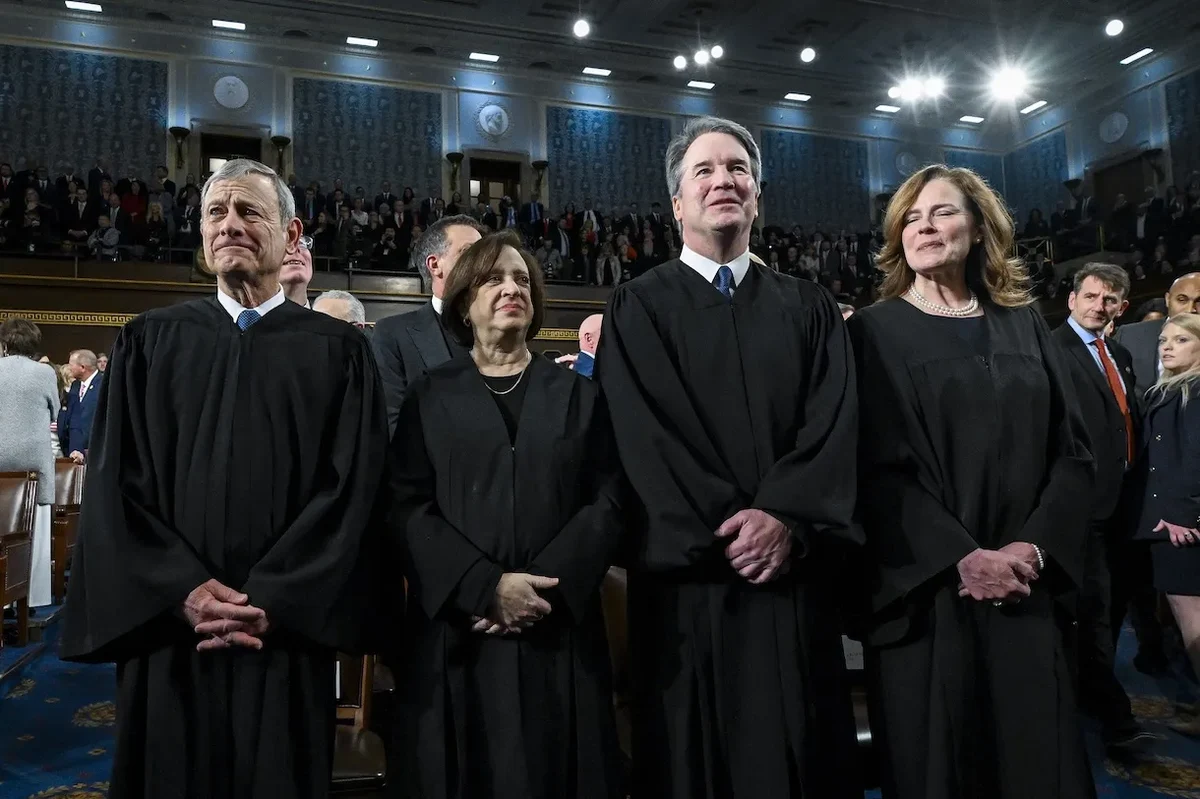
Image: Getty (Pool / Pool)
What do you really think about President Trump, American politics in general, and everything else? Share your reality, join the YouGov panel, and get paid to share your thoughts. Sign up here.