



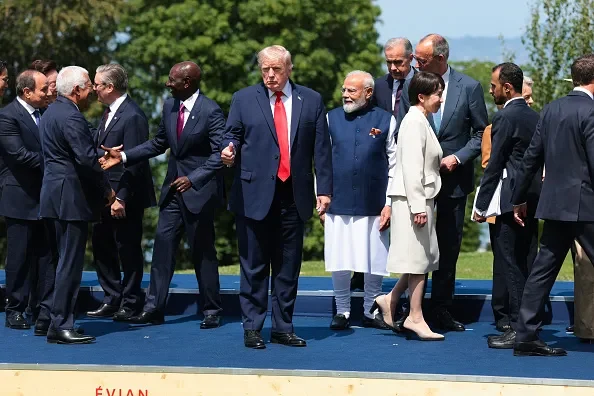
With NATO’s future increasingly called into question by the Trump administration, our survey shows that a majority of people in each country have a positive view of the institution, including in the US itself (55%). Poles and Britons in particular take a favourable view of the alliance, at 74% and 70% respectively.
Attitudes to NATO broadly match or outperform those towards other major international organisations in all countries surveyed, namely the United Nations (53-61% favourable), European Union (52-60%) and the World Trade Organisation (38-50%). It is nevertheless worth noting that in all countries attitudes to each entity are net positive overall.
Core to the continued existence of the NATO alliance are two major factors: defence spending and trust.
The failure of most NATO member states to abide by the alliance’s commitment to dedicate 2% of GDP to defence spending has been a particular bugbear for Donald Trump, having threatened not to defend allied nations if they do not pay more.
Aside from the fact of whether NATO could continue in its current form without US backing, there is also the more prosaic issue that the alliance in Europe risks destruction by conquest as a result of not spending enough.
In five of our seven countries, the most common view is that their nations are spending too little on defence and security. This is particularly the case in the UK, where 57% say so, alongside 40-45% in Germany, France, Australia and Canada.
By contrast, in Poland the main sentiment is that the amount being spent is about right, at 47% - although the remainder fall much more on the side of ‘too little’ (29%) than ‘too much’ (9%). Polish defence spending has ramped up significantly since the Russian invasion of Ukraine, from around 2.2% to 2.3% of GDP in 2020-21 to roughly 4.5% to 4.7% in 2025.
By contrast, in the US – where defence spending was $954bn in 2025 (about 3.1% of GDP), and is set to increase dramatically to $1.5tn in 2027 (about 3.6% GDP) – opinion is evenly split between the 34% who think too much is spent and the 34% who say it is about right. Only 15% think the US spends too little on defence.
Are people willing to support the changes necessary for greater military spending?
While there may be perceptions that military spending has not been high enough in five of our seven countries, this does not necessarily mean that there is willingness to make sacrifices in order to increase military funding.
In each of Australia, Canada, France, Germany and the UK, there is overall unwillingness among those who say too little is spent on defence to see taxes raised or borrowing increased in order to move more money to the military
Reducing spending on public services in order to increase defence spending is divisive in the UK, Germany and Canada by those who think too little is spent on defence, although it is generally supported by Australia (58%), and is treated with enthusiasm in France (70%).
Looking at attitudes among the wider populations, there is overall unwillingness to take either of these three measures in order to increase defence spending – with the sole exception of France, where 53% overall are willing to back public services funding cuts in order to do so.
NATO members still generally trust the US and other allies to come to their aid
The second core element that is key to NATO’s survival is trust. Article 5 of the NATO charter commits members to collective defence, with an attack on one member supposed to be treated as an attack on all.
But the alliance cannot continue to exist if members do not believe that their counterparts will abandon its core principle when the bullets start to fly.
There is still public backing in each country surveyed for collective defence.
With the US president’s general negativity towards NATO – and indeed his threats against two of its members – it is no surprise to see that expectations that the US will defend Europe are somewhat lukewarm.
Among the NATO members surveyed, 41-44% in each of Poland, France, Canada and the UK believe that the US would help defend them if they came under attack – although in each case this is still higher than the 25-30% who think the US would leave them to fend for themselves.
However in Germany, slightly more think the US would not come to their aid (39%) than think they would (32%).
By contrast, in Australia, sentiment is much more positive, with 57% of Australians thinking the US would assist them, compared to 21% who do not.
For their part, American expectations mirror those in the main clutch of NATO member states surveyed, with 45% of US citizens thinking other NATO countries would come to their aid if the US was attacked, compared to 23% who think they would not.
The other NATO states surveyed are much more convinced that their non-American NATO allies would help defend them if they came under attack, ranging from 56% in Poland to 65-67% in Canada and France and to 76% in the UK and Germany. Likewise, 73% of Australians think “other allied countries” would lend them a hand if they were attacked.
Are Americans willing to defend NATO allies? And are NATO countries willing to defend the US?
But do expectations match reality?
In the US, the number of Americans who say they would be willing to come to the aid of Germany, France, Poland, Australia and the UK stands at 65-73% (they were not asked about Canada, although there is no reason to suspect the answers would be radically different). Only 7-11% of Americans say the US should not be willing to help their fellow democracies in the event of an attack.
The other countries are likewise willing to assist the US, although to a lower degree: while 49% to 63% in each of the other six countries say their government should be willing to send the armed forces to America’s aid if it was attacked, between 19% and 28% say they should not.
This stands in contrast to the 67-80% in each non-US country that say they would be willing to defend a European NATO ally if they came under attack (“an allied democracy” in the case of the question in Australia). A lower rate of 5-14% would be unwilling in these circumstances.
Military alliances are still seen as important for national security
While our results clearly show a willingness to continue to abide by collective defence, this does not merely reflect a dedication to existing commitments, but also a belief that such alliances are necessary for protection.
Our survey shows that there is a clear sense in each country that military alliances are still key to their national security, with between 65% and 91% in each nation saying that they are “very important” or “fairly important”.
This includes 65% of people in the US, who are of course the country least at risk from a direct military confrontation on their shores.
The Australians are the most likely to think alliances are “very important”, at 55%, along with 50% of Britons and 48% of Germans. By contrast, the French are the least likely to feel this way, at 24%.
Do people think an attack on their country is likely, and how confident are they in the armed forces?
For all the talk of conflict, only although a small minority of 5-9% see a full scale military attack on their country as “very likely” within the next 10 years.
The Americans and French are the only countries where most people are confident that the armed forces are strong enough to protect the nation in the event of an attack – although there is a big gap between the two. While 77% of Americans are confident, including 40% who are “very confident”, this falls to 52% in France, were only 11% express the highest level of confidence.
Nevertheless, this is still more optimistic than its neighbours, with only 38% of Britons and a mere 21% of Germans having confidence in the armed forces.
How many are willing to defend their country?
Should their country come under threat of attack, how willing are younger generations to take up arms in defence of their homeland?
Levels of enthusiasm, or at least willingness, differ by country. Men aged 18-39 in Australia and Canada are the most likely to say either that they would volunteer for military service if their country was under imminent threat of invasion (24-25%) or would be willing to serve if called up (30-31%).
By contrast, younger men in Germany stand out as the most likely to say they would actively refuse to serve in the armed forces, at 41%, compared to 20-31% in the other nations surveyed. A little over a third in Germany (36%) say they would volunteer or be willing to serve.
In the UK, 27% of British men aged 18-39 say they too would not be willing to serve, as do 39% of British women. This gives a figure of 33% among all Britons this age – a similar level to the 37% we recorded in a 2024 survey. You can read that study further for more detailed reasons this group gave for their reluctance to defend their country.
Results
Topline results for each country
Individual country results
Interested in taking YouGov surveys? What do you think about the United States, global politics, and everything else? Have your say, join the YouGov panel, and get paid to share your thoughts. Sign up here.
Interested in commissioning YouGov research? We connect in real-time with real people around the world to gather their thoughts, behaviours, and opinions, to ensure that our research data is powered by reality. Explore our survey services here.
Photo: Getty