
Economist / YouGov Polls in September painted a promising picture for Democrats in the 2026 elections: double-digit leads among likely voters, and a record-large lead for this election among registered voters.
But the latest poll shows a shrinking Democratic lead: 5 points among registered voters, and 7- and 9-point leads under YouGov's likely voter screens. The Democratic leads among all three groups have fallen for two consecutive polls. Democrats' lead under YouGov's strict voter screen — registered voters who have already voted or say they will definitely vote — has fallen to 9 points from a peak of 14 points four weeks ago.
Does this mean Republicans are catching up in the congressional elections? Let's look at the data.
1. There's no clear sign of a tightening race among registered voters
While Democrats' lead among registered voters has fallen to 5 points from 8 points two weeks ago, that kind of shift is far from unusual in Economist / YouGov Polls. Week-to-week variations of this magnitude have happened regularly over the past two years. The overall trend in recent months is still an increasing Democratic lead.
If next week's poll continues to show a Democratic lead of no more than 5 points, that might provide more evidence for a tightening race among registered voters. But so far there's no way to know if this is anything more than normal week-to-week variation.
2. Republicans are becoming more likely to say they'll vote
Besides voter registration status or intent, the main question YouGov uses to define likely voters is, "How likely are you to vote in the election in November?" Registered voters who say they "definitely" will vote or who have already voted are likely voters under YouGov's strict screen. The loose screen adds people who say they'll "probably" vote.
Democrats have consistently done better among likely voters using the strict screen than they have among registered voters, because Democrats have been more likely to say they definitely will vote or already voted. Among registered voters, 18% of Democrats and 19% of those who support Democratic candidates have already voted, compared with 5% of Republicans and 7% of Republican supporters. 87% of Democrats and 89% of Democratic supporters say they either already voted or definitely will vote, compared to 80% of Republicans and 83% of Republican supporters.
But that 7-point gap between the share of Democrats and Republicans who have already voted or say they'll definitely vote is much smaller than it was last month. While around 85% of Democrats have consistently said they'll definitely vote or already did, in mid-September only 70% of Republicans did — 16 points behind Democrats at that time.
The result is that the population of likely voters — under YouGov's strict screen — is getting comparatively more Republican than it was in September. That explains why the Democratic advantage under the strict screen has shrunk more than the Democratic edge among all registered voters.
3. The big polling picture is still friendly to Democrats
While Democrats' 9-point lead among likely voters is down compared to September, it's still higher than the 4-point lead Democrats had with a similar group at this stage in the 2018 midterm elections. Economist / YouGov Polls in 2018 also showed Democrats peaking in September among likely voters, followed by a tightening race in October. Democrats won the national popular vote by 9 points and won 235 seats in the House.
Most registered voters disapprove of Donald Trump's job performance, as has been the case for months: 40% strongly or somewhat approve of how Trump is handling his job, while 59% disapprove.
Trump's net job approval among registered voters of -18 is far below his net approval of -8 with the same group at this point in 2018.
Most registered voters who are supporters of Democratic candidates (66%) say it feels like Trump is on the ballot, compared to 51% of Republican supporters.
Two-thirds (66%) of registered voters say the country is off on the wrong track. At this point in Trump's first term, 52% said the country was on the wrong track.
Belief that the country is off on the wrong track is nearly unanimous among registered voters who are Democrats (91%), and three-quarters (76%) of Independents say the same. Republicans are more divided, with 57% saying the country is generally headed in the right direction and 34% saying it's on the wrong track.
Republicans who are MAGA supporters are optimistic about the country (66% say right direction and 26% say wrong track) but non-MAGA Republicans are more pessimistic (44% vs. 46%).
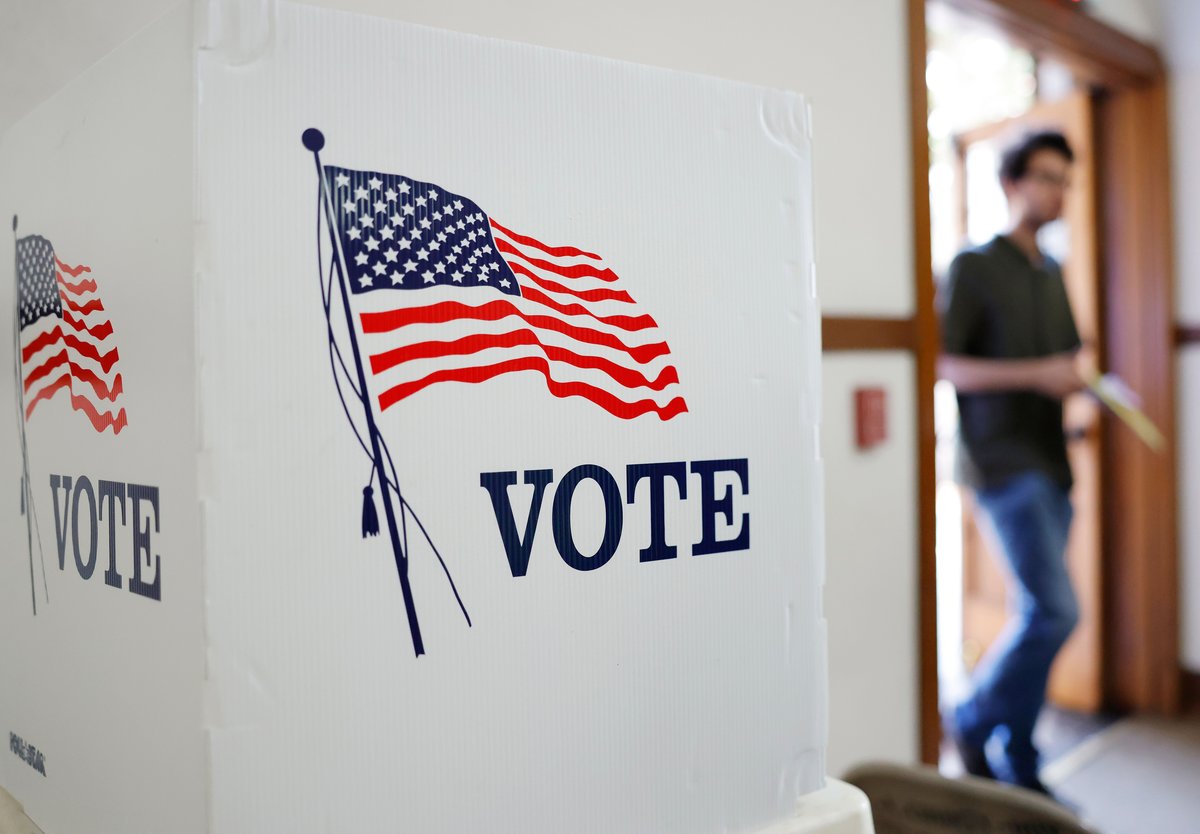
Image: Getty (Antranik Tavitian / Stringer)
What do you really think about President Trump, American politics in general, and everything else? Share your reality, join the YouGov panel, and get paid to share your thoughts. Sign up here.