

Sports fans were spoilt for choice over the weekend of 4-5 July. Wimbledon, the British Grand Prix, the inaugural Rugby Nations Championship, men's and women's T20 cricket, the Tour de France and a FIFA World Cup schedule featuring England's clash with Mexico all competed for attention across one of the most crowded sporting weekends of the year. But while fans revelled in the abundance of live sport, the weekend posed an intriguing question for broadcasters, rights holders and sponsors alike: when everything is on at once, where does attention actually go?
To answer that question, YouGov combined proprietary consumer survey data, Barb television audiences, social media analysis and sponsorship valuation metrics to understand not only what people intended to watch, but what they actually watched, talked about and ultimately delivered value for.
Tracking viewing intent ahead of the UK’s super sporting weekend
The first finding was clear before a ball had even been kicked.
Despite kicking off in the early hours of the morning, England's FIFA World Cup match against Mexico generated the highest level of viewing intent, with 39% of the UK population planning to watch according to YouGov Sport survey data. Among those intending to tune in, almost two-thirds (63%) planned to watch the match live. The same pattern was evident across almost every event during the weekend, highlighting something rights holders have long understood: sport remains one of the few forms of content that audiences still overwhelmingly want to consume live.
Behind the FIFA World Cup, Wimbledon and the British Grand Prix emerged as the weekend's biggest attractions. Viewing intent was almost identical, with 19% of the UK population planning to watch Wimbledon and 18% intending to watch Formula 1 from Silverstone. Yet the survey also revealed the hidden cost of a congested sporting calendar. When asked whether they would have been more likely to watch if there had been no scheduling clashes, both Wimbledon and Formula 1 returned exactly the same answer: 13% of the population said they would have been more likely to tune in. For events already attracting around one in five Britons, that represents a substantial pool of lost potential attention.
The effect was even more pronounced for sports attempting to grow beyond their core fan bases. The opening weekend of the Rugby Nations Championship attracted viewing intent from 11% of the population, while 8% planned to watch the Women's T20 Cricket World Cup Final between England and Australia. Yet a further 7% and 5% respectively said they would have been more likely to watch if those events had not clashed with other major sporting fixtures. The issue wasn't a lack of interest; it was a lack of available attention.
What the official viewership data shows
Official rated audience data collected via Barb allows us to move beyond intention and examine what actually happened.
If the survey suggested football would dominate the weekend, television ratings confirmed it.
On Saturday, the FIFA World Cup round between Canada and Morocco and later Paraguay and France were the biggest draws on the sporting schedule, averaging around three times the audience of any other live event and peaking at just over five million viewers. Their influence extended beyond their own broadcasts, visibly shaping viewing behaviour elsewhere across the sporting landscape.
Wimbledon became the clearest example of audience migration in action. As Canada versus Morocco gathered momentum, audiences on BBC One and BBC Two softened, suggesting viewers were actively moving between football and tennis depending on where the most compelling action was unfolding. At 18:51 BST, when the World Cup match entered half-time, Wimbledon immediately experienced an uplift as viewers returned to catch Arthur Fery's match point. The gains disappeared once the second half began, only for audiences to surge again after the final whistle as Grigor Dimitrov and Matteo Berrettini's five-set thriller reached its climax. Wimbledon ultimately peaked at approximately 2.3 million viewers.
Not every sport experienced the same volatility. England's Rugby Nations Championship match against South Africa proved resilient throughout the evening, maintaining a relatively stable audience despite intense competition elsewhere. While football and tennis fans demonstrated a willingness to switch channels, rugby viewers appeared more loyal to the action in front of them.
Sunday brought a different dynamic.
Although the FIFA World Cup would once again dominate the day's largest audiences, Formula 1 became the event that most visibly influenced behaviour across the rest of the sporting schedule. Wimbledon built steadily during the afternoon, climbing from around 500,000 viewers at 12:30pm to more than two million by 3pm as Novak Djokovic took centre stage. The start of the British Grand Prix coincided with a noticeable slowdown in Wimbledon growth, providing one of the clearest examples of audience competition across the weekend. Tennis remained surprisingly resilient, averaging approximately 1.6 million viewers during the race compared with Formula 1's 1.17 million.
The strongest evidence of audience migration arrived at 4.28pm when the chequered flag fell at Silverstone. Within the next 30 minutes Wimbledon audiences increased by roughly 50%, while the Women's T20 World Cup Final also enjoyed a smaller uplift, peaking at around 400,000 viewers during the final overs of England's innings. Once again, viewers were demonstrating a willingness to move rapidly between competing events as key moments unfolded.
Later in the evening, football came back into play. Brazil versus Norway produced one of the defining audience moments of the weekend, peaking at 7.3 million viewers at exactly 23:01 as Brazil were awarded a penalty. Viewership remained above seven million until the final whistle. Meanwhile, the audience-switching behaviour observed throughout the weekend resurfaced once again, as Wimbledon benefitted from a temporary influx of viewers during half-time before audiences returned to football for the second half.
Then came England versus Mexico.
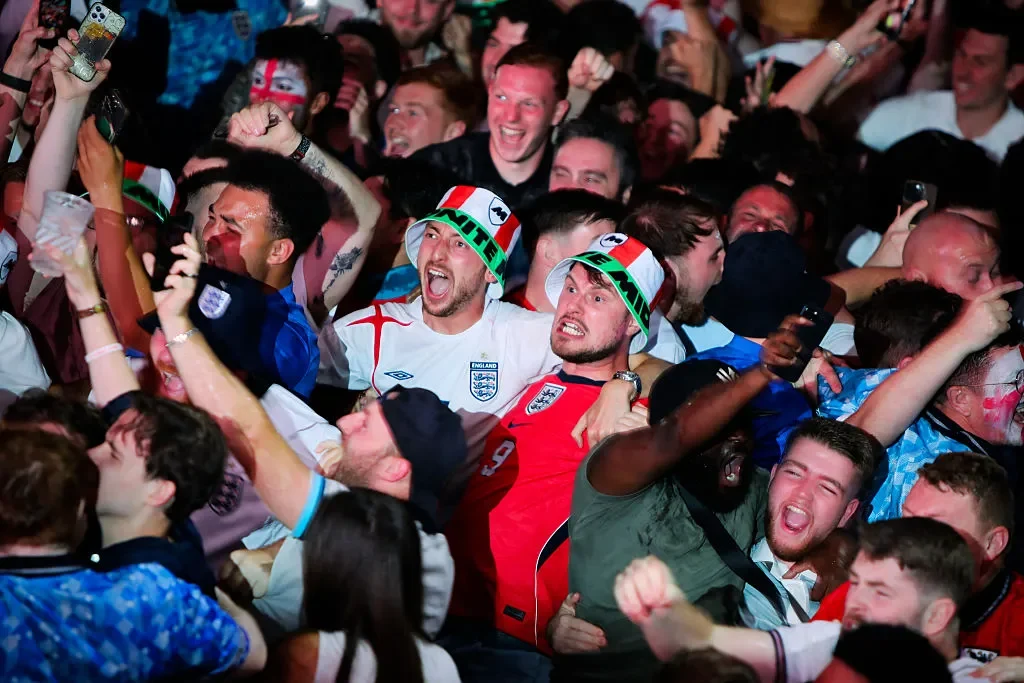
Despite taking place overnight, the match opened to approximately 5.9 million viewers before reaching 8.9 million immediately after Jude Bellingham's opening goal. Audience levels remained strong throughout, settling at around seven million after England's second goal before rising again as the contest entered its closing moments. The size of the audience underlined the ability of England football to cut through scheduling challenges, time zones and sleeping habits.
What drove the most buzz on social media?
Social media activity revealed that what people watch and what they talk about are often very different things.
According to data collected through YouGov’s partnership with Meltwater, Canada versus Morocco provided the cleanest relationship between audience and online engagement. Television viewership peaked at just over 5.2 million at 7.45pm, while social media conversation peaked just 15 minutes later as Ounahi scored his second goal. Viewers and social media users were effectively reacting in unison.
Brazil versus Norway delivered an even tighter alignment. Audience and social mentions peaked in exactly the same 15-minute window as Brazil's penalty was awarded. By this stage of the evening, virtually every other sporting event on UK television had finished, focusing attention on a single sporting moment and creating a rare instance where viewers and online commentators moved in sync.
Other events told a different story.
Paraguay versus France generated one of the weekend's most interesting disconnects between audience and conversation. While television audiences peaked shortly before 11.30pm, the biggest social media moment arrived almost two hours later. Nearly 3,000 mentions across UK authors were recorded within a single 15-minute window as debate erupted around a contentious penalty decision, criticism of the referee, Michael Olise's yellow card and a confrontation involving Kylian Mbappé after the final whistle. The biggest social spike of the weekend wasn't driven by the match itself, but by the controversy that followed it, even after the programming ended.
England versus Mexico produced a similarly layered outcome. Viewership peaked immediately after Bellingham's goal, but social media engagement reached its highest point almost 90 minutes later at full-time, after England survived with ten men to secure a dramatic 3-2 victory. People watched the goals, but they posted about the win.
Formula 1 demonstrated another fascinating dynamic. Online discussion peaked hours before the largest television audience arrived, driven by Lewis Hamilton's surprise Sprint and Qualifying performances against championship leader Antonelli. By race day, anticipation had already been established which supported viewership within a busy calendar. Yet even after the race, the social media story wasn't Charles Leclerc's victory. Instead, discussion was dominated by frustration around Verstappen's late crash and a Safety Car finish that many fans felt robbed the race of a proper conclusion. In Formula 1, as in football, controversy proved just as valuable as competition itself for generating online engagement.
Wimbledon perhaps best highlighted the challenge of measuring attention in a multi-match environment. On Saturday, social media reaction centred around Alex Eala's shock victory over defending champion Iga Świątek, while peak television audiences arrived hours later. By Sunday, however, the narratives had converged. Aryna Sabalenka's defeat and Novak Djokovic's near disqualification scare dominated discussion, bringing television audiences and social engagement much closer together.
Sponsor impact: How schedule clashes impact brand sponsor value
The battle for attention observed across audiences and social media has important implications for sponsors.
Earlier in the analysis, consumer research suggested that Wimbledon and Formula 1 could each have attracted an additional 13% of the UK population had scheduling clashes not existed. The audience data appears to support that theory. Wimbledon audiences plateaued as the British Grand Prix got underway and then surged by roughly 50% once the race finished, indicating that many fans were effectively being forced to choose between two premium sporting properties.
For sponsors, those choices carry a measurable cost.
Across the weekend, Emirates generated £5.4 million in Net Sponsorship Value across UK Wimbledon broadcasts. When incorporating YouGov's NSV-X methodology, which accounts for positive brand recall and sponsorship perception among fans, the figure rose to £5.7 million. Had scheduling conflicts not suppressed audience levels, that value could have reached £6.4 million, representing a potential loss of approximately £738,000 in sponsorship value.
Rolex faced a similar challenge through its highly visible Wimbledon partnership, while Formula 1 title sponsor Pirelli generated £624,521 in NSV-X value during the British Grand Prix weekend, but could potentially have achieved almost £796,000 under a no-clash scenario.
The lesson is a valuable one. Scheduling conflicts do not simply divide audiences between broadcasters or sporting properties; they also dilute the commercial value available to sponsors. Brands are not only competing for share of voice within an individual event, but increasingly across multiple simultaneous sporting broadcasts.
Ultimately, the weekend demonstrated that modern sports consumption cannot be understood through a single lens. Survey data revealed what people wanted to watch. Television audiences showed what they actually prioritised. Social media measurement exposed the moments that resonated most deeply. Sponsorship analysis quantified the commercial impact of those decisions. Together, they paint a picture of a sports marketplace where attention is the most valuable currency of all. And on one of the busiest sporting weekends of the year, every event, broadcaster and sponsor was fighting for its share.
Article contributors: Umang Poddar, Sarah Melville, Tom Church, Aparajith TK, Atharva Kabra, Suvarun Mazumder, Aditya Shriram, Akhilesh Mesta and Rajinder Singh Bhatti.
Methodology:
Viewing intent and consumer sentiment
Viewing intent data was sourced from a nationally representative YouGov Sport survey of UK adults (18+), conducted ahead of the sporting weekend of 4-5 July 2026. Respondents were asked which sporting events they were aware of, intended to follow, how they planned to consume coverage, and whether they would have been more likely to watch if competing sporting events had not taken place simultaneously. Results are weighted to be representative of the UK adult population. Sample size: 2,095.
Television viewership
Television audience analysis was based on BARB (Broadcasters' Audience Research Board) viewing data, the official television audience measurement currency for the UK. Live audience figures were analysed on a minute-by-minute basis across relevant broadcast channels to understand audience levels, viewing peaks and audience movement between competing sporting events across the weekend of 4-5 July 2026.
Social media analysis
Social media analysis was conducted using YouGov Sport's social intelligence capabilities, combined with Meltwater’s AI-powered online media and social tracking platform, following publicly available online conversations relating to the featured sporting events between 4 and 6 July 2026. Analysis included volume of mentions, engagement patterns and key conversation-driving moments across major social media and online platforms, enabling comparison between audience behaviour and online discussion.
Sponsorship value analysis
Sponsorship valuation was conducted using YouGov’s Sport Sponsorship solutions, which measures the value brands receive from sponsorship exposure across media coverage. The analysis covers the featured sporting events across 4-5 July 2026 and evaluates brand exposure using YouGov’s proprietary Image Recognition Analysis Tool ‘Theia’. Net Sponsorship Value (NSV) is calculated using YouGov’s five-factor Brand Impact Score methodology, then coupled with YouGov's enhanced NSV-X methodology, which incorporates the impact of consumer brand recall and brand perception to provide a more comprehensive measure of sponsorship effectiveness.