- By Rishika Arora
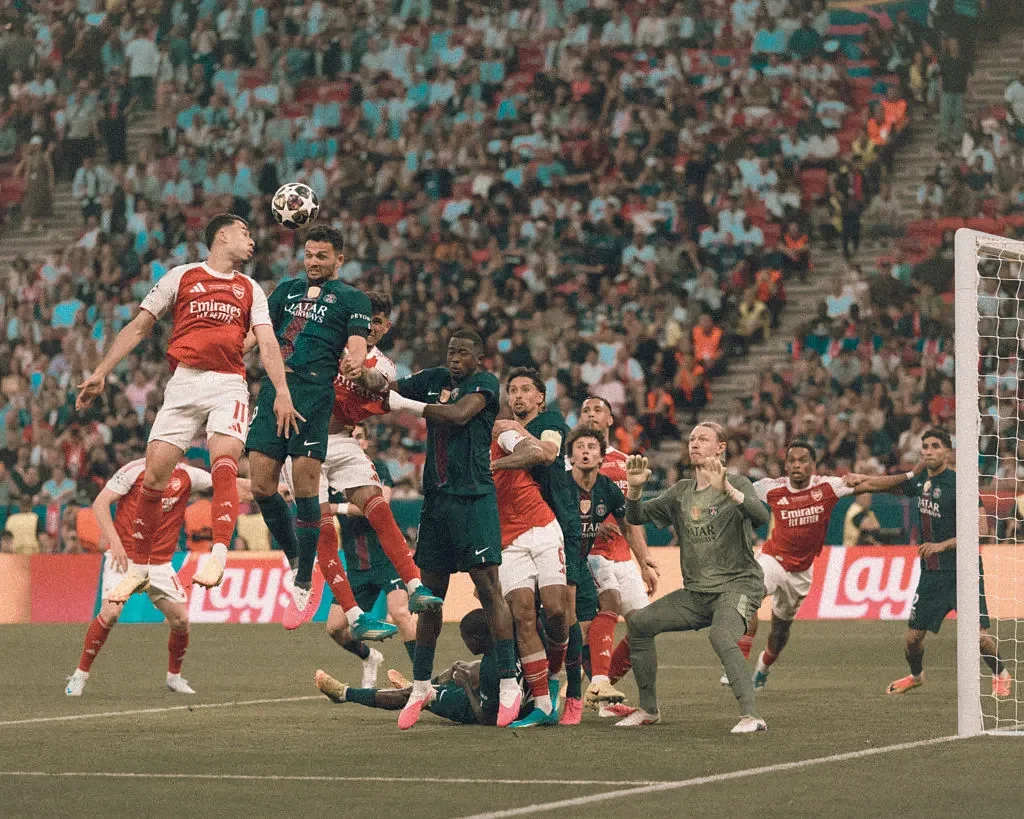
Paris Saint Germain (PSG) retained their UEFA Champions League title on 30 May 2026, defeating Arsenal 4-3 on penalties after a dramatic 1-1 draw at Budapest's Puskás Aréna. To understand audience engagement with the final, YouGov Sport Sponsorship Measurement Solutions provides a comprehensive overview of viewership and social media engagement data, using syndicated data from YouGov Profiles, social media data from Meltwater, and broadcast data from viewership measurement agencies such as Barb and Médiamétrie.
Based on this data, the match attracted a combined audience of approximately 17.5 million viewers across finalist nations the UK and France, host nation Hungary, and the United States. While an estimated 17 million watched through official channels across all four markets combined, an estimated additional 500,000 watching in London and Paris through out of home (OOH) sources (e.g. at the match itself, pubs, group events).
A final watched across screens, streets, and stadiums
Three million UK viewers watched the match through TNT Sports and HBO Max. A figure lower than previous years, likely in part due to the broadcasting move from free-to-air to pay TV. French viewers significantly exceeded the UK’s official viewership figures, with 9.5 million tuning in via M6 and Canal+, while the U.S. contributed 4.8 million across CBS, Univision, and Paramount+.
Beyond the broadcast, YouGov Profiles data estimates approximately just under 500,000 Arsenal and PSG supporters watched from bars and pubs across London and Paris, respectively. A further 60,000+ spectators were inside Puskás Aréna.
Arsenal may have lost the game, but front of shirt sponsor Emirates won the night
YouGov Sport's brand exposure analysis shows Arsenal's front-of-shirt generated 2 hours, 52 minutes of on-screen exposure with a Brand Impact Score (BIS) of 3.54, compared to PSG's 1 hour, 54 minutes and BIS of 3.25. This suggests Arsenal players remained on screen more frequently during key passages of play, whether through attacking sequences, defensive actions, player reactions or replays.
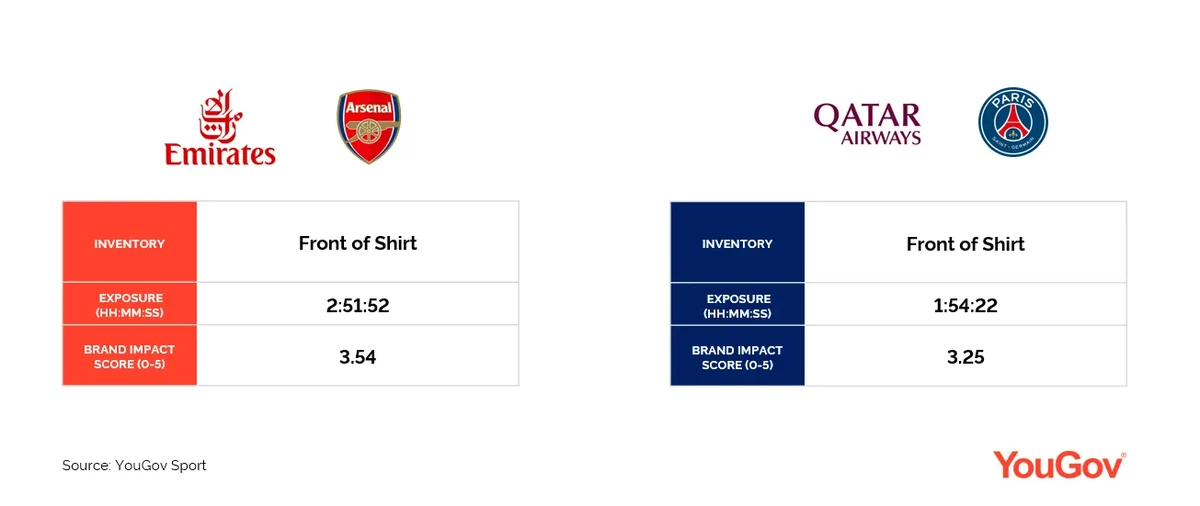
Broadcast cameras follow the match, not the scoreboard. Close-ups, replays and sustained player focus all influence how frequently a sponsor's branding appears on screen, and throughout the final Arsenal's players drew greater cumulative broadcast attention. Arsenal sponsor Emirates achieved a higher BIS than PSG sponsor Qatar Airways (3.54 vs 3.22), driven by slightly larger logo size, stronger on-screen prominence, a greater proportion of solus branding and lower levels of surrounding brand clutter. Longer average exposure durations also helped increase the impact of each appearance. These factors contributed to the higher BIS score, making the branding more prominent when visible on screen.
For brands evaluating shirt deals, this is significant: a dramatic performance from a losing side can – and in this case did – deliver greater exposure returns than victory itself.
42 billion Impressions: Monitoring the social media Buzz around the final
The final's impact didn't end at the final whistle.
Based on Meltwater’s social and news tracking database, the UEFA Champions League Final generated more than 40,500 social media posts, 13,700 videos and 24,500 online articles over the course of 48 hours (30-31 May), resulting in 42 billion potential impressions, 1 billion video views and 10 billion in potential readership.
PSG dominated the social conversation, generating 8.6 billion impressions and 418.6 million video views across its official social media accounts, compared with Arsenal's 3.7 billion impressions and 49.7 million video views. PSG's larger content output translated into significantly greater overall reach, extending the club's victory well beyond the pitch.
Brand exposure measures how often a sponsor is seen. Consumer sentiment helps explain how strongly that sponsorship resonates with fans
Using YouGov BrandIndex, Recommend scores for Emirates among Arsenal supporters in the UK, and Qatar Airways among PSG supporters in France, were compared against their respective general populations. In both cases, fans were significantly more likely to recommend the sponsor than the broader public, highlighting the strength of the association between club and brand. Emirates also recorded an increase in Recommend scores among Arsenal supporters around the time of the UEFA Champions League Final.
While multiple factors can influence brand perception, including Arsenal's successful domestic season and progression to the final, the findings demonstrate how periods of heightened fan engagement can coincide with stronger brand advocacy. Qatar Airways, meanwhile, consistently maintained strong recommendation levels among PSG supporters in France throughout the period measured.
These shifts in fan sentiment can have a meaningful impact on sponsorship effectiveness. Through YouGov Sport's BIS-X framework, sponsorship exposure is enhanced by incorporating fan perception and brand health metrics, helping to quantify how positive consumer sentiment can amplify the value generated by a sponsorship. The stronger uplift in recommendation observed among Arsenal supporters suggests that Emirates may have benefited not only from greater visibility during the final, but also from stronger fan advocacy, further enhancing the overall impact of the partnership.
Measuring the full impact of team sponsorship
The UEFA Champions League Final demonstrates why modern sponsorship measurement requires more than audience figures or logo counts.
No single metric can fully explain sponsorship performance. By combining audience measurement, brand exposure, social media buzz and consumer sentiment, brands can gain a more comprehensive view of how partnerships resonate with audiences and deliver commercial value. In an increasingly fragmented media landscape, measuring who watched is only part of the story. Understanding how fans engaged, how sponsors were seen and how audiences perceive brands provides a far richer view of sponsorship effectiveness.
Methodology: YouGov BrandIndex collects data on thousands of brands every day. Brand Recommend scores for Emirates and Qatar Airways are based on the question: “Which of the following Airlines would you RECOMMEND to a friend or colleague?" and are based on daily UK and France surveys weighted by age, gender, region, social grade, and ethnicity. Figures cover the period 23
OOH viewership is estimated based on YouGov Profiles data. Estimates based on responses to the question, "Which, if any of the following do you use as a means to watch/follow sports?" from a 52-week dataset published accessed on 7 June 2026. Base: Arsenal FC supporters in London who selected "Out of home (e.g. at a bar, restaurant or other public place)" (n = 979) and PSG supporters in France who selected "Out of home (e.g. at a bar, restaurant or other public place)" (n = 3,056).
Key metrics:
Brand Impact Score (BIS) is YouGov Sport's proprietary measure of exposure quality, scored on a scale from 0 to 5. It evaluates how effectively a sponsor's branding is displayed on screen by assessing factors such as logo size, screen position, visibility, duration and brand clutter. A higher BIS indicates more impactful exposure and a greater likelihood of the brand being noticed by viewers.
Net Sponsorship Value (NSV) is YouGov Sport's estimate of the actual value delivered by a sponsorship after accounting for both the quantity and quality of exposure.
Brand Exposure is a measure of how frequently and for how long a sponsor's branding appears during a broadcast or event. It quantifies the visibility a brand receives and serves as a key input in calculating sponsorship value
Further Reading: