 United Kingdom
  United States
  Deutschland
  France
  España
  Italia
  International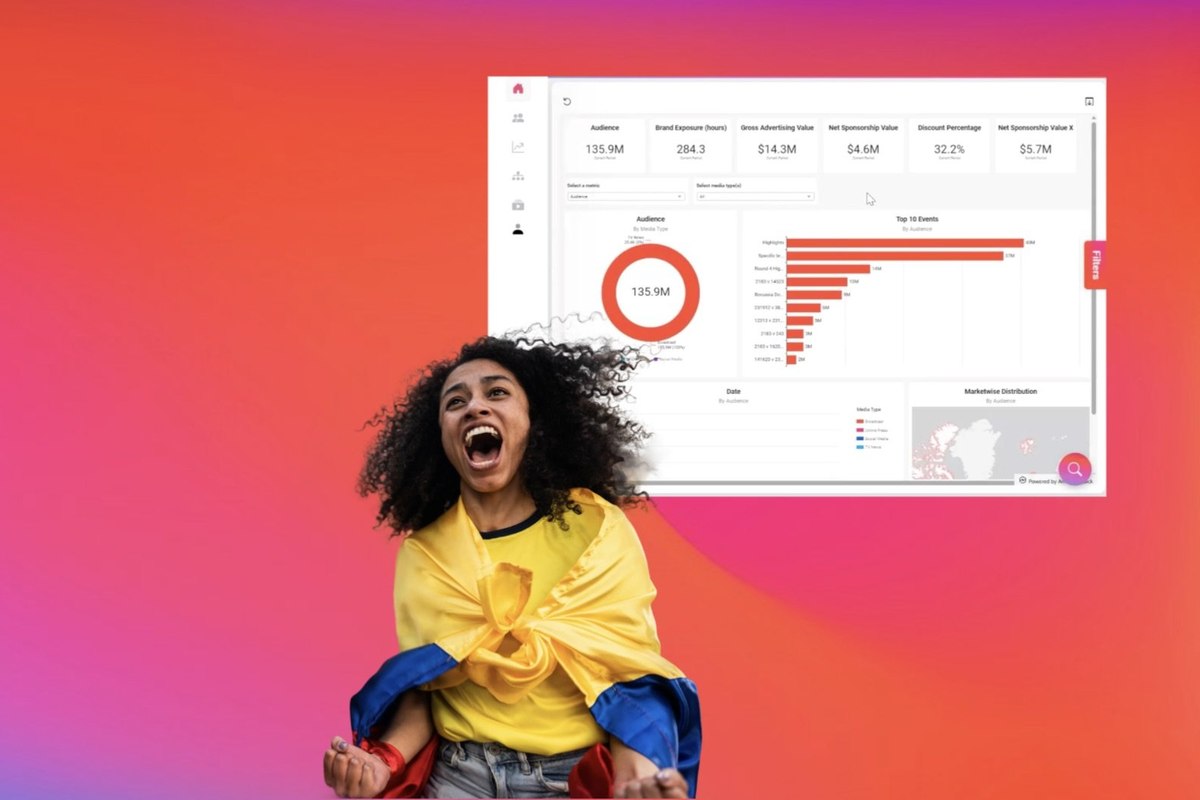
Key insights:
- Accurate audience measurement is the foundation of sports sponsorship valuation: errors in estimation at this stage compound throughout the process of evaluating sponsorship ROI. Reliable audience data ensures sponsorship valuation calculations and investment decisions are based on trusted evidence.
- Measuring sports audiences is more complex than ever: modern sports audience measurement combines data from broadcast TV, streaming platforms, social media, connected TV, and out-of-home viewing to reflect how fans consume sport today.
- Not all audience metrics measure the same thing: average audience, reach, unique reach, impressions, streams, and viewing sessions represent different metrics, making consistent methodology essential for accurate sponsorship valuation.
- AI strengthens audience forecasting when built on trusted data: AI enhances audience forecasting by analyzing trusted historical data and modeling sponsorship scenarios, but reliable results still depend on transparent methodologies and expert oversight.
Sponsorship valuation usually begins with one fundamental question: how many people actually saw it?
Whether you're evaluating a sponsorship opportunity, negotiating a rights deal, benchmarking performance against competitors, or proving return on investment, almost every commercial decision depends on understanding the true audience size. Yet despite its importance and new technologies, precise audience measurement is becoming increasingly complex, and as sports media continues to evolve in the AI era, confidence in those numbers matters just as much as the numbers themselves.
Audience data underpins all sponsorship valuations. If the estimate is wrong, every calculation that follows, from media value to ROI, becomes less reliable. Brands may overestimate the value of a partnership. Rightsholders may undervalue premium inventory. Agencies may benchmark against misleading figures. Budget decisions that appear evidence-based can quickly become distorted.
For organizations investing millions into sports sponsorship, audience measurement is among the most important, and often least understood, parts of the decision-making process.
Why measuring sports audiences has become more complex
There was a time when measuring sports audiences was comparatively straightforward.
Most fans watched live sports on linear television. National ratings providers measured audiences using well-established methodologies, broadcasters largely operated under similar reporting standards, and comparing audiences across competitions was relatively simple.
That landscape has changed dramatically.
Today's sports fans consume content across free-to-air television, subscription broadcasters, streaming platforms, connected TVs, mobile devices, tablets, and social platforms. Increasingly, they are also watching together in pubs, fan parks, and other out-of-home environments that have historically been difficult to measure.
Just as viewing behavior has fragmented, so too has the data available to measure it.
Official audience measurement still exists in many mature broadcast markets, but comprehensive ratings are only available in a relatively small proportion of countries worldwide. Around 30 to 35 major markets provide robust official audience data, leaving large parts of the world where no equivalent measurement exists. As a result, global audience measurement increasingly relies on sophisticated audience estimation.
The continued growth of digital platforms has also increased the proportion of sports viewing taking place on independently unmeasured platforms, creating additional gaps in audience data even in established broadcast markets.
This is where the quality of audience measurement becomes critical. The challenge isn't simply filling the gaps. It's filling them with trusted data and robust methodologies.
Factors that influence audience size around the world
Reliable audience estimation considers dozens of variables simultaneously. Many of these may appear relatively small in isolation, but collectively they shape the accuracy of the final audience estimate:
1. Broadcast availability
Free-to-air television naturally reaches more viewers than subscription broadcasters or streaming services. Rightsholders often accept smaller audiences in exchange for higher rights revenues behind a paywall, creating an important commercial trade-off between reach and income.
For sponsors, that distinction can significantly affect sponsorship value. Moving a competition behind a paywall may increase rights revenue while reducing brand exposure for commercial partners, making broadcast availability an important factor in audience estimation.
2. Program format
Live coverage typically attracts the largest audience. Once the result is known, casual fans are unlikely to watch full replays.
However, dedicated supporters may watch pre-match build-up, highlights programs, delayed broadcasts, post-match analysis, and magazine shows, creating additional sponsorship exposure that would be missed if only live broadcasts were considered.
3. Time zones and viewing habits
A football match played during an evening kick-off in Europe may air overnight in Asia or early morning in North America. While committed supporters may stay awake to watch live, many viewers choose highlights or delayed broadcasts instead.
Historical audience data helps reveal how different markets typically respond to these scheduling challenges, allowing analysts to estimate audiences more accurately than simply applying the same assumptions globally.
4. Competition for attention
Peak viewing hours alone do not guarantee large audiences. A busy summer weekend featuring Wimbledon, Formula One, international football, and cricket may split sport audiences across multiple events and devices. Casual fans inevitably choose between them, as well as non-sport programming.
Understanding these competitive viewing behaviors requires more than analyzing broadcast schedules. It also depends on historical audience data, market-specific viewing habits, and an understanding of how fans prioritize different events.
5. Local market behavior
Two neighboring countries can consume the same sport very differently. Standard household sizes vary. Favorite sports differ. Broadcasters change. Some markets embrace streaming rapidly while others continue to rely heavily on traditional television.
Accurate audience estimation depends on understanding local viewing behavior through high-quality consumer data, rather than assuming neighbouring markets behave alike.
6. The importance of the event itself
The stage of a competition naturally affects viewing interest, with finals, title deciders, or key qualifying events, tending to attract larger audiences than lower-stakes competitions. The presence of nationally significant teams or star athletes can also increase local audience sizes considerably.
Social conversation around an event often provides useful context for understanding shifts in public interest, while consumer research helps validate whether changing viewing behavior reflects genuine long-term trends rather than short-term anomalies.
Ultimately, broadcasters, rightsholders, and sponsors all need to correctly calibrate their viewership models to properly align data science with expert judgment, rather than relying on simplistic extrapolation from minimal sets of rated data.
Why audience numbers aren't always comparable
At the same time, streaming has introduced another layer of complexity. Unlike traditional broadcasters, many digital platforms are under little obligation to publish viewing figures. When they do release numbers, they often use entirely different metrics, such as streams, viewing sessions, or accounts reached, as these metrics are often designed for their own commercial reporting rather than industry-standard television measurement. This makes direct comparisons with television audiences difficult.
Mistakes in sponsorship measurement often result from treating all published audience figures as the same metric. While many in the industry use metrics interchangeably, they have distinct definitions.
Different organizations may report:
- Average audience - the average number of viewers throughout a program.
- Reach - the number of people who watched for at least a minimum period during the broadcast.
- Unique reach – the number of people who watched the broadcast, counted once per person and once per day.
- Total viewers – the amount of people who viewed a broadcast based on live broadcast views, recorded program watches, and streaming views.
- Viewing sessions – the total number of times viewers start watching a television program.
- Streams – the number of times a program has been streamed.
- Impressions – the number of times a program is displayed on a user’s timeline or search results.
Each metric measures something fundamentally different. These numbers cannot be compared directly without understanding the methodology behind them.
A sponsorship benchmark based on reach cannot be meaningfully compared with one based on average audience, without a carefully curated estimation model. Likewise, comparing television audiences with streaming sessions without accounting for methodological differences risks errant commercial conclusions.
Understanding what an audience figure actually represents is therefore every bit as important as understanding its size.
The challenges of audience measurement in the age of AI
Artificial intelligence has made audience estimation more accessible than ever. Anyone can ask a generative AI tool how many people watched a sporting event and receive an instant answer.
However, the difficulty lies in trusting the answer to be true, both in understanding its source and ensuring that source’s estimation accounts for the many factors that impact sports viewership.
General AI models typically rely on publicly available information rather than licensed audience ratings. Because of this, they may not know whether a rightsholder changed broadcasters or broadcast type, if published figures represent reach or average audience, or whether a match extended beyond its scheduled broadcast due to extra time or penalties. This assumes, too, that the information is not hallucinated.
Again, inaccuracies introduced at the beginning stage can compound through every subsequent calculation.
An audience estimate influences sponsorship valuation. Sponsorship valuation informs ROI calculations. ROI influences investment decisions.
When the foundational data is unreliable, every downstream decision becomes progressively less dependable.
To illustrate this, YouGov Sport compared responses from two leading generative AI tools against official audience ratings for a major football match in Germany.
While the AI tools generate plausible estimates, they consistently underestimate the total broadcast coverage, overestimate live viewership, and, in some cases, confused metrics such as average audience and reach. They also appear to rely on broad assumptions about similar events rather than the match-specific context, such as broadcaster, program format, and competing programming. Individually, these discrepancies may appear relatively small, but when used as the starting point for sponsorship valuation, they compound throughout the calculation process, resulting in increasingly unreliable commercial outcomes.
That does not mean AI has no role to play, just that AI is only as reliable as the data and governance supporting it.
How AI can strengthen - not replace - audience forecasting
Rather than replacing audience analysts, AI has the greatest impact when it enhances expert workflows. When connected directly to trusted datasets through a Model Context Protocol (MCP), AI becomes a powerful analytical assistant, enabling users to interrogate accurate data in natural language rather than relying on publicly available information.
Instead of searching the internet for estimates, AI tools can interrogate validated historical ratings, compare audience trends across markets, explain why forecasts have changed, test alternative broadcast scenarios and help analysts review their assumptions before recommendations reach clients.
Importantly, analysts remain part of every stage of the process.
Rather than producing a single unexplained answer, AI can expose the steps behind its reasoning, allowing specialists to verify assumptions, challenge anomalies, and refine outputs before they inform commercial decisions. This human-in-the-loop approach combines the speed of automation with the confidence that comes from expert review, trusted data governance, and decades of audience measurement experience.
How YouGov Sport can help
Accurate sponsorship valuation starts with accurate audience intelligence.
As sports media continues to fragment across broadcasters, streaming services, social platforms, and digital channels, measuring audiences has become significantly more complex than simply collecting viewing figures. Organizations that can combine trusted data with the right expertise are better equipped to negotiate rights deals, benchmark sponsorship performance, and invest with confidence.
At YouGov Sport, audience measurement is built on decades of sports-specific expertise and trusted, granular data. Official audience ratings from more than 35 major markets are combined with proprietary estimation models covering territories where official measurement does not yet exist. These models draw on years of historical broadcast data, scheduling intelligence, YouGov Profiles, behavioral data, and sports media expertise to create robust audience estimates across global markets. From exposure-level valuation to audience forecasting, every estimate is grounded in quality-controlled methodologies developed by dedicated sports specialists.
Building on this foundation, YouGov Sport has recently launched an AI-powered tool that helps users interrogate trusted datasets, explore future scenarios and better understand the factors driving audience forecasts. Built on AWS-powered infrastructure and governed by human oversight, it gives analysts and clients faster access to the insights behind the data, while ensuring every output can be reviewed and validated before informing commercial decisions.
The result is sponsorship intelligence that is not only more accurate, but also easier to access. Through always-on, self-serve reporting, intuitive filtering, natural language search and flexible dashboards, organizations can explore audience and sponsorship performance without waiting for bespoke analysis. Historical comparisons, benchmarking, and custom reporting help users move from data to decisions more quickly.
By bringing together broadcast, streaming, social, and other media sources in a single platform, YouGov Sport provides a unified view of sponsorship performance. Instead of working across disconnected datasets, brands, rightsholders, and agencies can benchmark properties, compare performance over time, and understand the complete picture of sponsorship value.
Because when sponsorship decisions are worth millions, confidence in the audience behind them matters just as much as the audience itself.