
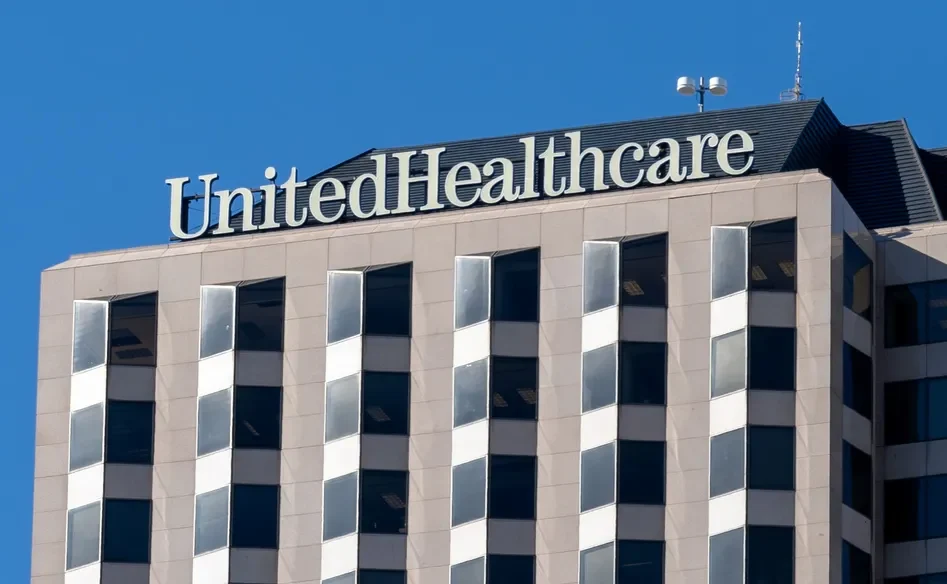
On December 4, 2024, UnitedHealthcare CEO Brian Thompson was killed outside a hotel in New York. The accused was allegedly motivated by resentment toward health insurance companies, spurring a series of media headlines. Following the incident, UnitedHealthcare’s Index score, a composite measure of brand health, recorded a significant decline.
Nearly two years later – and with recent news of the accused’s trial being delayed until January – how have public perceptions of UnitedHealthcare changed?
UnitedHealthcare brand health remains below pre-incident levels despite recovery
YouGov BrandIndex data suggests the company's brand health has recovered from its lowest point following the incident, but remains well below pre-incident levels.
In the aftermath of the event, net Index scores (which take the average of our Impression, Value, Quality, Reputation, Satisfaction, and Recommend scores) fell from 14.9 on December 4, 2024, to a low of –3.0 on September 21, 2025. A decline of 17.4 points.
Today, in July 2026, the health insurance brand’s scores sit at 3.9. A healthier position than in late last year, but still a long way from the pre-incident scores of 2024.
The pattern is similar across several component metrics. Impression, which measures overall positive and negative sentiment towards the brand, declined from 17.5 to 4.3 over the same period. Although still 13.2 points below its December 2024 level, the score has recovered from its low of -4.4 in September 2025.
Quality scores declined from 18.8 to 6.3 between December 4, 2024, and July 21, 2026. Again, an improvement on mid-September last year, when scores plunged to –2.0.
Value has been slower to recover than other measures. Perceptions of value for money declined from 10.0 to 0.2 between December 4, 2024, and July 21, 2026, a drop of 9.8 points. The slower improvement in Value suggests that some consumers may still see value for money as a potential barrier.
Looking at Satisfaction among current customers, the story is similar, but much less pronounced. The decline in this metric since December 4, 2024, till now is noteworthy (4.9 points), but less severe than the other brand health metrics tracked. It is the only metric that has not dipped into a negative during the period – consistently contributing positively to the company's overall brand health.
UnitedHealthcare consumer Consideration has almost fully recovered
Despite the challenges reflected in other metrics, the Consideration score – measuring the likelihood of consumers choosing UnitedHealthcare for their insurance needs – has seen only a slight decline (2.2 points).
Overall, the data shows that UnitedHealthcare has regained ground across several brand health measures since the lows of 2025. However, most metrics remain below their pre-incident levels, suggesting the company's broader reputation has recovered only partially, even as customer-facing measures such as Satisfaction and Consideration have remained comparatively stable.
Methodology: YouGov BrandIndex collects data on thousands of brands every day. UnitedHealthcare Index, Impression, Quality, Value and Satisfaction scores are based on the question(s): “Overall, of which of the following confectionary brands do you have a POSITIVE impression? / Now which of the following confectionary brands do you have an overall NEGATIVE impression?”, “Which of the following confectionary brands do you think represents GOOD QUALITY? / Now which of the following confectionary brands represents POOR QUALITY?”, “Which of the following confectionary brands do you think represents GOOD VALUE FOR MONEY? By that we don't mean "cheap," but that the brands offer a customer a lot in return for the price paid. / Now which of the following confectionary brands do you think represents POOR VALUE FOR MONEY? By that, we don't mean "expensive," but that the brands do not offer a customer much in return for the price paid”, “Of which of the following confectionary brands would you say that you are a "SATISFIED CUSTOMER"? / Of which of the following confectionary brands would you say that you are a "DISSATISFIED CUSTOMER"?”. Data is weighted using a propensity scoring methodology with targets from the American Community Survey (ACS) to ensure representation by age, gender, race, education, and region. Figures are shown as an 8-week moving average with sample size ranging from 3,501 to 4,019 between December 1, 2024, and July 21, 2026.
Image: Getty Images