




Every month, YouGov identifies the brands generating the strongest surge in Word of Mouth scores in Canada.
Using data from YouGov BrandIndex, our daily brand tracking solution, we measure Word of Mouth, the percentage of people who say they have talked about a brand with friends or family in the past two weeks - whether in a positive, neutral, or negative capacity. The brands featured here recorded the largest increase in Word of Mouth in the latest month compared to the previous month. These scores are attributed to positive and negative conversations about the brands.
Word of Mouth Marketing: Brands with the strongest growth in September 2026
- CIBC – 3.1 point increase (from 7.3% in August to 10.4% in September)
- Starlink – 2.7 point increase (from 7.2% in August to 9.9% in September)
- Stella Artois – 2.6 point increase (from 6.6% in August to 9.2% in September)
- Molson Canadian – 2.4 point increase (from 6.6% in August to 9.0% in September)
- NIVEA – 2.3 point increase (from 7.1% in August to 9.4% in September)
- Coors Original – 2.3 point increase (from 2.9% in August to 5.2% in September)
- M&M'S – 2.2 point increase (from 7.9% in August to 10.1% in September)
- RITZ – 2.2 point increase (from 3.2% in August to 5.4% in September)
- Staples/Bureau en Gros – 2.1 point increase (from 5.0% in August to 7.1% in September)
- WINNERS – 2.0 point increase (from 21.7% in August to 23.7% in September)
Word of Mouth Marketing: Brands with the strongest growth in August 2026
- WestJet – 6.1 point increase (from 12.5% in July to 18.6% in August)
- IKEA – 4.1 point increase (from 13.5% in July to 17.6% in August)
- Cadbury – 3.8 point increase (from 9.0% in July to 12.8% in August)
- Band-Aid – 3.7 point increase (from 8.7% in July to 12.4% in August)
- Airbnb – 3.6 point increase (from 17.3% in July to 20.9% in August)
- Tim Hortons – 3.5 point increase (from 32.6% in July to 36.1% in August)
- Wendy’s – 3.2 point increase (from 9.1% in July to 12.3% in August)
- Nissan – 3.0 point increase (from 8.3% in July to 11.3% in August)
- Fireball – 3.0 point increase (from 4.8% in July to 7.8% in August)
- Apple – 2.9 point increase (from 13.8% in July to 16.7% in August)
Word of Mouth Marketing: Brands with the strongest growth in July 2026
- Tylenol – 6.6 point increase (from 19.7% in June to 26.3% in July)
- Walmart – 5.1 point increase (from 29.1% in June to 34.2% in July)
- Amazon – 4.7 point increase (from 32.9% in June to 37.6% in July)
- No Frills – 3.8 point increase (from 11.5% in June to 15.3% in July)
- CeraVe – 3.7 point increase (from 8.4% in June to 12.1% in July)
- Dairy Queen – 3.5 point increase (from 11.4% in June to 14.9% in July)
- Fitbit – 3.4 point increase (from 11.2% in June to 14.6% in July)
- KitKat – 3.2 point increase (from 11.1% in June to 14.3% in July)
- Old Navy – 3.2 point increase (from 9.6% in June to 12.8% in July)
- The Home Depot – 3.2 point increase (from 8.8% in June to 12.0% in July)
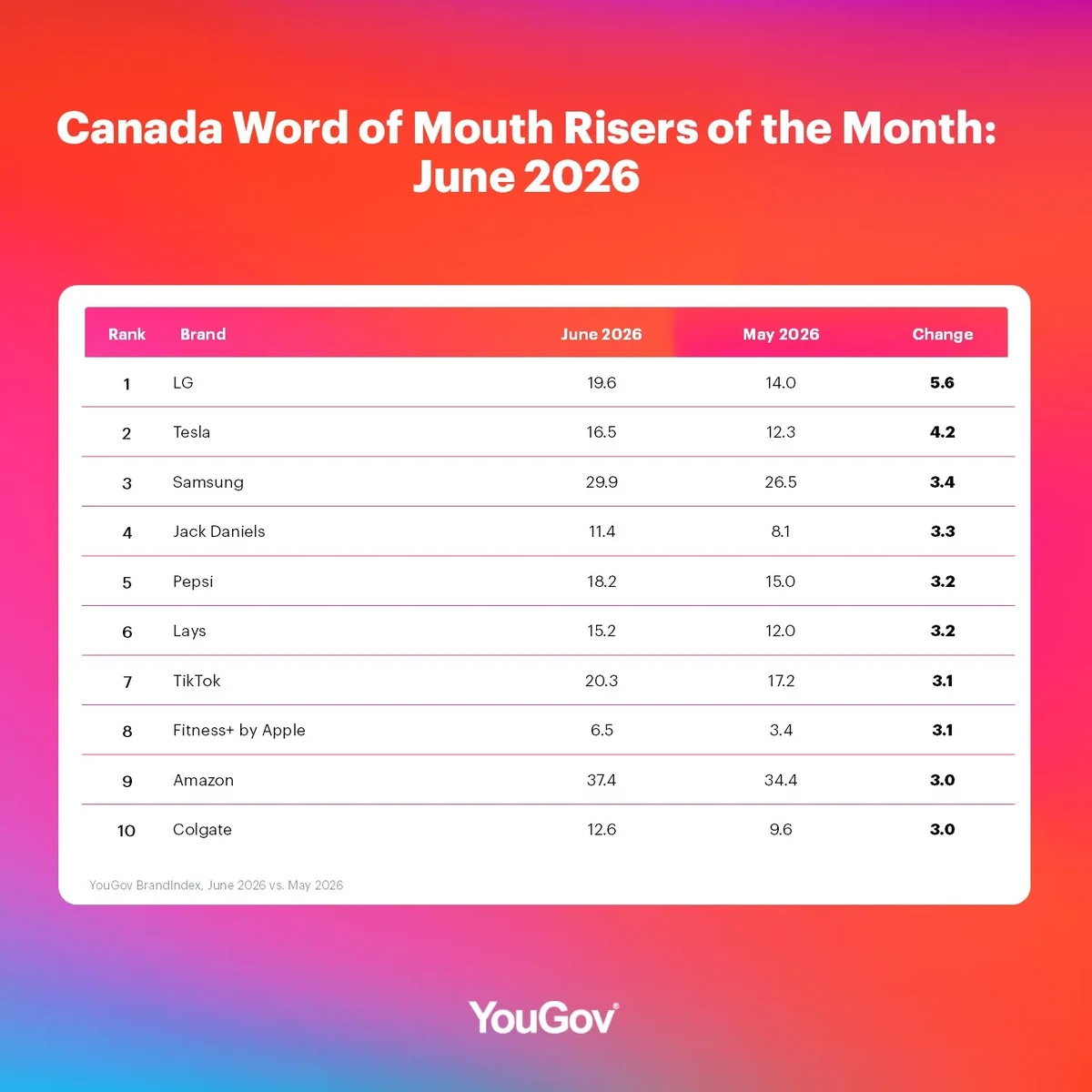
Word of Mouth marketing: Brands recording the greatest growth in June 2026
- LG – 5.6 point increase (from 14.0% in May to 19.6% in June)
- Tesla – 4.2 point increase (from 12.3% in May to 16.5% in June)
- Samsung – 3.4 point increase (from 26.5% in May to 29.9% in June)
- Jack Daniels – 3.3 point increase (from 8.1% in May to 11.4% in June)
- Pepsi – 3.2 point increase (from 15.0% in May to 18.2% in June)
- Lays – 3.2 point increase (from 12.0% in May to 15.2% in June)
- TikTok – 3.1 point increase (from 17.2% in May to 20.3% in June)
- Fitness+ by Apple – 3.1 point increase (from 3.4% in May to 6.5% in June)
- Amazon – 3.0 point increase (from 34.4% in May to 37.4% in June)
- Colgate – 3.0 point increase (from 9.6% in May to 12.6% in June)
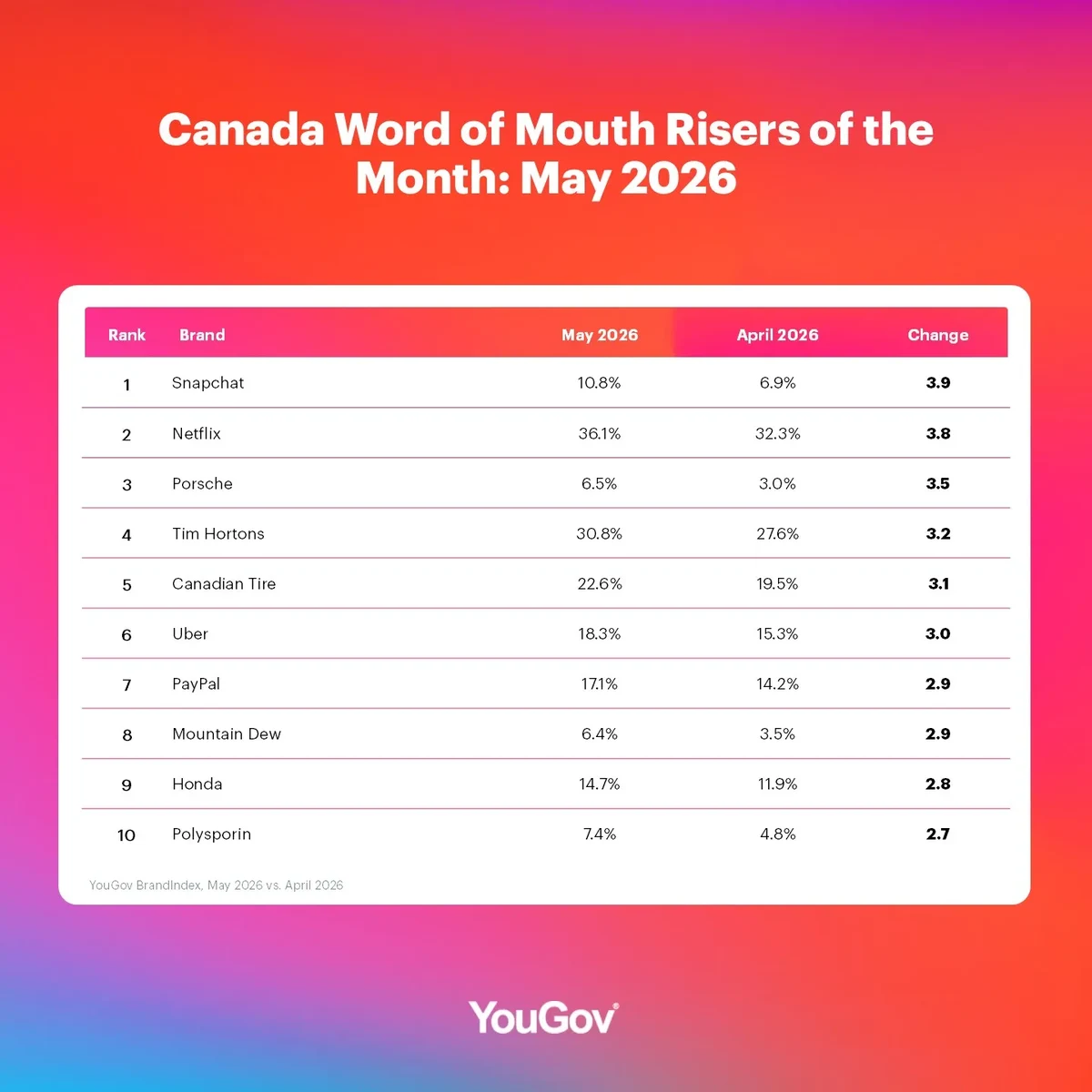
Word of Mouth marketing: Brands recording the greatest growth in May 2026
- Snapchat – 3.9 point increase (from 6.9% in April to 10.8% in May)
- Netflix – 3.8 point increase (from 32.3% in April to 36.1% in May)
- Porsche – 3.5 point increase (from 3.0% in April to 6.5% in May)
- Tim Hortons – 3.2 point increase (from 27.6% in April to 30.8% in May)
- Canadian Tire – 3.1 point increase (from 19.5% in April to 22.6% in May)
- Uber – 3.0 point increase (from 15.3% in April to 18.3% in May)
- PayPal – 2.9 point increase (from 14.2% in April to 17.1% in May)
- Mountain Dew – 2.9 point increase (from 3.5% in April to 6.4% in May)
- Honda – 2.8 point increase (from 11.9% in April to 14.7% in May)
- Polysporin – 2.7 point increase (from 4.8% in April to 7.4% in May)
Methodology:
YouGov BrandIndex collects data on thousands of brands every day. Word of Mouth score is based on the question: “Which of the following brands have you talked about with friends or family in the past two weeks?"
Rankings in this article are based on change in Word of Mouth scores. To qualify as top improvers, a minimum base size of 300 (n) is required. In cases where the change in scores is the same between two brands, the current scores are used as a secondary metric to determine their ranking.
Brands tracked across multiple sectors are ranked based on their highest-performing sector. Both parent and child brands, such as Google and YouTube, are included to allow for greater granularity in performance tracking.