




In a market defined by changing consumer expectations, data‑driven insights matter more than ever. The 2026 edition of the YouGov Fashion Retailer Rankings for Sweden offers a clear picture of how consumer consideration in the country is shifting and which brands are successfully capturing attention in an increasingly competitive landscape – highlighting who is winning attention, who is gaining momentum, and which value drivers shape purchase decisions today.
H&M leads the pack in consumer consideration
According to the latest YouGov BrandIndex data, H&M stands as Sweden’s most considered fashion brand with a consideration score of 31.1 %, outperforming both global and domestic competitors. The brand is especially strong among Gen Z and Millennials, underlining its continuing relevance with younger, style‑driven shoppers.
Online fashion heavyweight Zalando follows as the second most considered retailer with 25.1 %, reflecting the continued strength of digital-first fashion ecosystems. Stadium, the Swedish sportswear and equipment chain, holds third place with 22.4 %, while Kappahl and Lindex complete the top five with 21.7 % and 21.1 % respectively. Together, these results underline a market where accessibility, assortment breadth and strong brand familiarity drive consumer decision-making.
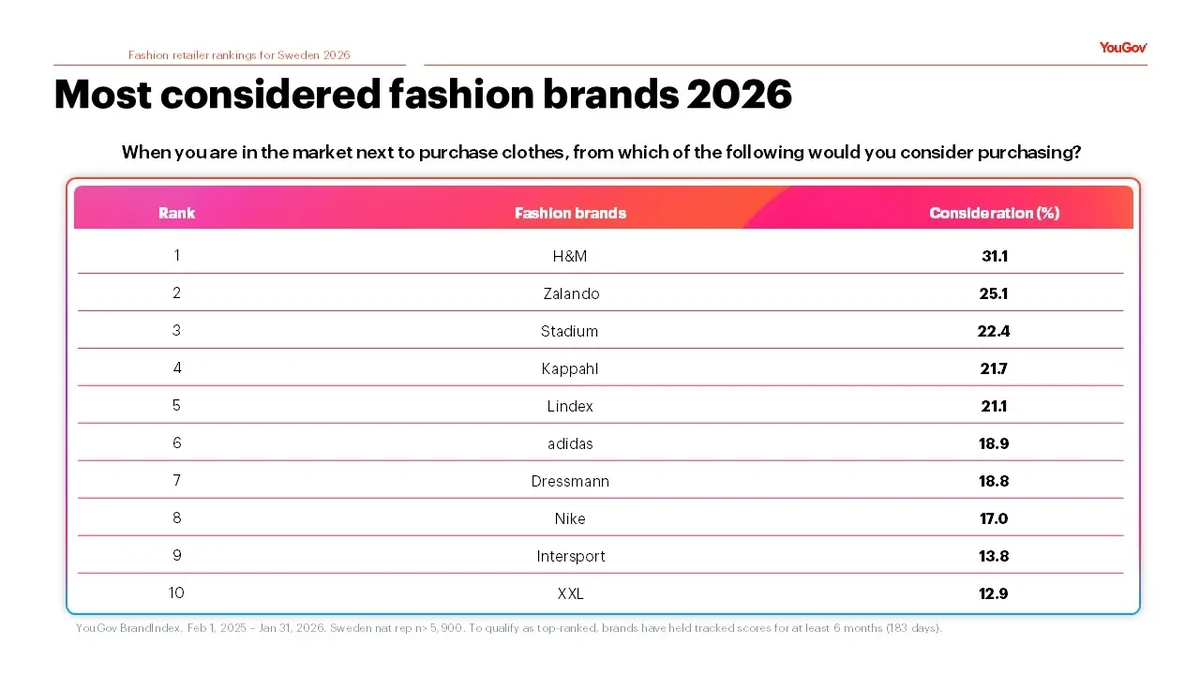
Beyond the top tier, the ranking highlights a diverse mix of sportswear and apparel specialists that remain deeply anchored in Swedish consumer preferences. adidas achieves a consideration score of 18.9 %, marginally ahead of Dressmann at 18.8 %, followed by Nike at 17 %. Intersport at 13.8 % and XXL at 12.9 % round out the top 10 in ninth and tenth place round-up the top 10 on ninth and tenth place. The presence and performance of these brands signal the ongoing integration of sportswear into everyday fashion, reinforcing its cultural and commercial relevance.
Most Improved Fashion Brands
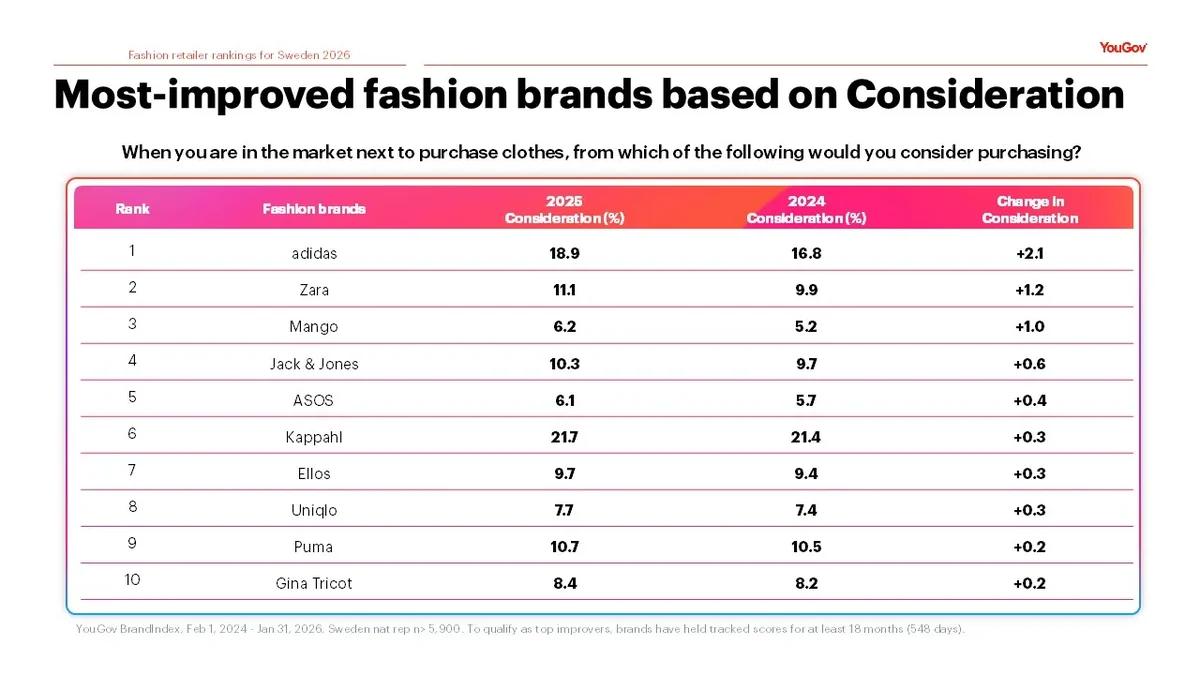
One of the most notable shifts comes from adidas, which emerges as the most improved brand in this year’s ranking with a year‑on‑year uplift of 2.1 points. Fast‑fashion players Zara and Mango also achieve meaningful increases of 1.2 and 1.0 points respectively, pointing to a renewed interest among Swedish consumers in fast‑moving, trend‑driven fashion propositions. These developments reflect a broader trend of consumers gravitating towards brands that successfully balance speed, style and accessibility.
Quality and value remain the decisive drivers in Sweden’s fashion market
Quality and value perception remain two of the most critical elements influencing purchase behaviour. In the 2026 ranking, adidas leads the quality assessment with a score of 27.6, closely followed by Stadium with 27.0 and Nike with 25.9. Intersport and Lindex round out the top performers, showing that both global and regional players are able to secure trust in product durability and performance.
On the value‑for‑money side, Stadium leads the field with a score of 22.1, ahead of Lindex at 17.4 and H&M at 17.2. Dressmann and Kappahl complete the list of brands that consumers associate most strongly with a compelling balance of price and product benefit.
The data collectively emphasises that Swedish consumers continue to evaluate brands through a multidimensional lens that blends price sensitivity, quality expectations, and emotional resonance. While younger generations maintain their influence as major drivers of fashion trends and purchasing behaviour, the dominant performance of sportswear brands shows how versatile and lifestyle‑integrated the category has become.
About the Sweden Fashion Rankings 2026
The results are based on YouGov BrandIndex daily online surveys conducted between 1 February 2025 and 31 January 2026, with a nationally representative sample of more than 5,900 Swedish adults. Only brands tracked for at least six months (183 days) were eligible for inclusion.
Consideration, Quality, and Value-for-money scores are net measures (positive minus negative perceptions).
Audience profiling insights are sourced from YouGov Profiles (February 2026), drawing from one of the world’s richest consumer datasets covering more than 29 million panel members worldwide.