




What past disruptions reveal about sustainability’s next recalibration
Renewed geopolitical instability in the Middle East is adding pressure to energy markets, logistics, and raw material costs, creating another layer of uncertainty for European households.
As costs rise again, sustainability is increasingly being evaluated through the lens of affordability, availability, and reliability, rather than as a standalone aspiration.
This is not a new dynamic. Over the past six years, shoppers have navigated repeated disruptions, from the pandemic to the war in Ukraine and the wider cost-of-living squeeze. What changed was not whether sustainability mattered, but how it fit into decision-making under pressure.
From aspiration to expectation
During the pandemic, sustainability benefited from reduced mobility and a stronger focus on everyday behaviors. Environmental topics gained visibility and relevance across many European markets.
The context shifted as inflation, energy volatility, and food price increases reshaped household priorities. Rising living costs did not remove sustainability from purchasing decisions, but they did change how it was evaluated. Sustainability moved from a point of differentiation toward a baseline expectation.
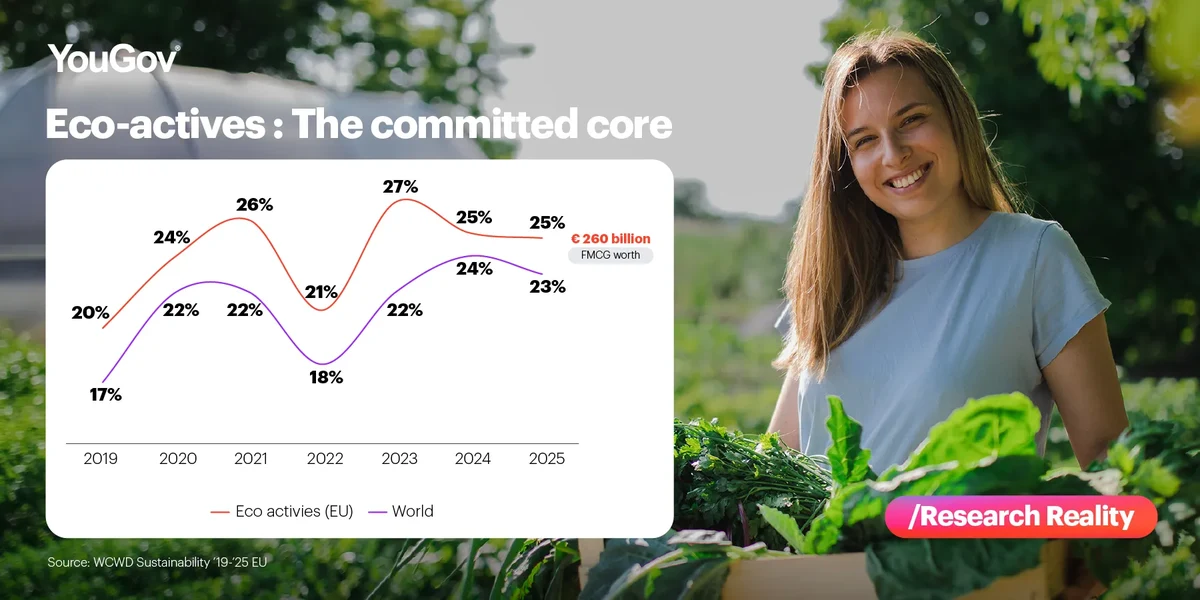
This shift is visible in longitudinal data from YouGov’s annual Who Cares? Who Does? study. The share of Eco-Actives in Europe rose from around 20% in 2019 to 26% in 2021, then declined to 21% in 2022. Engagement stabilized at around 25% in 2024 and 2025.
A similar pattern can be observed in market behavior. In Germany, organic food accounted for 7.5% of total food and beverage spend by 2021. Long term growth was interrupted in 2022 and 2023 before returning from 2024 onwards.
The data suggest that sustainability remained relevant but became more conditional. It increasingly sits alongside price, availability, and perceived risk in everyday decision-making.
Sustainability still matters, but it competes
Concern about climate change peaked in 2024 before declining from 34% to 26% by Spring 2026. At the same time, economic concerns remained elevated.
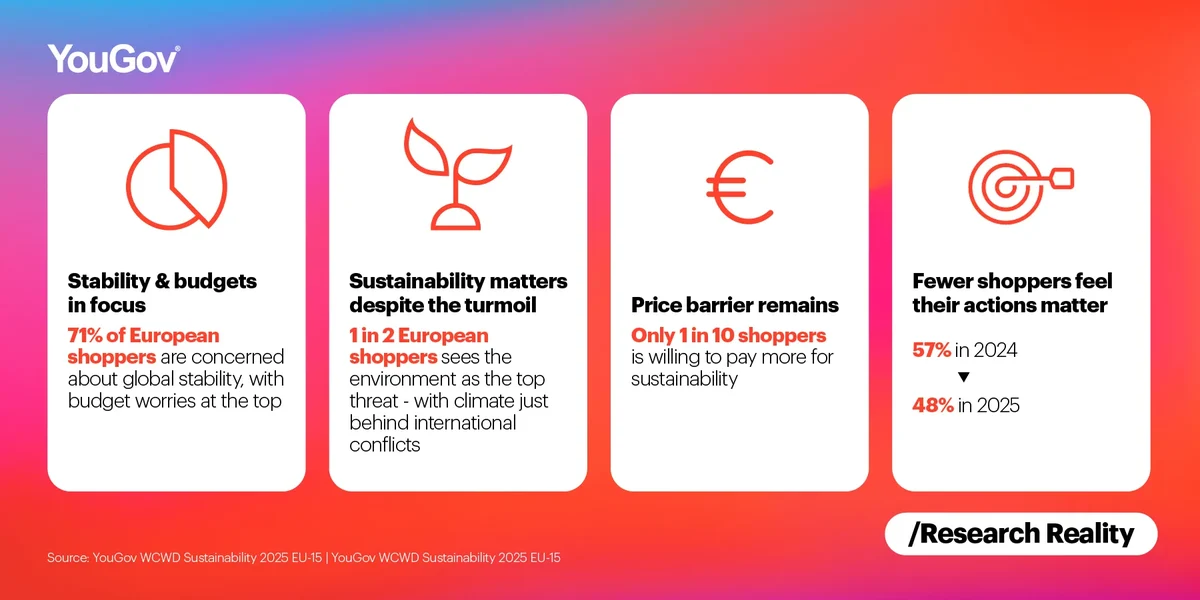
This does not indicate disengagement. Who Cares? Who Does? shows that one in two shoppers views environmental issues as a critical threat. What changed is prioritization. Sustainability is now one of several competing filters through which purchasing decisions are made. This has a direct consequence. Sustainability is not evaluated in isolation, but weighed against affordability, convenience and perceived necessity.
The green gap remains
The gap between attitudes and behavior becomes more visible during periods of financial pressure. Only around one in 10 shoppers is willing to pay a premium for eco-friendly features. The current cost environment reinforces this dynamic. Price increases linked to energy, logistics, and agriculture are increasing scrutiny on FMCG purchases.
Sustainability propositions that add cost without delivering a clear consumer benefit are more likely to be deprioritized. By contrast, sustainability aligned with value or utility remains more resilient and relevant.
Practical value replaces conviction
Waste avoidance shows how sustainability adapts under pressure.
YouGov’s Behavior Change Spring/Summer 2026 data indicates that 44% of shoppers plan to reduce food waste. This behavior addresses multiple needs simultaneously: it reduces cost, minimizes loss, and creates a greater sense of household control.
The scale of the issue is significant. Around 61% of food waste occurs at home, while approximately one-third of purchased food is never consumed. Food waste contributes between 8% and 10% of global emissions and represents more than $1 trillion in economic losses.
Retail behavior reflects the same logic. Near-expiry discounts rank among the most valued promotion mechanics. These offers combine savings with a clear, visible action.
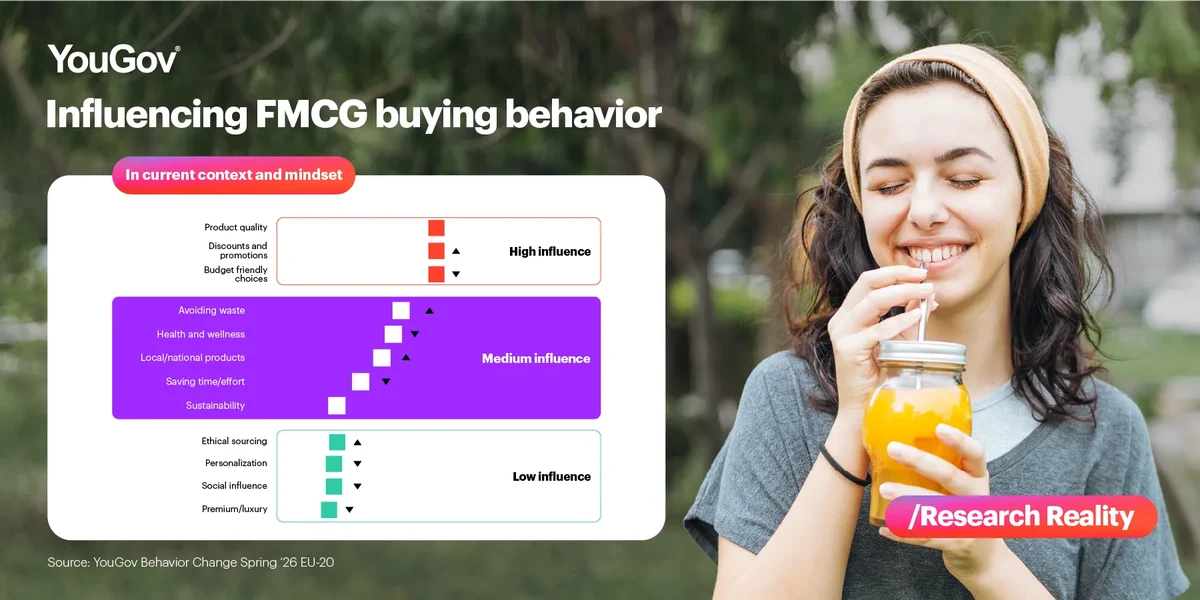
Waste avoidance is not niche sustainability behavior. It ranks among the top four drivers of FMCG purchase decisions alongside price, promotions, and product quality.
A relevant opportunity exists among Eco-Considerers – shoppers who express environmental concern but remain constrained by price and convenience.
Panel purchase data shows that engagement increases when solutions combine waste reduction with savings and simplicity. Examples include Too Good To Go in Denmark (value share index 118), portion-controlled meal kits in Poland (index 126), and pre-packaged fresh meal salads in Sweden (index 120). The index reflects the segment’s value contribution to the category relative to its share in the total market (YouGov Shopper Panel, MAT Q2 ’25).
This also helps explain why food waste ranks as the third most pressing environmental concern in Europe, and even the top concern in Czech Republic, Slovakia and Poland – markets where Eco‑Active engagement is lower, but show strong signals of economic concern.
Waste avoidance resonates because it aligns with how shoppers already think about spending, rather than requiring additional effort or compromise.
Local sourcing: reassurance over ideology
Local sourcing follows a similar pattern. Around one-third of Europeans report buying more local products, a level that has remained relatively stable since 2022. What changed is the meaning attached to purchasing local. Local sourcing is not only linked to environmental considerations, but also by perceptions of availability, resilience, and reliability.
Behavior Change data shows that local sourcing increased from 19% to 21% as a purchase driver in Spring 2026, coinciding with higher concern about product availability. Local products are increasingly perceived as less exposed to disruption and supply volatility. In this context, they offer reassurance in uncertain conditions. This makes local sourcing part of a broader shift toward more risk-aware purchasing behavior, where relevance increases when products signal stability and predictability.
Health as robust personal anchor
Health appears more resilient than many other sustainability-related themes.
Categories linked to functional health rank among the fastest growing in volume terms across markets (YouGov Shopper Panel, HY1 ’25 vs HY1 ’24, in country Top 5).
Health feels personal, immediate, and controllable. The benefits are direct and tangible, making health-led purchase decisions less vulnerable to economic trade-offs. By contrast, many sustainability topics are experienced at a broader system level. Energy transition and resource independence gained visibility through price and supply chain shocks, but often remain abstract within everyday shopping decisions.
Who Cares? Who Does? Data also shows that responsibility for sustainability is primarily assigned to governments and brands rather than individuals. This creates an important distinction. Health tends to influence behavior more directly because consumers experience the benefit personally. Sustainability often depends more heavily on visible system-level change.
Where sustainability aligns with health – for example through ingredient quality or functional benefits – it becomes more actionable for shoppers.
What this means under renewed cost pressure
The current cost environment is tightening the conditions under which sustainability propositions succeed.
Three patterns are likely to persist:
- Affordability and availability remain primary decision factors
- Sustainability linked purely to premium pricing loses relevance
- Sustainability linked to value, control, or personal benefit continues to engage consumers
Implications for FMCG manufacturers and retailers
Sustainability does not disappear during periods of pressure. It adapts to prevailing consumer realities.
Three principles increasingly stand out:
- Economic logic first
Solutions that reduce waste, improve efficiency, or lower household costs are more likely to scale successfully. - Performance over positioning
Product performance and clearly communicated consumer benefits matter more than sustainability messaging alone. - Integration into value
Sustainability resonates when embedded within the overall product experience rather than presented as an added on
Shoppers increasingly expect sustainability to fit naturally into existing purchase behaviors, rather than requiring additional effort or cost.
Sustainability has not lost relevance. Its role within FMCG decision-making has evolved. Rather than operating as a separate decision layer, sustainability is increasingly integrated into how shoppers navigate everyday choices under economic constraint.