Editor's note: This article was also published in The Surveyor, YouGov America's email newsletter. Subscribe to The Surveyor for regular updates on YouGov's polling.
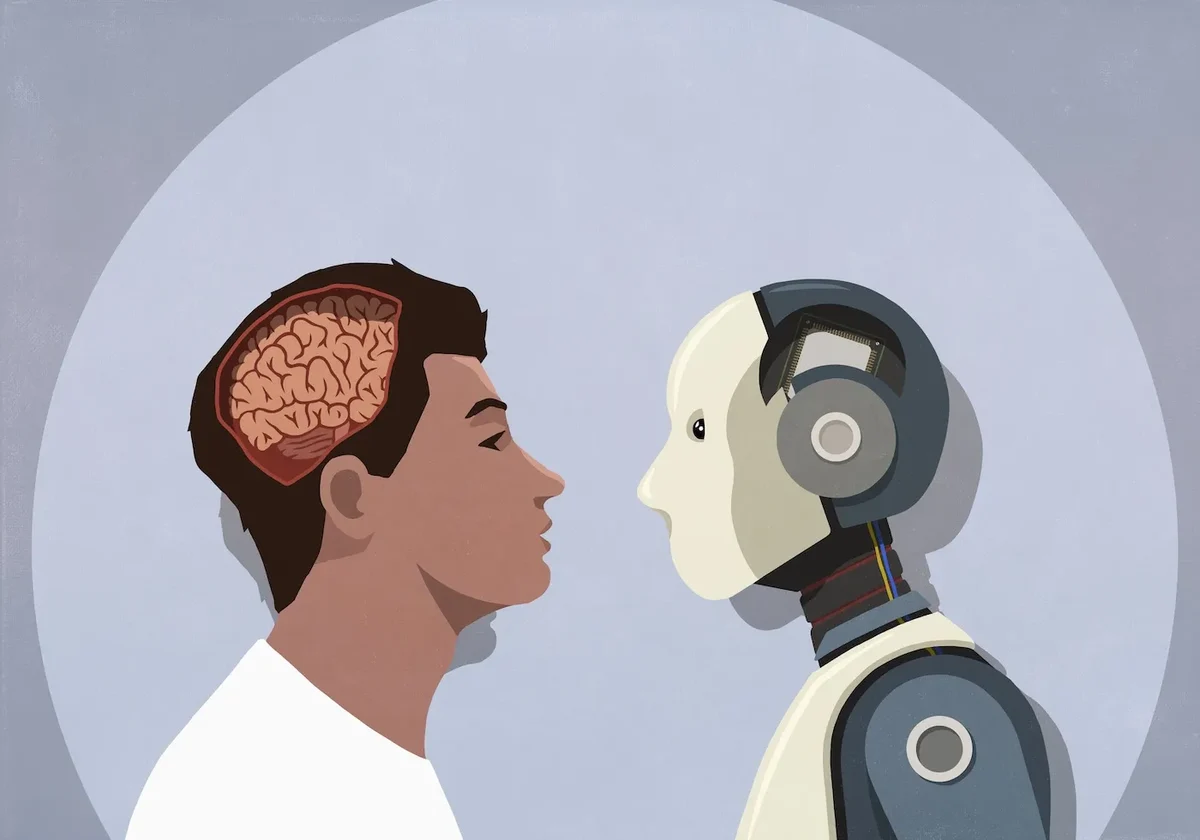
Is AI currently able to think better or worse than the average person? Americans are split, a recent YouGov survey finds: 33% say AI is better and 29% say it's worse, for a net difference of +4. Another 25% say AI and the average human are about the same in their ability to think.
But the "average" human covers a lot of variability. Americans say AI is better at thinking than the average college professor by a 1-point margin (30% vs. 29%), and that it's better than the average computer programmer by 2 points. But far more Americans say AI thinks better than the average toddler (+45), elementary school student (+40), and high school student (+27).
While Americans say by a 4-point margin that AI is better at thinking than humans rather than worse, they say AI is better than Democrats by a 13-point margin and better than Republicans by a 15-point margin. That reflects partisan differences: Democrats are much more likely to say AI is smarter than Republicans than to say it's smarter than Democrats, and vice versa. And in both cases people are more down on the intelligence of members of the other party than they are up on the intelligence of their own party.
YouGov also asked Americans to compare AI's thinking ability with that of well-known public figures, including politicians, celebrities, and a few people famous for being smart, including Jeopardy! Champion Ken Jennings and astrophysicist Neil deGrasse Tyson. We also asked respondents how "you" compare to AI in thinking ability, rounding out the 14 options.
Tyson is the poll's only option for whom more Americans say AI is worse than better at thinking: 23% say AI is better than him at thinking and 27% say it is worse at thinking. About each of the other 13 people asked about, more Americans say they are worse at thinking than AI than say they are better.
Americans are particularly likely to say AI is better at thinking than several current and recent presidents and vice presidents. 52% say AI is better at thinking than Donald Trump, while only 19% say AI is worse than Trump. Americans come to a similar conclusion about AI and Joe Biden (51% vs. 17%). Kamala Harris (45% vs. 22%) and JD Vance (43% vs. 19%) also trail AI in perceived reasoning abilities. Barack Obama has a slightly smaller gap, with 37% saying AI is better at thinking than Obama and 27% saying AI is worse than Obama.
These views also reflect partisan differences. Overall, Republicans are more likely than Democrats to say AI is better at thinking than most of the figures. The only exceptions are the Republican figures Trump, Vance, and Elon Musk: Democrats are more likely than Republicans to say AI is better at thinking than each of the trio. But Republicans are still more likely to say AI is better than worse at thinking than all but one of the figures: Musk. For Democrats, that's true for all but Obama, Tyson, and Bill Gates.
Republicans are more likely than Democrats to use AI and to think its effects on society will be positive.
YouGov asked Americans to compare AI to humans in several different areas of reasoning. Many say AI is better than humans at answering questions that require factual knowledge (44% say AI is better and 18% say AI is worse). Americans are more divided over how AI compares to people in handling questions that require complex reasoning (33% vs. 28%), and are less likely to favor AI rather than people at answering questions that require creativity (25% vs. 37%).
For each of the three types of reasoning asked about, Americans who say they use AI a lot themselves are more likely than those who rarely or never use it to say AI is better than humans.
Methodology: The July 16 - 20, 2026 poll was conducted among 1,110 U.S. adult citizens. Respondents were selected from YouGov's opt-in panel to be representative of U.S. adult citizens. A random sample (stratified by gender, age, race, education, geographic region, and voter registration) was selected from the 2019 American Community Survey. The sample was weighted according to gender, age, race, education, U.S. region, 2024 presidential vote, 2020 election turnout and presidential vote, baseline party identification, and current voter registration status. 2024 presidential vote, at time of weighting, was estimated to be 48% Harris and 50% Trump. Demographic weighting targets come from the 2019 American Community Survey. Baseline party identification is the respondent's most recent answer given around November 8, 2024, and is weighted to the estimated distribution at that time (31% Democratic, 33% Republican). The margin of error for the overall sample is approximately 4.0%.
Image: Getty (Malte Mueller)
What do you think about the election, American politics in general, and everything else? Have your say, join the YouGov panel, and get paid to share your thoughts. Sign up here.