On 8 October, Anthropic, the company behind the Claude chatbot, announced a new usage policy which prohibits “sustained and needless abusive or cruel behavior” toward its models, potentially resulting in users being banned from accessing the tool.
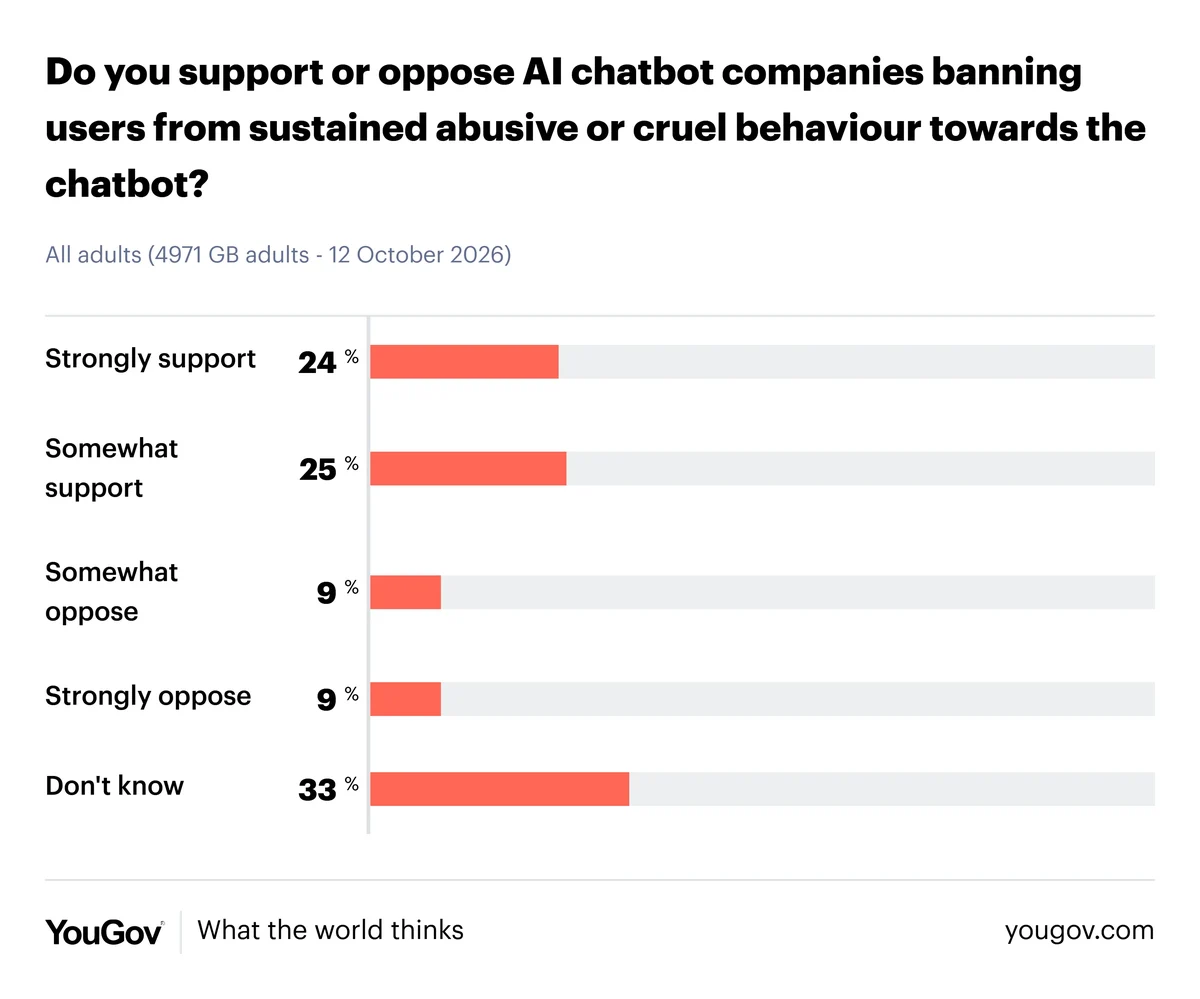
Britons are more likely to back such a move than oppose it, with 49% supporting AI chatbot companies banning users who show sustained abusive or cruel behaviour towards the chatbot, compared with 18% who oppose it.
But what do Britons make of AI chatbots? To find out, we used our new YouGov AI Interviewer tool to ask respondents: “What do you think about AI chatbots more generally?”
The AI agent then conducted interviews with each respondent, following up on their responses, in order to provide ‘the why’ behind what Britons think. Our qualitative analysis of attitudes, including quotes, can be found below, along with examples of respondent interviews in their entirety.
Useful for quick answers and everyday tasks
Many said AI chatbots are useful for getting quick answers and finding information, and for help with everyday and work tasks, from wording CVs and emails to sorting out spreadsheets.
- “I think they are helpful and help me get my work tasks done quickly and also give good explanations for things that I wouldn’t be able to just find on Google” – Woman, 18-24
- “also information that is tailored to me personally, i like how they remember past conversations aswell, I have been using chat GPT on my phone to help me navigate the redundancy process i am going through at work” – Woman, 25-34
- “Plenty of times at work where I had a question about something or needed it to reword or write something for me” – Man, 35-44
- “I use AI when it comes to writing a CV and applying for jobs” – Man, 55+
Frustrating to deal with, and no substitute for a human
Many found chatbots frustrating, particularly when contacting a company’s customer services. They described bots that misunderstand them, can’t cope with anything beyond simple queries and send them round in circles, and said they would rather speak to a person.
- “It kept going around in circles and I had to ask to speak to a real person who had to resolve it with a more senior part of apppe” – Man, 18-24
- “If you speak to a chatbot about a problem they don’t have the human side of it and it’s very black and white which can be frustrating.” – Woman, 25-34
- “I ask a question, it answers, then I explain the situation is different, it gives me the same answer and eventually I will need to speak to a live agent.” – Man, 35-44
- “There’s more to a story than just a basic question and answer that needs a human to listen to the full story of the person’s needs AI should accept it can’t answer complex questions and should transfer you to a human” – Woman, 55+
You can’t always trust what they tell you
Some said chatbots can’t be relied on to get things right. They described wrong, out-of-date or conflicting answers, and said anything a chatbot tells you needs to be checked.
- “gemmini on google kept coming up with different things and sources said different things” – Woman, 18-24
- “When you want to look up important information, they make errors, fabricate information and hallucinate results” – Man, 25-34
- “Sometimes they just get things wrong so you always have to double check which takes time.” – Woman, 45-54
- “A bot is just a computer programme which can give false information and is not accountable” – Man, 55+
Worries about safety, privacy and control
Some worried about where the technology is heading: what happens to the personal data people share with chatbots, whether they could be used to steer what people think, and whether AI could slip out of human control. Some called for tighter regulation.
- “They are becoming more human like in the way they "speak" and could become dangerous” – Woman, 18-24
- “The amount of personal data you have to give it access to in order to maximise benefit. You can’t trust the owners of ai and it’s frustrating that you’re forced to give it so much data just to help you as a necessity” – Woman, 25-34
- “Chat bots are unregulated, it may be possible to get answers based on propaganda” – Man, 55+
- “If AI develops its own mind and has survival instincts, any that goes rogue is likely to take measures to protect itself from being terminated by humans.” – Woman, 55+
The cost to the environment and to jobs
Some pointed to costs beyond the screen: the water and energy used by the data centres that power chatbots, and the jobs lost as companies replace staff with bots.
- “We're already using more water than is sustainable and data centres for ai use huge amounts to cool their systems” – Man, 18-24
- “I've seen reports of how AI centres use huge amounts of fresh water which is already quite low, to help keep systems that run it, cool. This is concerning as humans require fresh water to drink” – Woman, 35-44
- “Customers rarely notice but it deeply affects the people who face redundancy because of AI chat bots” – Man, 35-44
- “I find them extremely useful but I am concerned about the amount of energy they use” – Woman, 55+
Making people over-reliant and more isolated
Some worried about what chatbots do to the people who use them. They said people are leaning on chatbots instead of thinking for themselves, and that bots which tell users what they want to hear can deepen loneliness.
- “It feels like an amplifier, if you use it correctly it's amazing but it allows you to just be lazy aswell” – Woman, 18-24
- “At best, they can be something fun to play around with in moderation. At worst, they can become a crutch for lonely people that may cause them to isolate themselves further or worsen the delusions of those who need mental health care” – Man, 18-24
- “A chatbot will tell you you’re always right and that the other people in your life are always wrong. A human therapist will encourage you to see things from other people’s viewpoints.” – Man, 45-54
- “Not a lot. I think people should to talk to each other face to face. Talking to AI is sad and can only cause loneliness.” – Woman, 55+
Other themes
Some raised other points. These included students passing off chatbots’ work as their own, the help chatbots can give disabled people, using them to talk things through, and a sense that they are getting better. Some also said a chatbot is only as good as the questions put to it.
- “It's unfair that they are passing AI work off as their own and getting high marks” – Man, 18-24
- “Talking about feelings. It's nice to talk things out with an AI because, much like talking to a therapist, there's no judgement and so can feel freeing” – Man, 35-44
- “Excellent it really is part of my daily life as a physically disabled lady AI makes tasks easier and quicker to get done.” – Woman, 45-54
- “I’m glad they have evolved in a meaningful way which has gained my trust - I’m more accepting of using them instead of customer services now” – Man, 45-54