Following a series of warnings about the risks posed by artificial intelligence this week, where does the British public stand?
Key takeaways
- 34% of Britons now see AI as a top-three likely cause of human extinction, a figure which has more than doubled since this time last year
- 66% think AI has the potential to end human civilisation, including a quarter who see this outcome as likely
- 52% think AI’s overall impact will be negative, up from 34% in 2024
- 73% of Britons think AI companies face too little regulation…
- …and 79% have little to no confidence in AI companies to develop the technology responsibly…
- …but 80% also lack faith in government to effectively regulate the sector
- 61% of Britons support slowing down pace of AI development
- Most support trying to reach agreement with non-democratic countries on AI development, but public are split on what we should do if such countries refuse to slow down
Recent days have seen numerous figures from the AI industry warning that the technology could pose enormous harms to the human race if development is not slowed and regulation is not imposed.
This latest wave of warnings was kickstarted by former Anthropic employee Jacob Coxon in a resignation thread on X, in which he warned that both OpenAI and Anthropic are acting irresponsibly and “gambling with our lives”.
This has prompted Anthropic CEO Dario Amodei to publish an essay voicing his own concerns about the pace of AI development, with his recommendations endorsed by fellow industry chiefs OpenAI boss Sam Altman, Google DeepMind Chairman Demis Hassabis, and xAI leader Elon Musk.
Britons increasingly see AI as a potential cause of human extinction
In response to Coxon’s resignation warnings that AI could kill all humans within the next 10 years, another Anthropic employee Evan Hubinger publicly agreed, putting the likelihood of apocalypse at greater than 10%.
The latest YouGov tracker data shows that a third of Britons (34%) now see “robots / artificial intelligence” as a top three likely cause of human extinction. This is more than twice as high as it was in our previous survey in August of last year, when 15% said so.
Nevertheless, for the time being AI still lags behind nuclear war (58%) and climate change (43%) as a top likely cause of human extinction.
A separate YouGov survey as part of this study also found that 66% of Britons think AI has the potential to bring about the end of human civilisation. However, most of this group (43%) think such an outcome is unlikely, relative to 23% who think it is, while another 17% don’t think AI has the potential to end human civilisation in the first place.
However, an AI apocalypse is still not top of mind for people when the subject comes up. Most Britons (56%) say that the impact of AI on everyday life – like jobs and society – is more likely to be their first thought if someone brought up the topic of AI in discussion, compared to only 19% who associate the topic foremost with humanity’s survival as a species. Indeed, this latter figure is effectively unchanged from all previous times we have asked this question, stretching back to May 2023.
Public expectations of AI’s impact are increasingly negative
While many may not go so far as to say that AI is an apocalyptic risk, our data shows that half of Britons (52%) are pessimistic about the overall impact that artificial intelligence will have, an increase from 34% in 2024. This compares to only 19% who are optimistic, a figure largely unchanged over the past two and a half years.
Certainly, the British public have rock bottom expectations of AI companies and the government. Around eight in ten Britons say they have little to no confidence in AI companies to develop the technology responsibly (79%), with 80% saying the same of the ability of current and future UK governments to effectively regulate the sector.
What approach should we take with AI development? Britons are most likely to support slowing down or pausing
Perhaps unusually, artificial intelligence is an area where industry leaders are calling out for regulation: as noted by Coxon in a post-resignation interview with Wired, many Anthropic leaders have publicly called for the government to introduce regulation for the AI industry.
One such suggestion is to slow the pace of development, based on regulation targeting US frontier AI companies – a call Anthropic CEO Dario Amodei made in his own recent essay.
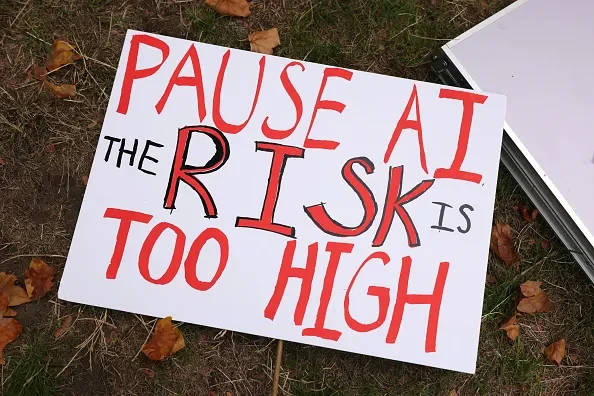
The British public certainly agree that AI companies need more regulation, with 73% saying so, including fully 51% who say they face “far too little regulation”. Only 7% think current levels of regulation are about right, and a mere 1% think AI firms face too much red tape.
When it comes to the pace of development, out of six possible scenarios, Britons are most likely to endorse the Amodei recommendation for slowing the rate at which capabilities are improved. Six in ten (61%) say they would support the pace of AI development being slowed down, but still being allowed to continue, an approach only 24% would oppose.
The second most widely-supported approach is to temporarily pause the development of AI, before allowing it to continue again in future, which 51% give their backing.
A significant minority support more dramatic measures, with 40% supporting permanently stopping the development of AI, and only allowing people to use AI technology that has been invented to date, while 29% support permanently ending AI development and banning the technology.
The status quo is less popular, with only 21% supporting allowing the pace of AI development to continue at current rates, with 62% opposed. And speeding up AI development is out of the question for 75% of people, compared to only 11% who support ramping up the rate of progress.
What if slowing AI development meant falling behind authoritarian nations? Britons are unsure on how we should proceed
As part of his essay, Amodei noted that slowing development could pose a strategic risk if it meant that authoritarian nations could gain an advantage with AI. Such considerations are also clearly on the mind of Donald Trump, who has played down calls to regulate AI and has expressed concerns about ceding the US’s AI edge to China, saying that “whoever wins AI wins”.
Amodei called for attempts to reach agreement on AI with non-democratic countries, a move which the British public support. More than half (57%) think that the West should try and reach an agreement with non-democratic countries on the speed and ways in which AI is developed. By contrast, just 11% think we shouldn’t try and reach such an agreement.
But what if authoritarian countries aren’t willing to abide by such an agreement? This question divides the British public.
A quarter (26%) say that in this case the West should try and keep ahead of non-democratic nations in terms of the speed of AI development, even if this means greater risk of developing an uncontrollable AI that could cause the end of civilisation.
By contrast, 31% say in this case that it would be better for the West to slow our own development of AI in order to mitigate the risk, even if this means potentially handing the advantage to non-democratic rivals.
However, it is a dilemma many of the public are yet to grapple with, with 42% answering “don’t know”.
Do the British public agree with Dario Amodei’s positive scenarios for AI?
Aside from his calls for greater caution on AI, Amodei also set out the positives he thought AI could achieve: “I believe that AI could cure most major diseases in the next 5–10 years, greatly accelerate economic growth rates, create a world of abundance and empowerment, and usher in a renaissance of democracy and freedom”.
While Britons tend to agree that AI has the potential to cure most major diseases in the next 5-10 years (51%), and to greatly accelerate economic growth (46%), this includes only 12-13% who think this is actually likely to happen. A further 27-32% don’t think AI has the potential to make these improvements in the first place.
And when it comes to the idea that AI will dramatically improve freedom and democracy, fully 51% dispute this prediction in the first place. While 27% think AI does have the potential to do so, this includes only 5% who think this outcome is likely.
No party leads on the issue of AI in the eyes of the British public, while voters are united in a negative view of the technology
With Barack Obama calling for the Democrats in the US to make AI a campaign issue at the coming midterms, it is clear that in the UK no party leads on the issue. Asked which party would be best on the subject, no party is backed by more than 9% of people, with most answering either “don’t know” (39%) or that no party would be capable at managing AI (27%).
Indeed, no more than 31% of 2024 voters see their own party as likely to be the best on the issue of AI.
Artificial intelligence is not an issue that divides the electorate, with a majority of those who voted for each of the five largest parties in 2024 holding a pessimistic outlook on the technology, a belief that AI companies aren’t regulated enough, a lack of confidence in AI companies to act responsibly (or the government to regulate them), and a preference to slow the rate of AI development.
There is also relatively little difference in the number of voters for each party who see AI as a top three likely cause of human extinction.
That said, there are degrees of difference within this broader negativity, with Green voters in particular often more likely to take the very most negative view for each question.
One area of more obvious difference between voting groups is when it comes to competing with non-democratic nations. While voters for all parties want to see an agreement reached on the pace of AI development, Greens prove substantially more likely than other voters to say the West should unilaterally slow down development (52%), while Tories are notably more likely than others to back an AI arms race (40%) if non-democratic nations won’t scale back development.
Frequent AI users are more optimistic about the technology, while still being sceptical about AI companies and the speed of development
Breaking down attitudes by AI usage, shows that the more frequently Britons use AI, the more optimistic about the technology’s impact they are. For instance, while only 19% of all Britons are optimistic about the impact of AI, this increases to 44% among those who use the technology on a daily basis, and drops to 4% among those who have never done so.
That is not to say that AI users defend the industry – 75% of daily AI users think the sector faces too little regulation, and 70% lack confidence in AI companies to develop the technology responsibly.
Likewise, while frequent AI users are more likely to agree with Amodei that the technology has the potential to bring about major positive changes, the belief that they are likely to actually do so is still a distinctly minority position.
When it comes to the pace of AI development, the majority of AI users support slowing the rate of improvement – indeed, this is the only approach that the majority of such users (67-69%) back. While 53% of those who have never used AI also support slowing development, they are most likely to support temporarily pausing development (59%). Indeed, there is support among those who don’t use AI for permanently stopping the technology – 46% support a ban entirely, compared to only 12-18% of those who ever use AI.
See results here
Batch 1) Extinction tracker, AI optimism, regulation, pace, West approach
Batch 2) Public view on Amodei assessments (diseases, economy, freedom, also end of civilisation)
Interested in taking YouGov surveys? What do you think about artificial intelligence, they danger it poses to humanity, and everything else? Have your say, join the YouGov panel, and get paid to share your thoughts. Sign up here.
Interested in commissioning YouGov research? We connect in real-time with real people around the world to gather their thoughts, behaviours, and opinions, to ensure that our research data is powered by reality. Explore our survey services here.
Photo: Getty